What does a Garden Gnome do when she is not gardening, in the kitchen or doing genealogy? Well the answer might just surprise you so read the entries to find out more. This blog focuses on everything we do to make our house a home. There will be a strong emphasis on home energy efficiency and do-it-yourself (DIY) projects. At the same time there will also be crafts, knitting and crocheting projects along with any other little tips we do to create that down to earth, I want to be here home. Please enjoy your visit :)


Showing posts with label frugality. Show all posts

Tuesday, March 26, 2013

Homemade Orange Cleaner

Earlier in the month, I bought a Bella High Power juice extractor.  Most fruits and vegetables being juiced do not need to be peeled but citrus fruit does.  That leaves the peels to either candy or dehydrate, or discard.  I did a bit of searching for something else to do with the peels and came across making homemade orange cleaner.  Anytime I can replace a store bought, toxic cleaner with a non-toxic, homemade cleaner I will so I decided to make a batch the next time I juiced oranges.

ingredients for orange cleaner
I recently made a orange pineapple juice (in mason jar) which left me with the peels from 7 navel oranges and the top of the pineapple.  I saved the seeds and pineapple top to grow.  I've had good luck with lemon seeds growing and now have three little lemon trees about 6 - inches tall. Pineapple tops will also root to grow into a lovely houseplant so I saved that as well. I set the orange peels aside to make the orange cleaner.  

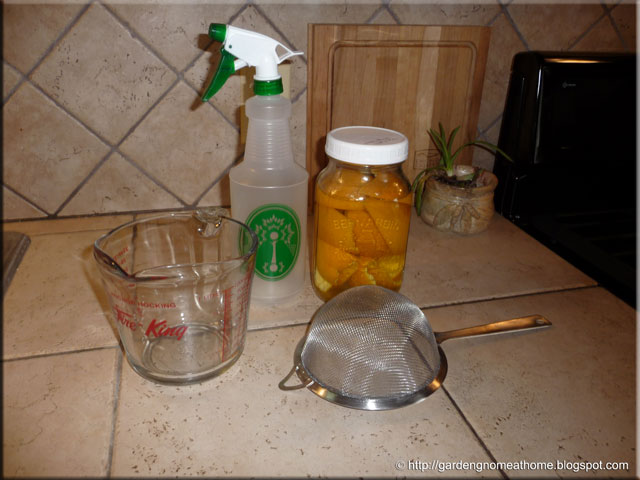
Materials needed for orange cleaner: large mason jar or similar with lid, white vinegar; later you will need a large measuring cup, fine mesh strainer, funnel and spray bottle.

orange cleaner set up
Setting up the orange cleaner is very easy.  Simply put the orange peels into the jar then cover with the white vinegar.  I used a 1.5 L mason jar and a reusable storage lid. I also used all natural vinegar because I was out of the cheap white vinegar but next time will use the cheap one.  Label the jar with the date then set aside and let sit for at least two weeks.  That's it.  The sitting time is the time consuming part so you will want to start another batch before running out of the orange cleaner you are using.  

The orange peels in vinegar looked rather pretty so I was anxious to test the results.  Once the sitting time was finished, it was time to move to the next step of making my non-toxic orange cleaner.
orange cleaner ready to strain
I make a lot of homemade cleaners and have found the spray bottles from the dollar store work well for liquid cleaners I want to use as a spray.  As you can see, after sitting for two weeks, the orange peel had absorbed some of the vinegar.  This really wasn't a problem.  I was more concerned about the amount of cleaner I would get as well as how well the orange cleaner cleaned.  

I strained the orange cleaner into the measuring cup.  At that point the orange peels themselves were of no further use so were put down the food disposal.  I ended up with 24 oz (750 ml) of homemade orange cleaning solution.

orange cleaner ready to use
Vinegar itself is a good household cleaner that kills germs, cuts grease and leaves a sparkly finish.  Orange peel contains oils that give the characteristic orange scent.  I tested the homemade orange cleaner on the counter.  It cleaned well with no residue yet had a pleasant smell.  I was quite impressed!

As is, the cleaner does a nice job cleaning.  If a sudsing orange cleaner was needed, a couple of drops of liquid dish detergent could be added but for most cleaning purposes this really isn't necessary.  The total cost of the 24 oz of homemade orange cleaning solution using the natural vinegar which is more expensive worked out to 56¢.  If using the cheaper, store brand white vinegar the price is reduced to 37¢ at our current prices. 

I am very pleased with the results.  It is nice to be able to add one more homemade, non-toxic cleaner to cleaning supplies.  The nice thing is, this cleaner is made from orange peels that many simply discard to begin with.  It is low cost and effective, making it an eco-friendly cleaning product.  Do give it a try the next time you have a few orange peels.  You will be pleasantly surprised!


Tuesday, February 26, 2013

The Cell Phone Verses Landline Delimna

There is the question as to whether to give up a landline (aka phone service) in favour of cell phones only.  Some of our kids have totally eliminated their landlines and a couple after using only cell phones for a couple of years went back to adding a basic landline.  We have Bell for our landline, Roger's for my husband's cell phone and I put my cell phone of a pay as you go plan through Telus because I seldom use it. 

Here's the problem in Ontario.  We have Bell so pay $54.85 for a very stripped down service that includes caller ID and 500 minutes of long distance for North America.  They were none to pleased when we cut over $30 worth of extras about three years ago after buying a home telephone system offering call waiting, call blocking and all those nice features on board so all we need is call display.  The only feature on our landline that can be reduced is long distance but that won't save us much.  I pay $100 per year for my cell phone pay as you go plan with the only problem being it is only good in the US but I can unlock the phone, buy a sim card and plan in the US which would be good at our vacation home.  I very seldom travel in the US by myself so really don't need a cell phone there.  My husband pays $86 per month for his cell phone which has a data plan.

We looked at getting a new cell phone for me and eliminating our home landline.  A new cell iPhone was $199 special and adding a family plan was $50 plus $16 for caller ID and shared data ($66 total).  We would be up to $152 per month BUT if my husband changes his current cell phone plan that is no longer available he would also have to pay $16 for caller ID which brings the total to $168 per month.  We are currently paying a total of $151.43 for both cell phones and landline so giving up the landline would actually cost us more money for less.  Plus, we have internet and television with Bell so get a bundle discount of $21 per month that we would lose if we eliminated the landline.  After doing the math, we quickly realized giving up our landline in favour of cell phone only would not save us any money but rather cost us more while getting less.  Now technically, we could without changing out my phone, adding US coverage with no data but it would still cost us more monthly. 

I personally would rather go to cell phones only.  It really is a lot more convenient and quite frankly the younger generation has embraced cell phones, choosing to eliminate landlines.  There are a lot of benefits going to cell phones only as you have instant communication pretty much everywhere.   So far, the problem of telemarketers is very low as you aren't listed in a directory so the calls for the most part that you get are for you. 

The downside is cell phone numbers like landline numbers are recycled which means you can have a high volume of calls from debt collectors from the previous owner of that number but the cost of those calls can cost you in addition to your actual cell phone plan.  We dealt with this problem with both our landline phone number and my cell phone number since moving here in September of 2011.  They can be very nasty as well as threatening and if you are on a pay as you go plan can really eat up your minutes AND they will not remove the number from their database even if you request it contrary to the rules set out by the CRTC.  The problem is, you cannot block these calls on a cell phone the way you can with a landline.  The best advice I have after having this cell phone number for 18 months is to not answer the call, find out who they are via a service like Who Calls Me then report them to the CRTC. 


Friday, January 25, 2013

A Cold Snap

There has been a lot of sickness going around especially cold and flu or flu-like illnesses. My husband came down with a cold just after the holidays and I've been down with a horrid cold with complications for two weeks now. When I was growing up, the winters were colder and believe me our house was poorly insulated at best. There would be frost inside on the windows, huge icicles hanging from the eaves troughs and quickly getting dressed before freezing was a challenge. Our bedrooms were downright cold at night as the only heat to them was via the two radiant heat gas heaters downstairs. We had a floor vent in the middle of the hall to help get heat upstairs. While heat does rise, little of it came upstairs. The basement was unfinished with a mud floor so the first level floors were beyond cold in the winter. I can remember my Mom opening windows on a sunny but bitterly cold day, enough to get a good cross-breeze. She would leave the house like that for a couple of hours! She hang clothes on the line on those days as well even though we had a gas dryer. Her reasons were simple. The fresh air got rid of stagnant winter air and killed germs. She was old school, born in 1903, raised on a farm and lived through two World Wars as well as the Great Depression. Let me tell you, she knew a thing or two about living frugally! We bought our first home in the early 80's and compared to my Mom's house it was quite energy efficient. We are now in our sixth purchased home, seventh if you count our vacation home. This house is a far cry from our first house in that it is so energy efficient and sealed so tightly we need an air exchanger. Heating costs are considerably higher than what my Mom paid but in reality a lot of the heating she paid for went out all the cracks and crevices of the house. Although it sounds like an expensive practice to do in modern, air tight homes her method of using cold air is just as effective now as it was then. Our winters have become warmer so what you need is a cold snap where the temperature is below freezing for a few days. Wait for a sunny day during the cold snap then shut off your furnace. Go through the house and spray all touchable surfaces (eg. phone handsets, door knobs, remotes, light switches, keyboards, etc) with rubbing alcohol. This greatly reduces any germs on those surfaces making the cold air treatment more effective. Change the filter as it may harbour germs. Open at least two windows to create a cross breeze. A kitchen or bathroom exhaust fan can be turned on to help remove the stagnant air. Leave your house like this for at least a half hour then shut the windows and start the furnace. This is long enough period to remove stagnant air in the house without lowering the indoor temperature too much. Germs go out the window along with the stagnant air.


Tuesday, November 20, 2012

Natural Pain Relief

Our pharmacies are filled with a wide variety of chemical pain relievers.  The problem is chemical pain relievers can be addictive and they can actually increase the risk  of further injury.  The bottom line is, pain is your body's way of telling you there is a problem.  Suppressing pain in that respect really is not in your best interest but at the same time no one wants to endure pain if they don't have to.  Years ago, folks dealt with pain management without resorting to chemical pain relievers.  That is still a good course of action.  Here's a few pain relievers this frugal household uses:

  • ammonia -  If applied shortly after being stung by a bee, hornet or other insect liquid ammonia will remove the venom while reducing any reaction to the sting/bite. 
  • milk -  Apply milk to any area of skin that has been sun burned.  It will relieve the pain while reducing inflammation and promoting healing.
  • apple cider vinegar - Apple cider vinegar is a heal all externally and internally.  It will reduce inflammation while restoring the natural pH to skin promoting healing while reducing any pain associated with acne and psoriasis.  It has anti-fungal properties that will help cure internal and external fungal infections especially gastrointestinal that can cause considerable pain and discomfort.  Apple cider vinegar in warm water is one of the best ways to stop the pain of heart burn.  It will relieve the pain and itching of many skin disorders.
  • oatmeal - Oatmeal relieves many minor skin irritations while promoting healing but it is the primary way to treat poison ivy, poison oak and poison sumac.  It dries up the rash while reducing the swelling and the pain.
  • yogurt - Yogurt with active bacterial is the natural way to deal with any yeast infection while soothing the pain and promoting healing.  
  • ice - Ice packs are the natural way to reduce inflammation and swelling thus relieving pain.  An ice pack is also a great way to relieve headaches.
  • heat - Heat packs are the natural way to reduce transient pain, usually alternating between icing and pain for injuries but heat only for other types of pain.  
  • epsom salts -  Epsom salts is a very inexpensive and natural way to reduce muscle pain.  Simply add a cup of epsom salts in a tub of hot water then soak for 10 minutes.
  • arnica cream -  Arnica cream (available at health food stores) soothes the pain of bruises while promoting healing.  Bruises treated with arnica cream will heal in about a third of the time as those not treated with arnica cream plus the pain is greatly diminished after only one application. 
  • walking -  Walking is the number one way to relieve and prevent back pain according to my physiotherapist.  A 30 minute walk daily really does help reduce and prevent pain of many motility problems.  The body is designed for movement and that movement relieves pain.
  • steam - Sinuses can become quite painful if congested, inflamed or infected.  The most natural way to treat this problem while relieving the pain is steam.  It opens up the sinus passages, allowing them to drain while reducing the swelling that causes the pain and headache.


Monday, November 19, 2012

Moving Towards Natural Hair Care

Even before I had health problems and well before I was educated, I was adamant about avoiding white sugar, excess salt and food additives.  I really don't know why, just I knew this was ingredients to avoid in our foods.  Those ideals moved into household cleansers not only as a way of being frugal but also as becoming eco-friendly.  We began making our own 100% all natural, vegetable based bar soap for bathing back in 1995.  Within a year, my husband's psoriasis was completely gone and the patches have never returned.  The last stronghold was my beloved Pantene products.


I have waist length hair, worn straight.  It is prone to frizzing in high humidity.   I was told by one hair salon not to use Pantene products as they leave a build-up in your hair but since I don't colour or perm my hair, I wasn't concerned.  The main problem with a lot of hair products is they contain sodium chloride (drying, stripping), sulfates (strips hair of keratin making it prone to frizzing), sodium lauryl suflate (stripping, carcinogenic), alcohol (drying, stripping, increases frizzing), silicon (synthetic) and scents (synthetic, allergenic).  In short, the majority of hair product are not good for you so I decided to take a bit more natural approach.  

I tried the No-Poo method which is washing with a baking soda solution followed by an apple cider vinegar rinse.  This is the ultimate natural approach for hair care if it works for you.  It takes about three weeks for your hair to adjust but after that it is reported to work rather well.  The No-Poo method does work well but my hair really needed something else.  As hair ages, it loses the protein, keratin.  The loss of keratin results in more frizz so it make sense to replace the keratin rather than use a synthetic like silicone to control frizz.  I switched to the Organix line of hair products that are sodium and sulfate free so they aren't stripping my hair of keratin nor are they drying it.  Before blow drying and styling, I use Moroccan argan oil.  This is almost a miracle natural hair treatment that protects the hair from heat styling treatments, UV damage and frizzing while mending split ends as well as giving the hair a gorgeous shine AND it doesn't leave the hair oil feeling.  I use this a couple of times a day just sprayed on my brush then brushed through my hair.  I also use extra virgin olive oil just after styling my hair.  I don't use a lot, just a little rubbed between the palms of my hands then over my hair.  Olive oil is rich in vitamin E, an antioxidant that evens slows the greying of hair while darkening natural hair slightly as it controls frizz.  


Friday, November 16, 2012

How I'm Successfully Treating My Melasma

A few days ago, I shared tips on beauty from the kitchen.  Essentially this is using natural foods like cucumber, milk, lemon juice and oatmeal in place of chemically laden beauty products that can have a toxic effect on your body.  I have been battling melasma for about 15 years now and let me tell you it is a costly battle.  Melasma is a skin disorder that results in large patches of hyper-pigmentation similar to freckles or age spots but a lot larger.  It can be in the epidermis giving a brownish look to the patches or in the deeper dermis resulting in blueish-black patches.  By far, melasma in the epidermis is easier to treat.  The problem is, many of the treatments used to correct melasma are not only toxic to the body but they can actually make the condition worse.  Here are some I tried that were somewhat successful but had negative results:

  • hydroquinone -  Hydroquinone is a chemical skin bleach available as a cream or gel.  It costs about $12 for a small tube so overall can become rather costly for long term treatment of melasma.  While hydroquinone can be rather effective after using for several months, one of the side effects is developing melasma in the dermis so even though your brownish patches are gone or considerably lighter, the blueish-black patches appear.  I used hydroquinone on and off during the early stages but never would have if I had known it could make my melasma worse.  The biggest problem I had with hydroquinone was constant diarrhea, a clear indication it was a toxin for my body.  I won't use it or any product with hydroquinone in it again!
  • the mask - My dermatologist used a mask to treat the melasma.  It went on clear then turned a horrible brownish yellow and had to be left on for 8 hours.  When I removed the mask, my face was a bright red (inflammation) and remained that way for 4 days.  I was physically sick the entire time (toxic).  Then it was onto special creams to stop my melasma from reverting.  They made me sick and the melasma obviously didn't read the book.
  • laser treatment -  Laser treatment for melasma is performed by a dermatologist as an outpatient.  The treatment is painful and the blotches form small scabs that fall off.  The patches are not fully eliminated but rather there is more clear spots in the patches.  Repeated treatments result in additional clearing.  It is costly.  I paid about $2,000 over the course of a year. The problems with laser treatment are not only does it damage hair cells it damages skin cells so the melasma actually gets worse.
  • alpha-hydroxy peels - An alpha-hydroxy peel brightens your skin by removing the top layer of the epidermis making melasma appear to be lighter.  Using an alpha-hydroxy peel becomes part of the weekly routine for combating melasma.  Continued use can be costly.  The biggest problem with alpha-hydroxy peels is they make you skin more susceptible to sun damage and skin cancer
  • MSM (methylsufonylmethane) - MSM in high doses has been reported to reduce the effects of melasma.  The problem is you have to take it in high doses which for me really affected my stomach as in vomiting shortly after taking a dose and I tried everything including eating before taking it.  I found I could work my way up to 1,000 mg a day but after that I got the ill effects.  It was nowhere near the suggested 20,000 mg a day for dealing with melasma.  
I finally got tired of dealing with the melasma - mainly the constant trips to the dermatologist, painful treatments and toxic effects on my body.  I decided to go as natural as possible treating both internally and externally.  The end result has been a marked improvement in my melasma plus I have extra space in the vanity cabinet and more money in my pocket.  My melasma is to the point of being barely noticeable.  Here's what I'm doing that is working for me:
  • hydration - Keeping the body hydrated is one of the primary ways to have healthy, glowing skin.  It lessens the appearance of melasma as well as help remove toxins from your body that can promote melasma.  I drink a lot of water to keep my body well hydrated as well as 
  • sun exposure - I avoid sun exposure other than to get enough daily for healthy Vitamin D production.  I always apply a high SPF (110) sunblock to my face even on cloudy day and most day three or four times.  But, I am also very conscious about getting in a daily walk.
  • Vitamin C -  Vitamin C is a water soluble vitamin so you can't over dose.  It is an anti-oxidant that is commonly found in OTC creams for dealing with blotchy skin.  I mega dose on Vitamin C at 2,000 mg three times a day (6,000 mg total daily).  I know you can easily go higher by my stomach gets irritated when I take more that 6,000 mg daily.  Externally, I use Vitamin C in the form of lemon juice that has long been used for removing age spots.  I just squeeze the juice from a lemon then apply at least once daily.  Lemon juice can give a temporary tingling sensation and make your face feel a bit tighter but other than that it does work well with no other side effects.
  • Vitamin A - Vitamin A is found in the retinol products for skin peels as retinoid acid.  I use a dietary supplement for Vitamin A.  Externally, I use milk on my face to promote the production of new skin cells.  I've also used yogurt as a mask that works just as nicely plus I eat yogurt daily.
  • Vitamin E - Vitamin E is a rather powerful anti-oxidant.  I feel I get enough Vitamin E through my diet so don't use a dietary supplement but I do use olive oil that is rich in Vitamin E on my face nightly.  It eliminates the dryness of lemon juice yet helps to reduce the melasma.
  • aloe vera - Aloe vera is a wonderful moisturizer that erases the effects of sun exposure.  I was told in Aruba that aloe vera actually fades any tan you get during the day.  I use it morning and night.  While I do have an aloe vera plant that is regularly harvested, I use so much of it I have to buy the gel.  Some aloe vera gels contain colourants and alcohol so it is very important to buy a certified organic aloe vera gel with no parabens, artificial colours or synthetic fragrances.  
  • avoid food additives -  I really haven't seen this mentioned on a lot of sites but I avoid any food additives that I can.  I am convinced that food additives can affect hormones in women that will lead to the development of melasma.  We rely on home canned foods, home frozen foods and foods cooked from scratch using whole ingredients.
  • the cover-ups - Many with melasma resort to cover-up make-up and there are a lot of good brands out there.  I don't unless it is a special occasion and even then go very minimal.  Cover-ups make your face look great and block UV penetration but they have a lot of toxins in them.  I use Vichy Dermablend ultra-corrective foundation cream stick for those times I really want to hide the melasma.  This is an amazing product that really does hide melasma and other skin blemishes nicely.  It is on the expensive side at about $40 per tube but you don't need much of it.   The Vichy Dermablend does work and it protects against sun exposure as well.  I got a colour matched to my natural skin colour then apply with a make-up brush to just the blotches and blend in the edges with a make-up sponge.
  • sunblock - I wear a high SPF sunblock 24/7 and reapply every 2 hours when I know I will be outdoors.  Even indoors you can be exposed to UV through windows and lighting so with melasma it is very important to keep that sunblock on the patches.  It is hard to find a good sunblock that doesn't make your face look greasy.  The best I have come up with to date is Neutrogena Ultra Sheer Dry-touch Sunscreen SPF 110 with helioplex.  This sunblock is waterproof, sweatproof, non-comedogenic, oil free and PABA free but more importantly is works well.  As sunblocks go it is a bit more expensive somewhere around $12 for a 3 oz tube but if using only on the face, that tube lasts a fair length of time.   


Saturday, November 10, 2012

Tea Tree Oil

I first learned about tea tree oil way back when our kids were little.  We had a bought of the flu go through the house and the recommendation to  help control the bacteria was tea tree oil added to the wash.  Tea tree (Melaleuca alternifolia) oil has been a staple in our medicine cabinet ever since.  It has anti-bacterial and anti-fungal properties making it a very versatile product plus a little goes a long way.  I buy mine at the health food store for about $11 per 1 fluid oz (30 ml).  Don't let that size fool you because a little goes a long way.  Here's some of the ways I use tea tree oil around our home:

  • as a beauty aid - Tea tree oil is wonderful for getting rid of blackheads as well as bacterial and fungal infections around the nasal flares.  Seriously, those little almost pimples around your nasal flares are actually a fungal infection according to my dermatologist.  I put a couple of drops on a cotton swab then apply where needed.  Usually only one or two treatments are required to clear the problem.  Athlete's foot can be cured by soaking your feet in warm water with two or three drops of tea tree oil and it also gets rid of the more common foot fungus, oncomycosis.  
  • as a mouth wash - Tea tree oil is a must have when it comes to good oral hygiene.  It doesn't taste all that pleasant but it works and works well!  Rinse daily with a warm solution made from a half cup of water and two drops of tea tree oil to keep your mouth healthy and happy.  If you have a plaque build-up, you will notice it falling off within the first couple of weeks of using this rinse.  If you use steroidal inhalers that can cause thrush, this is a must use rinse.  I have an impacted tooth that for other medical reasons cannot be removed at this time.  It became infected once requiring antibiotics something I detest taking.  I switched to using tea tree oil rinses and have not had a problem since.
  • as a purifying room blend -  A drop of tea tree oil added to grapefruit oil and 10 drops of lemon oil then placed into a diffuser makes a wonderful room purifier, killing off harmful bacteria without harming your lungs.
  • in the wash - If a gastrointestinal illness is going through the house, I add about 5 drops of tea tree oil into my HE extra capacity washer.  Tea tree oil will kill off any bacteria that escapes the laundry soap and cold water washes.  
  • tea tree oil spray - I mix 3 to 4 drops of tea tree oil in a litre of water then pour into a spray bottle.  This is an effective spray that kills fungus and bacteria on hard surfaces.  It is particularly useful on surfaces that will not tolerate a 50% ethanol solution that wipes 99% of all biologicals (eg. virus, fungus, bacteria).  It works nicely for germ control in vehicles as well.  
  • in the dish water - If there is an illness going through our household, I add a drop or two of tea tree oil to the water for any hand washing.  It doesn't make the dishes oily feeling even though it is an oil but it does kill germs pronto.  Now, soap will kill about 95% of all germs anyway but the tea tree oil just gets the rest.


Friday, November 9, 2012

Beauty From the Kitchen

Several years ago during my final pregnancy, I developed the 'mask of pregnancy'.  I thought it would go away and it did somewhat only to return about 15 years ago.  I went to a dermatologist who put me on some lovely creams and told me to never go without the strongest sunblock I could find on my face.  The diagnosis was melasma.  Within days of using the creams, I was sick with severe gastrointestinal upset but never made the connection that it was due to the creams.  I finally stopped using the creams because it was a pain traveling to the dermatologist but I continued to use strong sunblock.  Little did I know back then that the hydroquinone in the creams could result in ochronosis, a skin condition where the blotches turn a blue-black.  Fast forward to present times...

I do not nor have ever used much in the way of make-up.  I use a high SPF sunblock and mineral powder.  I did however use a variety of lotions and potions to lessen the melasma including those with alpha-hydroxy and Vitamin C.  We have a boat, a pool and now spend about 3 months of the year at our vacation home in Florida - none of which are good if you have melasma.  Seriously, a 10 minute sun exposure can easily undo all the hard work over the past year that you did to lighten the melasma.  I discovered the Aveeno Positively Radiant line when we were in Florida early last year.  The results were promising so showed them to one of my kids who promptly asked "Do you know what you are putting on your face?" and showed me the Environmental Workers Group website.  Right then and there I decided to change the way I dealt with my melasma as well as take a more natural approach to skin and hair care, without all the toxic chemicals like: parabens, synthetic fragrances, artificial colours, hair damaging sodium and sulfates, alcohol and silicone.  I turned to the kitchen for help.

For years we have avoided preservatives and all types of food additives preferring to grow organic, preserve our own foods and eat healthy.  Why I did not make the connection that certain chemicals in our shampoos, conditioners and beauty products were toxic when absorbed through the skin, is beyond me.  The impact of taking a more natural approach has saved us a lot of money, reduced our waste, reduces our exposure to BPA an endocrine disruptor, reduces our exposure to petrochemicals, and extra space in the bathrooms.  More importantly, I have seen a reduction in systemic symptoms clearly related to some of the chemicals in the formerly used products AND my melasma has faded to the degree it is almost unnoticeable AND my husbands psoriasis is completely gone!  Here are a few things we use:

  • 100% pure vegetable based soap - I actually make the soap myself so know what is in it. They are made right in my kitchen with vegetable oils, water and lye.  Most cleansing bars sold in the stores are detergent that can end up drying your skin out.  They have artificial scents and colourants.  My soaps use natural colourants and scents (eg. honey, cucumber) and occasionally I add essential oils.  
  • aloe vera - I have always had an aloe vera plant in the kitchen for burns.  Earlier this year I discovered the benefits of aloe vera in Aruba and have been hooked ever since.  Aloe vera actually undoes the damage the sun does in a day.  Not only that, aloe vera is a soothing moisturizer that appears to undo previous sun damage.  I use a lot of aloe vera directly from my kitchen plant simply by cutting a piece and squeezing out the jelly.  I also buy certified organic aloe vera with no parabens, artificial colour or synthetic fragrances at the health food store.
  • lemon juice - One of the ingredients used to lessen the appearance of melasma and age spots is Vitamin C.  I juice a lemon, dry the rind for baking and reserve the juice for my face.  I apply with a 100% cotton make-up pad focusing on the darker blotches.  It does give a bit of a tingle and can cause drying.  Some resources say to leave the lemon juice on for 5 to 10 minutes then wash off but I don't.  The reason being, any cream with Vitamin C is applied then left until night to be washed off and often reapplied then.  I use the lemon juice treatment at least once a day letting it dry on my face.  This method has reduced the appearance of my melasma by about 75%.  Lemon juice can be used as a safe and nature way to get sun streaks in your hair as well.  Just put the lemon juice in your hair where you want the streaks then go and sit in the sun until dry.  Wash out and the streaks are there.  If you want them lighter, repeat.
  • olive oil - Olive oil is amazing!  Not only is it good for you, when combined with cooked tomatoes it makes the anti-oxidant lycopene more accessible for your body.  But olive oil is also a good moisturizer that also helps strengthen your nails.  It is a natural oil that can be used for psoriasis and cradle cap.   I apply olive oil on my face daily.  I simply apply with a cotton pad then let sit for 5 minutes and remove any excess.  It does not clog my pores but leaves my skin soft and silky.  I also rub olive oil into my finger nails to keep them healthy and strong.  We treat any rough skin patches with olive oil as well.  This method has completely cleared up my husband's psoriasis.  Not only that, I use olive oil as a hair treatment.  It can be used as a deep hair treatment by applying to wet hair then wrapping and letting it sit or applied sparingly after styling your hair similar to the way you would use a silicone based shine and frizz reducer product.
  • milk/yogurt - Milk and yogurt contain lactic acid that act as a chemical peel to remove the upper epidermis of your skin to stimulate new skin cell production much the same way the high priced alpha-hydroxy creams work.  I apply the milk or yogurt using a cotton make-up pad then let sit until dry and rinse off.  I do this at night as part of my facial routine.
  • oatmeal - Oatmeal is a staple in our kitchen not only for the health benefits but as a rash cure-all and beauty product.  Anytime we have a rash we turn to oatmeal to soothe the itch while drying out the rash.  As a beauty product, oatmeal soothes itchy skin while acting as an exfoliant to remove dead skin.  
  • honey - Honey is a natural humifacant (moisture attracting) with anti-bacterial properties.  It is wonderful in homemade soaps turning them a rich golden colour with a lovely scent.  However, local unpasteurized honey is one of the best foods you can eat AND it is one of the best things you can use on your skin.  Honey greatly reduces if not entirely eliminates skin problems pimples and white heads.  It really gets to the root of skin problems, bacterial and/or fungal.  At the same time, honey is a great moisturizer for dry skin.  Simply apply local, unpasteurized honey to form a mask on your face.  Let sit for 10 minutes then rinse off.
  • baking soda - Baking soda has a gazillion uses around the house but it is also widely used in cosmetics to help whiten smiles and control personal odours (eg. in foot spray, deodorants).    If you want a brighter, whiter smile all you have to do is brush your teeth with baking soda.  That's it, cheap and effective.  Sprinkle baking soda into your shoes then let sit over night to get rid of odours.  Baking soda is also a very effective shampoo.  It cleans and deodorizes your hair without stripping it of the natural oils.  In fact baking soda is the first part of the No-poo hair treatment.  Simply mix baking soda with with water to form a strong solution.  Shake well just before using then use that to wash your hair.  It does work!
  • apple cider vinegar -  Apple cider vinegar (APC) is a must have almost miracle worker that can stop indigestion and intestinal upsets in their tracts.  Apple cider vinegar is the second component of the No-poo hair treatment, used as a rinse.  It leaves your hair soft and incredibly shiny.  APC also helps to control any scalp conditions like psoriasis, itchy scalp and dandruff because it restores your scalp's natural pH.  If your child comes home with lice. douse the hair and scalp good with APC then wrap in a towel and let sit for a half hour.  Problem solved.  Repeat if necessary but normally you won't have to.  APC is good for ridding the skin of dry patches and you can use it as a facial toner.  It does have anti-bacterial properties so will also help with any skin blemishes.  It also has anti-fungal properties to help clear any athlete's foot or fugal infections that can cause discoloured patches on your skin.
  • avocado - Avocados are rich in Vitamin E and natural oils making them the idea kitchen food for reducing facial blemishes and scars.  Simply mash an avocado and apply it to your face as a mask.  Leave on for about 30 minutes them rinse off.  I do this treatment once a week to give a deep, soothing facial.  A light nap during the treatment helps refresh as well.  I really don't have much in the way of facial blemishes and never have had.  My face is free of scars as well.  However, others have reported this is one of the best treatments for both.  I just like it because my skin feels wonderful afterwards.  Mashed avocado is a very good treatment for dry patches of skin as well as psoriasis because not only does it moisturize it helps in the healing process.


Monday, September 26, 2011

Dishwasher Detergent Does Expire

We have had a dishwasher ever since our first home purchase where we splurged at the second-hand store for a $25 portable, avocado green dishwasher.  The thing was a blessing with a growing family and the amount of cooking I do.  Back then I don't recall anything other than powdered dishwasher detergent and if there was we wouldn't have bought it unless it was less expensive than powdered.  Fast forward to 2011 where we have a dishwasher at our vacation home and just bought one for our new home.  My husband was being quite helpful setting up the dishwasher to run at our vacation home during our spring visit.  The next thing I saw was the full container of dishwasher gel sitting in the garbage.  When questioned he said there was something quite wrong with it.  The gel had separated to the point that even shaking it did not help.  The solids had congealed to the point he thought it could cause problems with the dishwasher.  This is a valid concern.

I did a bit of research to find that dishwasher detergent does indeed expire, losing it's cleaning effectiveness.  Powdered dishwasher detergent can be further affected in humid locations.  The problem is, some dishwashers can be a bit picky about their detergent.  I was using a Bosch dishwasher at our last house where the only detergent that worked well was the new dishwasher tab.   I tried gel and powder a couple of times and the Bosch simply would not perform well.  Our new dishwasher at our main home is a Whirlpool Gold that came with Finish dishwasher tabs.  That was fine with me because that is the brand I had been using in the Bosch.  The dishwasher at our vacation home is also a Whirlpool, new when the house was constructed in 2007.  My husband did a minor repair on it but other than sounding like a tank when it runs, the machine does clean well.  The pillow style dishwasher tabs do not fit the dispenser well and obviously the gel is not going to work so I bought a small box of powdered that worked good.  Next trip I will try the Finish tabs.  

The commendation for dishwasher detergent, regardless of what version you use, is to not buy any more than you will use within a three month period.  Unless you are using your dishwasher daily (full load) or more those gigantic containers of dishwasher soap are not the bargain you expect given that over time the cleaning effectiveness is reduced.  Even though you may save on the actual cost per unit on the detergent, any savings will be lost on re-washing dishes that weren't washed properly the first time.  

Garden Gnome
©2006-2011


Friday, February 18, 2011

A Few Ways to Increase Income From the Comforts of Your Home

Over the past couple of days I have discussed why the two income family is a myth for moms and some ways to cut back household expenses.  Many households may find that simply cutting expenditures is not enough because they have been overspending too long.  At the same time working outside the home for many moms involves a low paying job with expenses including daycare that in reality gives them a net gain of under $40 per week.  There are a surprising number of ways to make money from the comfort of home that in most cases will give a net weekly income greater than working outside the home.  Some of these activities have the added bonus of creating allowable tax deductible expenses towards the income as well.  Here's a few examples:

  • baby-sitting service - Providing childcare for one child in your home from 8 am to 5 pm can give you an income of $150 to $250 per week.  Many libraries have a lending program for larger toys or they can be bought used quite inexpensively.  You may have to provide breakfast, lunch and snacks but quite often Moms will send snacks with their kids.  The downside to this is providing childcare will not work well if you want extended periods of time away from the home (eg. vacations) or if you are a real stickler for the drop-off and pick-up times.  Sometimes parents run a little early or late so being a bit flexible will keep good relationships.   This job requires a good commitment because calling in sick is not an option.
  • cottage industry - Years ago women worked cottage industry (eg. knitting, sewing, candlemaking, soapmaking, and etc.) to make a bit of extra income.  The immediate downside is the expense of the materials needed to complete the projects.  The second problem is marketing.  However, many are making a rather good income doing just that!  There are a lot of online resources for selling homemade products as well - kijiji, ebay, craigslist, etsy to name a few.
  • selling on online auctions - Making money on online auctions has become the sole source of income for some people.  We joined eBay in late 1998.  By the following spring of we were grossing $400 per month with minimal out of pocket expense.  At most we spent around $50 for a net income of $350.  Selling on eBay and other online auctions takes time and effort but with a bit of effort netting $500 to $1,000 per month or more is quite an achievable goal.
  • other online income - There are many, many ways to make money online.  You can open up an online shop (eg. etsy, cafepress), sign up for programs like microworkers where you are paid to do small online tasks, and there are similar programs that have a good track record of paying.  Microworks should give an income of $15 to $20 or more per week for about 30 minutes worth of work each day.  In general stay away from paid to click and paid to surf programs as many of these are huge scams!  If you are good with html you can make a bit doing webpage design
  • blogging - Blogging can and does allow you to make money and there are several ways to do so.  The first is monetizing your blog using Adsense and various other advertising networks.  Sign up as publisher or advertiser on Adgitize and CMFads.  Become an affiliate for other programs like Payloadz.  On a one to one basis none will pay you a huge amount but combined you can make well over $100 per month with most of that being passive income meaning all you do is display the advertising on your blog.
Clearly working from home can certainly increase your income without all the expenses of working outside of the home.  I haven't even touched base on some of the higher paying jobs like telecommuting, teaching online and freelance writing.  In this day and age it is quite possibile to make a decent income without having to leave your home!

Garden Gnome


Thursday, February 17, 2011

Cutting Household Expenses

Yesterday I discussed how working outside the home ends up being a myth for many Moms.  The reason being is and especially true if working for minimum wage your net earnings after all expenses for the week will come in at about $40 if you are very lucky.  The fact is many Canadians are living above their means, struggling to keep all their toys while falling into the myth that a second income is the answer.  They could not be more incorrect!  The reality is a second job may not be cost effective.  The first in household finances should always be finding ways to not spend money.  How do you do that?

First off before giving you a few tips to help you save money lets consider one small expense.  A cup of coffee costs $1.25 or $6.25 per week or $325.00 per year.  Now the $1.25 doesn't sound like much until you put it into the big picture of the annual costs.  On the other hand adding a $5 movie option to your television subscription would cost $60 per year but is considerably less expensive than two movie nights out per year for two people.    That is what you should be doing for each and every expenditure.

There are a lot of ways to save on household expenses.  Here are a few tips to get you going but there are so many more things you can do to effectively save money:

  • cook from scratch - It goes without saying that in most cases cooking from scratch is one of the most cost effective things you can do.  Here a McDonald's happy meal goes for $5 for one person yet with a bit of careful planning a meal for four will come in at about $4 if not less.  Make your own convenience foods for the freezer or pantry shelves.  At best a cake mix will cost 99¢ on sale but can be made at home for under 20¢ so make up several for the pantry for days you don't feel like doing all the measuring.  Similar savings can be had by making your own seasoning blends, meat coatings and
  • grow what you can - This is one of the mantras of frugal living.  Some complain about growing their own but right now food costs are soaring which means soon there isn't going to be a choice.  Grow whatever garden you can then add rabbits and if possible backyard chickens.
  • eliminate fast food - By far one of the worst values for your dollars is fast food.  Currently Taco Bell has a lawsuit filed against them because even the USDA doesn't consider their meat product (36% beef) as beef.  McDonlald's burger buns are about as far away from a bread product as you can get according to some sources.  Fast foods are laden with salt, sugars, fats and preservatives so while that $5 meal may look somewhat tempting it is nutritional junk food. 
  • buy in bulk - We have bulk food stores here but there are other ways of buying in bulk as well.  The rule is only buy in bulk those foods you know you will use EXCEPT herbs/spice/seasonings then buy at the bulk food store but only the amount you need.
  • wear a sweater and turn down the indoor temperature 3ºC - Today is National Wear a Sweater Day in Canada.  The simple action of consistently reducing indoor heating temperatures by at least 2ºC will make a noticeable difference on your heating costs.  Many in Canada despite the cold winter temperatures fail to dress appropriately indoors.  Years ago when I was young, under shirts and long johns were a must in the Canadian winters but folks seem to have forgotten that as they sit dressed in summer garb watching television while turing the thermostat up instead of down.
  • use your affiliations - Alumni associations, memberships and unions can save you a great deal of money and yet in many cases they are overlooked.  We switched our vehicle insurance to one under my alumni association that saved us $1200 per year!  Other memberships can save on the cost of entertainment like theme parks.
  • reduce traveling - Here in Ontario the price of gas continues to soar meaning for those of us living in rural areas, the cost of living continues to rise.  The solution to this is to do less driving.  If one works out of the home and the other is at home have the one working outside of the home do whatever shopping is necessary on the way home rather than make a special trip.  If a special shopping trip is planned then make multiple stops to cover as many things as you need to do while out.
  • telecommunications - In Ontario, telecommunications are horribly priced!  Between telephone, cell phone, television and internet we come in close to $400 per month.  Than's to Dalton McGuinty's HST all of these services raised by 8% last July just in taxes alone.  We have pared down where we could even stripping our phone service down to only caller ID and an inexpensive long distance plan ($30 per month savings).  This still costs us $70 per month so we may do like the kids and eliminate the land line entirely.  So far two of our kids have done this and really like it.  We are on the cheapest satellite internet service possible with the only other available choice of dial-up which with a second phone line works out to be more expensive.  If we ever sell our house we can cut the internet cost by $25 per month so that will be a nice savings for real high speed.  We moved my cell phone to the cheapest plan possible ($25 per month savings) and tightened up my husband's plan saving about $10 per month.  If going to a bare bones budget though, all telecommunications other than a basic phone line can be eliminated.  In a pinch you can use one phone line and dial-up service for online work.  It would be slow and when online the phone line would be busy but it is about the cheapest way to go. 

Garden Gnome


Wednesday, February 16, 2011

The Two Income Family Myth of Mom Working Outside the Home

In days of yore women stayed at home to tend the home fires, cook the meals, care for the family garden and livestock,  and look after their children.  Three significant events took place affecting Canada and other parts of the world that took women out of the home and into the workforce.  They were:  World War I (1914 -1919), The Great Depression (1929 - to early 1940's) and World War II (1939 - 1945).  Women left the home to work as a sign of social responsibility as well as to help support their families.  Fast forward to 2011 and women are still working outside of the home mainly due to the cost of living has become so high that two incomes are necessary to keep a roof over their heads and food on their tables.  However, the two income family really is a myth.

Consider the family of four with husband gainfully employed.  Unless the wife has some type of formal education the minimum wage in Ontario is $10.25 per hour and $8.90 per hour if working in an establishment that serves liquor.  I'm going to do all the calculation based on a per week basis.  Assuming the higher amount a 40 hour work week works out to $410 per week before taxes at 15% for the first $41,544 earned in 2011 ($61.50 per).  Child care for two children comes in at $200.00.  Mom's too tired to make herself a lunch ($25.00) and usually buys a coffee ($7.25) on the way to work each day.  The cost of gasoline to drive the vehicle to work comes out to $35.00 plus addition miscellaneous vehicle expenses at an average of $15.00 per week which includes parking if charged, insurance, basic maintenance.  Mom is running late so picks up fast food once during the week at an average cost for a family of four $25.00.  At this rate Mom is actually netting a whole $41.25 per week.  Now $41.25 is still extra money but it is not a lot for the effort expended and the true costs of working outside the home haven't even been fully covered.  There's the extra clothing costs and extra grocery costs with increased convenience foods just to name a couple.

The way to get ahead first and foremost is to cut back on your expenses.  I will give a few tips on how to do that in tomorrow's post.  The following post will deal with a few legitimate ways to make money online.

Garden Gnome


Saturday, January 29, 2011

The Carters - Extreme Frugality

When it comes to frugal living everyone has their own definition.  For some it means getting the essentials for free or very low cost, ideally the cheaper the better.  For others like us it means getting the best value for our dollar.  I came across this video by Gourmet Magazine on the Carter family of Maine.  They are a family of six who have recently adopted the frugal lifestyle.  They have cut out all unnecessary expenses like buying toys, going out to eat and birthday parties.  While this seems like a logical plan they really have set themselves up for failure by trying to drastically change their lifestyle.

The Carters live on 40 acres.  Like many newbies adopting the frugal lifestyle they are focusing on their food costs which in many ways is their first mistake.  They plan to grow all they eat in that space.  This is unrealistic at best for many reasons.  While they are raising their own chickens he did not do a cost analysis as to whether doing so was really frugal.  Speaking from experience over more than three decades, even the best planned gardens simply cannot produce all the produce a family of six needs annually.  They don't want to buy any greens or fruits until at least December but in Maine this would mean going without a lot of fruits as you simply can't grow all that is needed and without greens unless growing indoors.  Nothing is mentioned as to home preserving (eg. canning, freezing, drying, fermenting) either although I suspect at some point they would have had to consider preserving their harvest for later use.  I honestly don't agree with buying something that is less expensive then putting it into a more expensive container basically for show.  Sorry, but this is a superficial keeping up with the Jones' attitude that will spell disaster when changing to a frugal lifestyle.  What they have missed is on 40 acres there is a wealth of free food available for foraging.  What I do agree with is cutting down on eating out especially with a family of six.  Speaking from experience raising a larger family eating out is costly.  However, we chose to give our kids that experience at least once a month and it was rarely fast food but rather sit down restaurants.  Here's their video talking about their beginning aspirations into the frugal lifestyle.  Enjoy!


Garden Gnome
©2006-2011


Monday, January 24, 2011

Frugal Times

Many Canadians have been faced with cutting back during the recent hard economic times.  In many ways the economic downturn has forced folks to become a bit more frugal.  The best way to become more frugal is to start with small steps with the full realization that the little things do make a difference.  For example if you stop at a coffee shop once a day during the work week (5 days) at a cost of $1.25 it works out to an expense of $7.25 per week or $377 per year.  Replacing this habit with a nice coffee maker, thermos or insulated travel mug and a couple of syrups to make gourmet style coffees would cost about $100 for a net annual savings of $277.  Simply by changing one small thing can make a difference!

Frugal living really means getting the best value for your dollar.  It means making a conscious choice or informed decision on what is important to you to soend your hard earned dollars.  In today's times it also means factoring in how consumerism affects the environment.  We have never been above shopping the thrift stores because even back in our newlywed days we recognized that buying used helped keep unwanted items out of the landfill.  We also realized that we could easily have what we wanted as far as household furnishings and clothing for the fraction of what it would cost to buy new.  Living frugally has helped us get to this point in our lives where we are basically semi-retired at well under the age of 60!


One inspirational proponent of the frugal lifestyle has been Amy Dacyzyn aka the frugal zealot and author of the Tightwad Gazette.  Amy and husband Jim raised their six children in the frugal lifestyle that many simply did not understand especially when the appeared on the Phil Donahu and Oprah talk shows.  What many missed is Amy and her family were able to live just the same as everyone else but at a reduced cost.   I have three of her books that have served me quite nicely over the years.  Some of Amy's advice is outdated but most of it still applies today.  New Hampshire Public Television caught up with Amy Dacyzyn  Amy's message has always been that frugality works, both in good times and bad.  I agree with her philosophy that if you are frugal during the good times that the bad times won't hurt as much.  Living frugally, below your means is a lifestyle that can have huge rewards.  Here's a short video of the interview at her home in Maine:


Garden Gnome
©2006-2011


Sunday, November 7, 2010

The Value of Electricity

Our Smartmeter was activated on September 9 meaning that we are now on TOU pricing for electricity.  Across Ontario there are outcries that the Smatmeters are actually costing people money.  It is a definite that the TOU pricing combined with the new HST have raised the cost of electricity in Ontario.  The HST alone has raised the price of electricity by 8% bringing the total tax on hydro bills to 13%.  The NDP have a petition to remove the HST immediately from the hydro bills but so far the HST is still in effect.  We get flyers in with our hydro bill to keep us informed.

First off Hydro One shows a pie chart of where our electricity dollars go.  Only 43% of our electricity dollars are used for actual hydro.  The rest is all in services charges including taxes.  The pie chart is wrong in that is says the HST is 12% when in fact it is 13%1.  In an attempt to make us feel good about the rising costs of electricity that are predicted to be an increase of 32% by the end of 2011, Hydro One gives us a couple of lame tips for saving electricity like not preheating the oven, waiting until the dishwasher is full and doing laundry during off-peak pricing.  Well that's all and good but the price saved by doing any of these would not even add up enough to offset the HST!  These types are at best a feeble attempt on the part of Hydro One to con you into thinking you are actually able to do anything to help with the costs of electricity.

Furthermore Hydro One tries to convince us that electricity is  a goof value compared to other activities.  I think most of us know this but they use rather dramatic comparisons to prove their point like:

  • dinner cooked at home for 4 costs about 80¢  but eating out could cost $60 - Somewhere along the lines they forgot to add in the cost of food for 4.  Quite frankly if they can cook dinner for 4 for 80¢ I'd love them to give me a few tips!
  • the cost of keeping a family of four connected to the internet, cable and 3 cell phones could cost around $180 per month - True it could cost that much but they did not factor in the cost of the electricity for these services nor did they acknowledge that electricity is needed for these services.  Some families are trying to make a living online simply to cut their out of house employment costs. 
  • the average Ontarian household uses 286 litres of gas per month (about $300.25) or $123.75 more on gas than electricity - Well duh!  The average Ontarian uses a vehicle to get back and forth to work.  If they don't go to work they really won't have much need for electricity. It is important to point out that gasoline is more expensive than hydro to begin with so this is comparing apples to oranges.  Besides a good portion of Ontarians live where there is no public transportation.  What would you have them do, go back to horse and buggy?  Then there would be all the costs associated with keeping a horse and buggy.
  • the average cost of a family of four going to the movies is about $50 while the cost for movie night at home is 40¢ - Again they did not factor in the true costs of a movie night at home that would include movie rental and snacks.
I'm sorry Hydro One but you are getting a failing grade.  The people of Ontario are not stupid and they won't be duped into falling into your dumbing it down tactics!  It wouldn't take a fifth grader two minutes to see you are glossing costs over to make it look like electricity is cheap.  It is far from cheap.  Take one good look at what you suggested.  The average family in Ontario can't afford to eat out.  Food security is a very real problem in Ontario where many cannot afford food much less the electricity to cook it.  Some type of television service is likely the only source of indoor entertainment for many.   Those who cannot afford to pay for a television service may if they are very lucky pick up one or two stations from antennas that are quickly going the way of the dinasaur.  They can't afford to rent a movie let alone pay to go to a movie.

We bought into energy conservation.  We have high energy efficient, EcoStar rated new appliances.  We use CFL light bulbs almost exclusively.  We run the dishwasher and washer before going to bed or on the weekend and then only when full.  We have unplugged every electrical appliance we can think of.  We cook on the outdoor natural gas grill when possible to avoid using electricity.  We use the most efficient, lowest energy user when cooking indoors.  We seldom watch television during the day.  Guess what?  OUR HYDRO BILLS HAVE INCREASED!  So for Hydro One to put out these environmentally unfriendly inserts in our bill telling us how to reduce our hydro consumption is totally assine!  For every household that finds a way to reduce their hydro consumption, the Government of Ontario and Hydro One will find one more excuse to raise the cost of electricity in this province.

Garden Gnome
©2006-2010


Tuesday, September 14, 2010

Labeling Canning Jar Boxes

I do a lot of canning which means I use a lot of jars.  As a result of the amount of canning some filled and empty jars must be stored in the original boxes.  I'm rather protective of my boxes because they are perfect for storing jars waiting to be put onto the pantry shelves.  I don't like writing on the boxes because they are used over and over until they fall apart.  That means the contents are constantly changing.

labeling canning jar boxes
Pictured is 2 of the filled box stacks when I started organizing.  Part of the top is cut off so there were actually 15 cases of 12 jars each (180 jars) of food.  I previously had been using a post-it note method for labeling (right) then changing the numbers with respect to content as the jars moved to the shelves while filling the empty spaces with empty jars.  While the system made a lot of sense to me what ended up happening is I would have part cases of food and occasionally a jar or two would be missed so would go beyond my 2 year comfort level for storing home canned foods.  Even worse is in trying to maximize space jars of food from 2 different years sometimes got mixed into the boxes.  So with the help of my husband we came up with a better plan.

In the lower right hand corner is the black shelf unit that was were the boxes are now stacked.  It is now holding the few plastic containers I still use.  The Tattler reusable canning lids (full review) I was testing out presented a labeling issue.  Since I could no longer use my method of writing on the lids with a Sharpie and writing on the jars wasn't working for me I rummaged through the utility room where I found a roll of painter's tape.  That solved my lid labeling problem but then I thought it would be a low cost way of labeling the stacked boxes as well.

My husband moved all of the empty cases of jars to the other side of the pantry.  They he started stacking the filled cases.  I'm now using painter's tape to label the boxes (left) which should pull cleanly off the boxes without damaging them.  This method gives me a good visual of what is in the box and what needs to be moved to the shelves.  I like that it is neat, tidy, cheap and effective!

Garden Gnome
©2006-2010


Tuesday, August 3, 2010

Frugality Verses Sustainability

Yesterday while blog hopping I came across a blog post asking the question "are frugal and sustainable mutually exclusive?".  The author admitted to subscribing to a newspaper to get coupons then recycling the paper that they considered wasteful.  The author said they sent away for samples and gave an example of getting two single serve packets of mayonnaise.  The author said they buy whatever they can get the best deal on but doesn't buy anything with phosphates in it, occasionally buys a small package of meat that was not humanely treated or chocolate grown with slave labour.  Finally the author sends for coupons and rebates.  There are a lot of fundamental concepts going on in this post but frugality and sustainability are not there.

My comments on the post: Using coupons is neither frugal or sustainable.  For the most part coupons are for higher priced brand name products that in many cases are over packaged.  Coupons are printed on paper that has been made from trees using a process that has a large carbon footprint.  A frugal person and one interested in sustainable living would not use coupons.  Buying foods produced in humane ways or not using slave labour are ethical and socially responsible morals.  Unless you grow the food yourself or personally know the farmer/producer well you have no idea as to their animal husbandry, hired help policies or use of synthetic chemicals.  The choice to not use products containing phosphates is a personal and eco-friendly decision.  However, if you use laundry soap which most people do while no phosphate is added, trace amounts may be present due to normal manufacturing conditions (from the Ivory laundry detergent box).  Unless specifically marked all dishwasher detergent contains phosphates with some heavy duty dishwasher tabs containing as much as 8% phosphates.  Finally recycling is better than having the item go to a landfill but simply putting an item into the blue box for cubside picked up is not eco-friendly.


Frugality and sustainability do interact nicely when done properly.  For example as a frugal person living in Ontario I am very concerned over the rising cost of electricity.  The frugal choice is to move off the grid by going solar which would effectively eliminate the electric bill.  At the same time this is a sustainable choice because solar once installed keeps producing with no further costs.  Home heating is another concern so choosing to use a renewable source for heating is both frugal and sustainable.  When it comes to foods it is frugal to grow as much as possible organically with a high portion of the fruits and vegetables being heirloom varieties for seed collection for the following year making the garden sustainable.  Hybrid varieties do not breed true and while the seeds can be collected you might not be happy with the results.  Foods should be home canned, home dried, home cured or home frozen to eliminate cans and excess packaging.  This is the least expensive way of food storage.  For example a 14 oz can of brown beans in the grocery store costs about 79¢ but a 500 ml (16 oz) jar of home canned brown beans costs about 10¢.  However the home canned is eco-friendly in that it removes the effects of transportation from farm to factory to grocery store and eliminates excess packaging.  Foods that you can't produce yourself should be purchased from organic local growers as close to your home as possible and within a 100 km radius of your home.   This is both a frugal and sustainable practice.  Riding a bicycle to work or other activities is both frugal and sustainable providing you are physically able.  The list of how integrating frugality into sustainability is quite extensive.    Anytime you integrate sustainability into frugality you are bound to save money while treading lighter on the environment!

Garden Gnome
©2006-2010


Tuesday, May 18, 2010

Keeping Towels Soft and Absorbant


A lovely, warm and fluffy towel is a treat to wrap in after a nice hot shower or warming up after swimming.  So how do you keep towels soft and fluffy?  When it comes to towels it it is important to wash any new towel in hot water with baking soda added.  This will remove any residues remaining from the manufacturing process.  Add vinegar to the rinse cycle to set dark colours, remove detergent build-up and any lingering odours.  Do not use fabric softener as this will leave a residue on the towels that will affect absorption.  Quite often amongst the frugal crowd there is the suggestion to toss a couple of new tennis balls into the dryer along with the towels.  This is not a good idea as new tennis balls will off gas resulting in residues left on your towels.  Tennis balls are not meant for use under higher heat conditions as found in dryer conditions so should not be used in a dryer.  There are specially formulated dryer balls meant for this purpose so use one of those instead.  Towels that have been air dried can be harsh, stiff or scratchy.  The work around for this is to use vinegar in the rinse then hang to dry.  When the towels are almost dry finish drying in the dryer. 


Garden Gnome
©2006-2010


Tuesday, May 11, 2010

A Few Dollar Store Finds

dollar store finds
A Few Dollar Store Finds
May 8, 2010
Last month I posted how  dollar stores are the new five and dime.  Some are a bit snobbish in that they feel dollar stores on sell cheap products and in fairness some products from China have really gotten a bad rap in recent months.  Despite this problem as long as you are an informed consumer there are a lot of excellent deals at the dollar stores. While a lot of products are from China a surprising number are from other countries including Canada and the USA.  Dollar stores are now carrying a lot more in the lines of groceries so they are quite popular with families trying to save a few dollars on their grocery bill.

Two or three times a year I check out a dollar store usually spending about $50 each time.  The times tend to be rather specific to spring when I'm gearing up for gardening, mid-summer before the busiest of the canning season and during the holiday season.  Of course a few other items find their way into the cart.  My recent dollar store shopping trip was to pick up damp traps (next post) and canning jar lids (the following post) along with a few gardening supplies.  I ended up spending $61.17 ($2.63 GST, $4.04 PST) total.

Pictured are a few of the extras I bought.  We have been using reusable cloth shopping bags for quite some time and we did splurge on a large insulated shopping bag that likely holds about 3 times the amount of cold foods as a normal shopping bag.  I found an insulated cooler bag at the dollar store for $1.25 that is about the same size as a normal shopping bag just perfect for bringing cold foods home from the grocery store when we aren't buying a lot.  This will help keep the food in the food safe temperature zone.  My cutting boards are getting to the point of needing to be replaced so I bought 2, one bamboo and one polyethylene.  Bamboo has natural antibiotic properties which is quite appealing but I want to see how the bamboo cutting board works with my knives before changing out the cutting boards.  This is an inexpensive way to do a kitchen test for performance.  I really like acrylic serving bowls for entertaining!  They have a nice sparkle while being functional indoors and out.  Since some of my serving bowls tend to develop legs throughout the year it seems I'm always replacing a piece or two.  I really liked the sparkly blue of the acrylic serving bowl that will look gorgeous on our dock!  I also bought a popsicle mold for when the grandbabies visit.  I can fill these with healthy juices for a summer treat.  The cost of the items pictured was $7.75 but they are are functional items that will last quite some time and save money over their lifetime.

Garden Gnome
©2006-2010


Monday, April 26, 2010

Frugal Living

We live a fairly frugal lifestyle revolving around family and friends.  Most of our meals are homemade from scratch.  I garden as well as freeze and can the bounty of the harvest.  We watch every kWh trying to get our hydro consumption as low as possible with a goal of getting completely off the grid.  We buy what we need while avoiding conspicuous consumption.  Don't get me wrong as we do buy things we want but those things tend to be utilitarian to help us in our goal towards a frugal lifestyle.  Even then our philosophy has been used is better than new. 

This time of year I tend to go through all of our utility and those types of bills to see what can be cut.  I fail to see the logic of paying for something we aren't using or seldom use.  What often happens with television, internet, and cell phone service is new packages become available that may be cheaper than your old package so it pays to check this out from time to time.  At the same time this is a good time to reconsider other expenses.  Here's how we faired out from this year's reassessment with net savings for this year in green:

  • lawn service - We have been paying $650 per year for lawn service, cutting and raking only.  It is extremely convenient when we are away alot yet our lawn always looks well kept.  This year my husband decided to buy a lawnmower to go back to DIY.  We have enough family in the area that will stop by to cut the lawn if we are away so we aren't giving up anything that way.  The lawnmower cost a total of $310.37 which will give a payback period of 3 months and a net savings of $339.63 for this year.  Next year will be a savings of $650 and each year there after since the lawnmower paid for itself the first year.
  • satellite television - In rural Canada if you want television you basically have to sign up satellite television.  When you do this the equipment can be rental or purchased.  The benefits to renting is not having to put out a large initial outlay of cash but the negative is you pay rent on that equipment each month.  We have been paying rent on 5 satellite receivers at a cots of $26 per month.  We just purchased used receivers to replace 4 of them and bought an additional PVR receiver for the main television with a 25% discount.  The net savings is $26 ($312 per year) with a pay back period of 18 months.  We did not change any of our programming.
  • cell phones - We each have a cell phone something that is quite important when we are both on the road.  However I'm home a lot so seldom use my cell phone but don't want to terminate it as it is good for emergency back-up and when I am on the road.  We were paying about $132 per month for the two cell phones including additional charges.  With a bit of juggling we managed to get the charges down to $73 per month by switching my phone to vacation use ($15 + taxes, 40 minutes per month) for a net savings of $59 per month or $708 per year.

Garden Gnome
©2006-2010