What does a Garden Gnome do when she is not gardening, in the kitchen or doing genealogy? Well the answer might just surprise you so read the entries to find out more. This blog focuses on everything we do to make our house a home. There will be a strong emphasis on home energy efficiency and do-it-yourself (DIY) projects. At the same time there will also be crafts, knitting and crocheting projects along with any other little tips we do to create that down to earth, I want to be here home. Please enjoy your visit :)


Friday, April 30, 2010

Flameless Candles

Burning candles add a warm, soothing ambiance to any room with their flickering glow.  I make my own beeswax and soy candles for regular use in our home.  As much as I love burning candles there are times where the ambiance of a burning candle would be lovely but without the associated safety concerns or heating the room.  A while ago I discovered flameless candles.

flameless candles
Flameless candles are battery operated to can be placed anywhere.  The 3V lithium batteries are not rechargeable so this is something to consider when using them to ensure the batteries are disposed of properly.   Each battery will give last about 100 hours of flameless candle operation.    Apparently now there are rechargeable versions available so that may also be an option.

Flameless candles now come in a wide range of sizes and some even have colour changing flames for a festive touch.  I have 8 flameless candles in the tealight style.  They don't get a lot of use so I'm still on my first batteries for each of them.  They really are nice for adding ambiance when the grandbabies are home without worrying about a candle being accidently knocked over.  I also turn a couple of them on when showing the house for a nice touch yet I don't have to worry about them accidently being left on.  In the warm weather months I can have a few on without heating the house.

lit flameless candles
The flickering flame of the flameless candle is quite realistic.  Mine have a flickering yellow/orange flame close to that of beeswax candles when they are lit but a bit darker.  The light given off is a bit less than a burning candle similar more to some of the energy efficient LED night lights.

I use the flameless candles most around the Christma holiday season season where I can scatter them about to get the ambiance.  They are small enough to set on a narrow windowsill for that homey feel inside and out.   I honestly wouldn't buy a lot of these candles simply because you have to turn each one on individually but in perspective it is no different than going around to light candles individually. 


Garden Gnome
©2006-2010


Thursday, April 29, 2010

Updated Technology Can Save You Money and Be Eco-Friendly


Pictured is our new PVR satellite receiver from Bell that was installed on Monday.  This is a 9242 that we bought rather than pay rental and thanks to a great deal from a friend who was switching to another television satellite provider, we were able to replace 4 additional rental receivers effectively eliminating the $26 monthly rental fees ($312 annually).  The PVR cost us $500 less a 25% discount for a total of $375.  So how does upgrading to new technology save money?
  • PVR - A PVR receiver is a personal recording device that works even when the unit is turned unlike a VCR.  This immediately saves on electricity use but it also saves on buying VCR tapes, DVDs and prevents these items from later ending up in the landfill.  The PVR model we bought can actually power 2 televisions, one on high definition and the other on standard definition.  This effectively eliminates one receiver further saving the electricity used for that receiver.  The payback period for our PVR considering only the rental cost is 18 months.
  • CFLs - Compact fluorescent lights are the norm when it comes to energy efficiency.  Incandescent bulbs are no longer being manufactured in North America.  CFL bulbs use a third or less electricity than incandescent bulbs.  The main downside to CFL is they do contain mercury so they need to be taken to centres that will recycle them without releasing mercury into the environment.  
  • telephones - I posted recently about changing out our old phone sets for a new phone system that not only reduces electric consumption by 59% but also is saved us $30 per month for 3 months then $24.95 there after by eliminating services we had through Bell.  They are even EnergyStar® rated!
  • EnergyStar® rated appliances - In today's world EnergyStar® rated large household appliances are a must as well as replacing any small appliances possible with those EnergyStar® rated.  Always look for the lowest energy consumption possible.  
  • electronics - Have you noticed that all electronics keep getting smaller and smaller?  That ultimately means that electrical usage for these smaller electronics decreases.
  • GPS - At one time I can recall buying a new Rand-McNally North American road map each year as well as picking up or buying various road maps along the way.  On average since we have been married at $50 per year for maps we have spent well over $1,000 but in terms of trees used for the paper for these maps we have spent much more.  A few years ago we went computerized using a program called Streets & Maps and then Google Maps both of which we could print out directions but then we borrowed Lucy, our nic name for one of our kid's GPS.  There is no paper involved and the directions got us from point A to B with no problems.  After borrowing Lucy several times we finally broke down and bought our own Lucy at a grand cost of $169 that eliminates buying any software or paper maps.  Thanks to Lucy we should never have to buy another road map again!
  • e-billing, email, e-flyers - All of these options greatly reduce the amount of paper used per household.  While there is no monetary savings, they are eco-friendly by saving paper used.
  • digital cameras - Oh my gosh, our digital cameras have to be one of the biggest money and paper savers possible.  I like average somewhere around taking 30 pictures on any given day but that dramatically increases for vacations and other special events.  Using a digital camera allows me to share pictures without printing, print those pictures I really want to while saving paper and the chemicals used for processing photos.  It's a win, win all the way around that for our use paid for itself likely in the firs 3 months of owning a digital camera.
Garden Gnome
©2006-2010


Wednesday, April 28, 2010

Five Mistakes That Will Cost You When Selling a House

Selling a house is a little more complicated that it appears.  In most cases the realtor will advise of various things the home owner can do to increase the possibility of a quick sale.  If you are selling privately using these tips will help you sell quicker and closer to the price you want.  Either way when selling a house there are a few mistakes you can make that will cost you both in terms of length of time to sell the house and they can influence the final selling price.  Here are five of these mistakes that will cost you:

  •  cigarette smoke - The presence of cigarette smoke lingering in a house is a complete turn off for many people and some are sensitive enough that it can cause asthma attacks.   In addition to that cigarette smoke leaves a yellowish residue that you may not be aware of but potential buyers will spot immediately.  If you smoke it in your best interests to hire a firm that specializes in cleaning and deodorizing the signs of smoking prior to listing your house.  While your house is listed do not smoke in the house.  Remove any clothes you were wearing while smoking and wash immediately to keep any smell out of the house.
  • any strong smell - This includes: air fresherners, cleansers, scented candles, litter boxes, cooking odours and any other odours that would fit into this category.  Again more and more people are becoming very sensitive to chemical scents that can trigger asthma for some.  If a potential buyer has an asthma flare-up or attack while viewing your house due to a strong odour the chances of them buying it decreases dramatically.  The second problem with strong odours is in the potential buyer's mind the question becomes what is that smell trying to hide?  and chances are they immediatly think it is hiding a problem.
  • too many house plants - Too many house plants can cause humidity problems which in turn lead to mould problems.  Moulds can cause significant health problems so any hint of mould including that from house plants should be eliminated.  
  • clutter - Clutter can be one of the biggest mistakes that will really cost you when selling your house.  Get the clutter out of your house to make it feel more open and spacious.  Without the clutter potential buyers can focus on the rooms and your house where it should be rather than all of your stuff.
  • ignoring eco-friendly living trends - Many potential home purchasers are interested in eco-friendly living so if your house is not up to snuff they may pass it by just on that basis.  Eco-friendly home buyers are looking for energy efficiency (hydro, water, gas) especially when it comes to home heating.  That means storm doors and updated windows make a difference.  The lower your home heating bill the better.  If appliances are included in the purchase it is imparative that they are EnergyStar® qualified.  Potential home buyers do not want the prospect of replacing appliances as soon as moving in.  If your appliances are old write them out of the deal unless a buyer specifically asks for them.  Carpeting is not on the eco-friendly list unless it is a special eco-friendly carpet which might be a selling feature but not likely.  Hard flooring is a high priority for those wanting eco-friendly homes.  If you have a carpeting in a room that needs replacing choose hard flooring rather than carpeting.  Pay attention to plantings around your house especially evergreen trees that may lessen solar gain in the winter months.  Solar tubes and solar powered roof vents aare also a big selling feature as are any type of solar water heating or electric generating solar panels.  If you have a vegetable garden which is a selling feature for eco-friendly home buyer be sure you have some type of rain collection system and a compost bin that are written in to remain with the house.
Garden Gnome
©2006-2010


Tuesday, April 27, 2010

Simple Plain Edge Dish Cloth

Knitted dish cloths are quite easy to make, perfect for your own use or gift giving.  They range from very simple to complex patterns but most work up quite quickly.  They are an ideal take-along project when traveling do to the size.    Today's post will give the pattern for working up a simple, plain edge dish cloth, one of my favourite patterns  

The dishcloth is worked on the bias from corner to corner in simple garter stitch.  Shaping is done via a series on increases and decreases on the edge stitches.  The resulting square has a nicely finished edge on all four sides. 

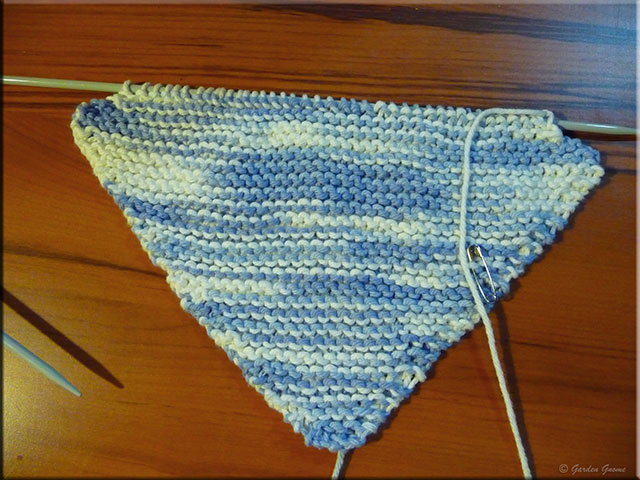
Pictured is the dishcloth in progress knit in Bernat Handicrafter® Cotton.  This is a 100% cotton perfect for dishcloths.  I like to use varigated colours when making utilitarian household items just because I like the effect so you will see varigated colours in things like slippers, afghans, and dishcloths that I make.  I started at the bottom corner then shaped to the size I wanted by increasing.  At the point where I start decreasing 2 corners are formed then continuing decreasing will form the final 2 sides of the dish cloth.  The cast off will form the fourth corner. 

Note that I use a safety pin to mark the front side of my work.  In this pattern the increases and decreases are done on the front side only.  Unless I'm working on a complicated pattern I seldom watch my work as I'm knitting.  The safety pin is a textural way of knowing which side of the piece I'm on. 

Pictured is the completed dishcloth with only the ends to be sewn in and trimmed.  On the lower left is the starting point (first corner) of the dishcloth and the fourth corner is in the upper right. The shaping give just a hit of a border.

Simple Plain Edge Dish Cloth Pattern

cast on  3 stitches
*row 1 - K into front of first stitch, K into back of first stitch (one increase completed), K to last stitch, K into front of first stitch, K into back of last stitch
row 2 - K*
repeat from * to * until there are 47 stitches on the needle
**next row - K2tog, knit to last 2 stitches, K2tog
next row - K**
repeat from ** to ** until there are 3 stitches
bind off


Garden Gnome
©2006-2010


Monday, April 26, 2010

Frugal Living

We live a fairly frugal lifestyle revolving around family and friends.  Most of our meals are homemade from scratch.  I garden as well as freeze and can the bounty of the harvest.  We watch every kWh trying to get our hydro consumption as low as possible with a goal of getting completely off the grid.  We buy what we need while avoiding conspicuous consumption.  Don't get me wrong as we do buy things we want but those things tend to be utilitarian to help us in our goal towards a frugal lifestyle.  Even then our philosophy has been used is better than new. 

This time of year I tend to go through all of our utility and those types of bills to see what can be cut.  I fail to see the logic of paying for something we aren't using or seldom use.  What often happens with television, internet, and cell phone service is new packages become available that may be cheaper than your old package so it pays to check this out from time to time.  At the same time this is a good time to reconsider other expenses.  Here's how we faired out from this year's reassessment with net savings for this year in green:

  • lawn service - We have been paying $650 per year for lawn service, cutting and raking only.  It is extremely convenient when we are away alot yet our lawn always looks well kept.  This year my husband decided to buy a lawnmower to go back to DIY.  We have enough family in the area that will stop by to cut the lawn if we are away so we aren't giving up anything that way.  The lawnmower cost a total of $310.37 which will give a payback period of 3 months and a net savings of $339.63 for this year.  Next year will be a savings of $650 and each year there after since the lawnmower paid for itself the first year.
  • satellite television - In rural Canada if you want television you basically have to sign up satellite television.  When you do this the equipment can be rental or purchased.  The benefits to renting is not having to put out a large initial outlay of cash but the negative is you pay rent on that equipment each month.  We have been paying rent on 5 satellite receivers at a cots of $26 per month.  We just purchased used receivers to replace 4 of them and bought an additional PVR receiver for the main television with a 25% discount.  The net savings is $26 ($312 per year) with a pay back period of 18 months.  We did not change any of our programming.
  • cell phones - We each have a cell phone something that is quite important when we are both on the road.  However I'm home a lot so seldom use my cell phone but don't want to terminate it as it is good for emergency back-up and when I am on the road.  We were paying about $132 per month for the two cell phones including additional charges.  With a bit of juggling we managed to get the charges down to $73 per month by switching my phone to vacation use ($15 + taxes, 40 minutes per month) for a net savings of $59 per month or $708 per year.

Garden Gnome
©2006-2010


Sunday, April 25, 2010

Knitting a Mitered Square

I've been knitting and crocheting since I was knee high to a grasshopper.  Like many who enjoy knitting I have a yarn stash that seems to just keep growing.  This happens because if I see a yarn I like I will buy enough to make something from it and there are always left-over bits and pieces of yarns, not quite enough for a large project but enough that can be worked into other projects.  Two of my favourite ways to use up left-over yarn is slippers and granny square afghans.

Mitered squares are extremely easy to knit.  If knit from cotton yarn they can be used as is for wash cloths.  However, they can be joined together to form an afghan.  The centre decrease forms a seam that can be oriented to create a pattern for the final afghan.  Here is a video of the basics.  At the end of the video there are pictures of a mitered square I made and the pattern for you.


Now that you've watched the video you have a good idea of how to proceed with this project.  The knitted mitered square is done in garter stitch using only one other stitch.  This is an excellent beginning project for someone just learning to knit.

The basic mitered square starts with a set number of stitches equal to 2 sides of the resulting square plus the 3 shaping stitches.  While it is not immediately apparent to a beginner, the piece is being knit from corner to corner in a diamond shape fashion with the 2 bottom edges of the diamond formed by the cast on stitches (1) and the 2 top edges of the diamond formed as the rows are knit.  Once a few rows are knit a peak becomes apparent (2) that when divided onto 2 needles the shape of the corner becomes clearer (3).  The final piece is square with a characteristic diagonal line from the decrease stitches (4).  I used size 4.5 mm needles and 4 ply cotton weight yar.

Mitered Square Pattern

Cast on 63 stitches.
1. K 30, S 1, K2tog, SYO, K 30
2. K
3. K 29, S1, K2tog, SYO, K 29
4. K
5. K 28, S1, K2tog, SYO, K 28
6. K
Continue in this fashion decreasing 2 stitches total on the right side (odd rows) and knitting the even rows until 3 stitches are left.
S1, K2tog, SYO, cut yarn and draw tail up though remaining stitch.

Garden Gnome
©2006-2010


Saturday, April 24, 2010

Dollar Stores are the New Five and Dime

When I was growing up we had Ross's Five & Dime that outlasted the old Metropolitan Store (aka The Met) which was also a five and dime store.  Ross's had squeaky wood floors all on one level with just about everything laid on sided tables, no racks or hangers.  The Met was absolutely fascinating to a me as a child.  It had squeaky wood floors that had a wonderful woodsy smell when it rained.  The main floor had a host of all kinds of things a kid could buy for their cherished 25¢.  Then there was the bargain basement.  The stairs creaked and groaned as I wandered down to see how what goodies my frugal little hands could find.  Even back then I was a very frugal shopper.  I would look through all the bargains finally settling on something like hair ties but quite often I would walk out without spending a penny.

Ross's and The Met are long gone, residing only in the recesses of my childhood memories.  Several years ago I discovered dollar stores.  While these stores don't have all the character of the old five & dimes they really are the modern day equivalent.  I love dollar stores!  There are a lot of good deals to be had at the dollar stores for in most cases $1 per item.  Like all shopping you really do need to know not only regular but sale prices because surprisingly dollar store items are not always cheaper.  Fast forward to 2010 and the 25¢ has been replaced with a $20 bill but I am just as frugal when I'm shopping, dollar store or otherwise.

In general the craft section is always a bargain in dollar stores.  Other bargains I've found are: canning jar lids, dishwasher rinse agent, colouring books, small gardening items, gift bags, party supplies, glassware, hair clips, specialty cookware like mise en place bowls, silicone pinch bowls/scoopulas and decorative garden items.  When it comes to those little extras like fancy glass serving One of the complaints I've heard is a lot of the dollar store items are from China but for the things I'm buying the countries of origin are Canada, USA, Brazil, and other countries including China.  I like that I can buy Canadian made products in Canadian dollar stores and I like I can still get a bargain for those little things I want or need.

Garden Gnome
©2006-2010