What does a Garden Gnome do when she is not gardening, in the kitchen or doing genealogy? Well the answer might just surprise you so read the entries to find out more. This blog focuses on everything we do to make our house a home. There will be a strong emphasis on home energy efficiency and do-it-yourself (DIY) projects. At the same time there will also be crafts, knitting and crocheting projects along with any other little tips we do to create that down to earth, I want to be here home. Please enjoy your visit :)


Showing posts with label lighting. Show all posts

Tuesday, January 13, 2015

Converting to LED Bulbs

Ontarians currently pay the highest hydro rates in Canada despite the fact that we produce natural sourced, inexpensive electricity.  Apparently our government deems it prudent to send our cheap hydro to the US then turn around and charge us premium prices, but that is a whole other story.  At any rate, our hydro rates are high.  We have always been fairly energy conscious because it is both frugal and environmentally responsible. Supplementary lighting is a necessity even if you are blessed with an abundance of natural lighting especially task and security lighting.  Lighting actually only comprises about 4% of hydro usage so there isn't a lot of savings even if not using hydro powered lighting.  The reality is every kWh not used is a good thing.

led bulb packaging showing wattage and lumens
Several years ago, I was excited to buy our first CFL bulb.  The base was big and bulky, limiting what fixtures it could be used in and at $30 was cost prohibitive to use in any number.  A few years later, smaller, spiral CFL that fit in most fixtures became available.  In comparison to incandescent light bulbs, the spiral CFL used less than half the wattage. 

Lowes had LED light bulbs on sale for $4.98 which is still more expensive than CFL but quite reasonable.  The price of LED bulbs is quickly coming down.  The key thing to look for is the lumens, the brightness of the bulb.  This will be the new value replacing wattage according to some sources.    I bought four of the 800 lumen bulbs (9.5 W = 60 W).

led compared to cfl bulbs
CFL bulbs have come down in price to as low as 70¢ per bulb and while they do save hydro, they have their own unique problems.  CFL take a few minutes to come to full brightness  They emit mercury when broken as the glass shatters in a million tiny, very sharp pieces.  CFL still don't fit in all fixtures and they perform poorly outdoors in cold weather.  Many complain there is a slight flickering to the CFL bulbs.  They can also interfere with other frequencies like garage door openers.

It's easy to see that the LED bulbs are lower wattage thus reducing hydro usage saving money.  They are by far the most energy efficient, cleanest and most eco-friendly light bulbs.  One of the CFL replaced was a 26 W bulb in the great room that is left on 24/7 when we are away.  It didn't behave nicely with the timer so we just left it on.  The three kitchen bulbs replaced were 13 W.

The LED bulbs are very similar in shape and size as the old incandescent light bulbs.  Aesthetically, they are a bit more appealing than the spiral CFL.  The A10 base will fit in most light fixtures but smaller based LED bulbs are available for specialty lighting.  LED bulbs contain no toxic materials and are 100% recyclable which is a huge improvement over CFL bulbs.  They produce little infrared light, close to no UV emissions and the operate in extremely cold or hot temperatures.  The light is instant with no warming period to reach full brightness. 
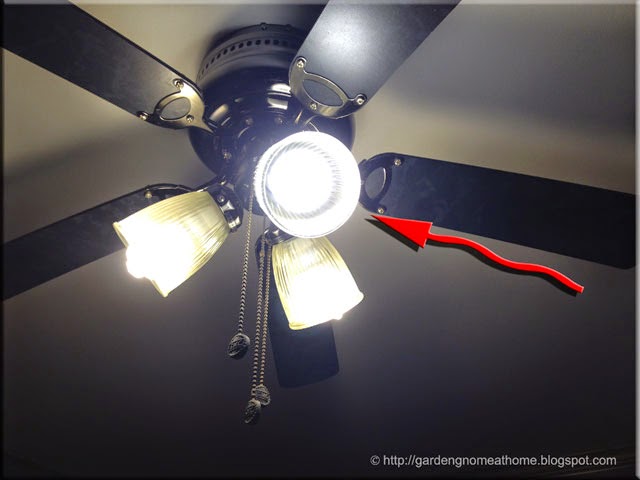
We are planning on replacing the ceiling fan in the kitchen with a solar tube.  That will be after we finish the deck.  If we put a roof on the beck, it will change the roof line so the solar tube is on hold until we decide what we are doing. 

It is a bit hard to see here but the back two bulbs are CFL and the front one (red arrow) is an LED.  The difference in lighting is significant!  The LED bulbs put out a nice bright, crisp, clean light in comparison to the CFL bulbs.  They really light up the kitchen while saving us 10.5 W total.  We are getting more light for less hydro.  We have even questioned whether we still want a solar tube. 

We are replacing most of the lights in our house with LEDs.  Some are the basic ones like these while others will be part of our home automation project.  These basic LED bulbs will be moved to fixtures not tied into our home automation system.  I talk more about that system when it is up and running.  LEDs really are the way to go with respect to lighting.  The greatly reduced energy usage makes them suitable for solar applications.  They can be used with dimmers as well.  You can even get colour changing LED bulbs for use in home automation so you can simulate dawn, dusk and personalized settings.  I bought two colour changing LED strips to replace the kitchen florescent strips.  I'll  discuss that as well when they are installed.  In the big picture, we will be reducing our lighting from 4% of our overall hydro usage to less that 2% which isn't bad but the payback period will be about 5 years at current hydro rates and replacement bulb costs.


Monday, March 25, 2013

LED Lighting

LED Christmas and nightlights quickly took over more energy inefficient versions and they cost pennies to operate.  Solar LED lights have become very popular because not only do you get the effect you want they only cost the price of the light itself with no further operating costs.  Over the past several years we have seen a move away from energy inefficient incandescent light bulbs CFLs and now LEDs for daily household use.  A 60W incandescent light bulb can be replaced with a 13W CFL bulb effectively saving 47W of power or an 11W LED bulb saving 49W of power.  Unlike CFLs, there is no mercury in LED bulbs and their lifespan is considerably longer (more than double) than CFL bulbs so they really are environmentally friendly.  Currently, the main deterrent to switching to LED bulbs is price at $19 to $24 for incandescent style bulbs and $26 for the prong type to replace halogen bulbs.

Sylvania Utra High Performance Series LED bulb
I bought a Sylvania Ultra High Performance Series LED light bulb to use in our new range hood.  This 8W bulb is the equivalent to an 11W CFL bulb or a 40W incandescent bulb.  It is dimmable, compatible with dimmers.   The bulb lasts 25,000 hours or 23 years based on 3 hours operation per day.  At a cost of 11¢ per kWh the bulb will cost 96¢ per year based on 3 hours operation per day.  If the bulb were left on 24 hours per day, it would last 1,041 days or 2.9 years at a total cost of $22.27 (96¢ x 8 x 2.9) or $7.68 per year making it a frugal if you have a location where a light needs to be on 24 hours a day, 7 days a week.  Under most household applications, an average of 3 hours per day is a reasonable estimate.  I paid $24.99 for the bulb so if the bulb lasts 23 years, it cost just over $1 per year plus the hydro use so in reality about $2 per year.

The new LED bulbs have a few features I really like.  The bulb contains no mercury which is a real plus over CFL bulbs.  Another plus is the base which does not have a transformer so it will fit any standard light fixture just as an incandescent bulb would.  The nice thing is there is no warm up period like there is with a CFL when first turned on.  There is no notation that LED bulbs are best in locations where they won't be turned on and off all the time as there is with CFL.  LED bulbs contain no toxic substances, they can be disposed in normal household waste but since they last so long, even that is of little concern. 

I can't wait for the price to come down on the LED bulbs!  I remember when the CFL first came out.  The transformer base was big and bulky so the bulbs could only be used in certain fixtures, mainly lamps or to replace a bare ceiling bulb.  I think I paid somewhere around $20 for the first CFL.  Now, we can buy an 8 pk of 13W CFL for $9 at Sam's Club.  As the LED bulbs become more popular, the price will go down.  There are less expensive ones already on eBay so I may order a couple of different styles just to try them. 

The LED lights have a lot of potential.  They can be used indoors or outdoors, in damp locations and at temperatures ranging between -20°C and 40°C (-4°F and 104°F).  The energy savings switching from CFL  to LED is not the huge difference it is when switching from incandescent to LED but it is still an energy savings.  Every watt saved reduces our energy usage as well as our hydro bill so the LED lights do look very promising.


Sunday, January 16, 2011

GE Nightlight

Night lights are rather popular lighting for adding a bit of low light just enough to see where you are going during the night.  The most common locations for night lights are hallways, near stair wells, children's bedrooms and bathrooms.  They are available in a wide range of styles to fit most decors and tend to be rather inexpensive.  Night lights are either controlled using a small switch, by solar or they are on all the time.  The bulb choices are small screw in Christmas light style, fluorescent or LED.  LED lights are the most economical to operate at at 0.5 to 0.7 W but they are on constantly when plugged in.  They give more of a dim glow just enough that you can see where furniture is in the dark.

GE nightlight
When we are away, we usually leave the light over the sink on.  It is an 11 W CFL so slow cost to operate but if we are gone for an extended period of time then the light stays on the entire time, something I would rather not do.  I found this GE Nightlight that has a higher light output than other nightlights I've seen.  It is 5 W so when the light is on would be saving 6 W and it turns on only when the existing room light gets low.  So the light is not on all the time reducing the amount of electricity used. 

This nightlight uses a small fluorescent bulb.  The light output is quite good for such a small light. The shape of this nightlight is rather interesting.  There are three settings - on, off, auto.  When clicked to auto the light will come on when the existing room light dims enough to trigger the light.  This will be a good light that is automatically controlled for those times that we are away and want light in the kitchen.

Garden Gnome
©2006-2011


Thursday, November 11, 2010

Oil Lamps

As the air turns cooler necessitating the need for the gas fireplace and/or furnace my candles and oil lamps are drawn into action.  I love my oil lamps!  Two oil lamps in my collection see regular use.  I've had them for years and they still bring a smile when I get them out to use during the fall months.  Don't get me wrong as I use them throughout the winter as well but the fall months when things are cooling off is when they see the most use.  I also love my homemade candles.  Now somewhere along my travels in the blogosphere I came across the suggestion to use candles to warm chilly windows and to use as a bit of supplemental heat.

flower based oil lamp
Using candles as a bit of supplementary heat does work but if you factor in the cost, it's cheaper to use electricity for the actual lighting.  Nine 11 W CFL bulbs will cost us 9¢ to run for 4 hours in comparison to 9 tea light candles that cost 35¢.  However the tea light candles are actually adding a bit of heat to the room, increasing the comfort level.  In comparison to tea light candles an oil lamps puts out a lot more light and heat.  Surprisingly the cost of lamp fuel per day is not a cost I have ever figured out so I should do that.  I run my lamps almost daily in the fall for 2 to 3 hours at a time.  The last time I bought lamp oil it was $4.99 and that's lasted me over 2 years so it is well under the price of candles per use.

One of my oil lamps has a lovely butter coloured base with a pretty spread of blue and pink flowers (pictured).  The lamp itself about 15 years old and it does have a replacement chimney.  I keep replacement parts for my lamps on hand including replacement wick.  Oil lamps are significantly more efficient at producing light.  It is a whiter light than the light from beeswax candles.  The light can be easily controlled.
 
crystal based oil lamp
My second oil lamp is about the same age.  It has a crystal bottom with the original chimney.  I think it is rather pretty.  Oil lamps are a inexpensive, practical way to add a bit of ambience and warmth to a room.  However, they do involve an open flame so should not be used without adult supervision when children or pets are in the room. 

Oil lamps require a bit of maintenance.  It is important to trim the wick so it burns properly without smoking.  I prefer a straight cut across the wick for a nice even flame but you can trim into a slightly rounded shape if desired.  The wick holder should not ever need replacing providing it is looked after properly but if using oil lamps as an emergency back-up lighting you should have a replacement holder just in case.  It is also prudent to keep at least one replacement chimney on hand since that is the part most likely to break and you can't use the lamp without it.   Just as in the olden days the lamp chimneys need to be cleaned.  I recommend cleaning daily but you can go two or three days without cleaning them.  I clean mine each morning so they are sparkly clean for that evening.  Whether or not they save a little on the lighting and heating they are a true treasure to enjoy!


Garden Gnome
©2006-2010


Thursday, August 26, 2010

New LED Lantern Added to Our Emergency Preparedness Supplies

We are always on the lookout for items to add to our emergency preparedness supplies.  Lighting using LEDs is perfect for emergency preparedness because the LEDs don't draw a lot of energy meaning your batteries last a lot long.  The lights are fairly bright but not the same as regular CFL lightbulbs.  Still when the power is out they provide enough light that you can get around by.  They are safe to use anywhere without a fire risk so are perfect for homes with children and pets.  I'm currently working on installing a push style LED light in each room of the house so if the power is out we still have a bit of light as needed that can supplement candles and the battery operated Coleman lantern and camp lamps. 

super-bright 12-LED indoor/outdoor lantern
My husband brought home this cute LED super-bright 12-LED indoor/outdoor lantern by Illumibeam.  It is about 8½- inches tall and designed like the traditional camp lanterns.  The lantern can be operated using 4 "D" batteries using the holder or it can be plugged in using a 6 V adapter.  It is not deep enough to use 6 V battery. We have rechargeable "D" cell batteries that can be charged using our solar battery chargers.  The lantern has a dimmable control for the long-life LED lights (100,000 hours) which is a nice battery saving feature.

This lantern is a nice addition to our emergency preparedness supplies.  I especially like that it is portable.  This is very important in the case of the event of emergency evacuation.  Not only that a portable lantern means you can take it wherever you need the light.  Now I need to do a bit of stocking up on rechargeable batteries but I'm holding off until I see how the start of our solar system install goes.

Garden Gnome
©2006-2010


Saturday, July 3, 2010

Replacing a New Light Fixture

On March 30 I posted about replacing the light fixture over my desk.  It was an easy DIY project.  The beveled fixture was aesthetically appealing perfect for adding a bit of pizzaz while trying to sell the house.  Despite the fact that the fixture used 25 W specialty bulb at a cost of $3.99 for 4 we went ahead and installed it.  The layout of the house means lights are on most of the time on the lower level that is the main living area and mostly underground.  The first week we went through 4 of the bulbs.  Thinking it was just a fluke we bought more bulbs and replaced the burnt out bulbs.  We replace bulbs again before going on vacation mid-May and again in June.  Finally I had enough!  First we were spending more in kWh just to have this light on but the price of replacing bulbs every other week was getting rediculous!

new CFL fixture
A couple of days ago we picked up an eco-friendly light fixture to replace the fixture we had installed in March.  We opted for a more utilitarian fixture that would hold CFL bulbs.  We put two 14W CFL bulbs  for a total of  28W compared to the 100 W of the other fixture so we are saving at least 72W when the light is on.  The reality is had we not replace this fixture in the first place for resale value we would have put an energy efficient fixture in instead of a fluff fixture.

I love the new fixture! It is energy efficient, low cost to operate and has an excellent light output.  The two CFL bulbs put out the same light as two 60W bulbs.  It's nice and bright without costing a lot of money to turn on and I fully expect to get a good 5 years worth of use out of the CFL bulbs in comparison to the under 2 weeks for the 25W designer bulbs.

Garden Gnome
©2006-2010


Tuesday, May 4, 2010

Compact Fluorescent Light Output Equivalency Chart


Compact fluorescent lights (CFL) have changed dramatically from the early days of large ballasts that would only allow the bulbs to fit into certain style fixtures.  Not only are the ballasts small the lights themselves are compact and come in a variety of shapes for both indoor and outdoor use.  The lights CFL spiral bulbs are available in a range of wattages and light outputs (lumins) ranging from cool natural light to soft white light.  They are even available in red, green, blue and yellow!  Where you use these bulbs really determines the type of light output your want.

Pictured is the light output equivalency chart for CFL bulbs.  My rule of thumb is to go to lower wattage where possible so most of our bulbs are in the 9 - 13 W range equivalent to 40 W incandescent bulbs.  Notice that both 9 W and 13 W CFL put out the same lumins?  There is no difference in light output to go to 13 W if a 9 W bulb is available and going to 9 W saves 4 W in energy use.  Given the design of our house (main living area including kitchen below grade) I use 15 W CFL bulbs on the lower level because it does need the extra light.  The colour of the light output does make a difference.  The softer lights tend towards a yellowish tone.  I switched out the lower level soft white CFL for daylight CFL and what a huge difference it made.  The light is cleaner and crisper. 


Garden Gnome
©2006-2010


Tuesday, March 30, 2010

More Electrical Updating

We have been updating and doing minor repairs ever since we made the decision to sell our house. These are all the little things that just make a world of difference when showing the house. No potential buyer wants to see signs of anything that looks like work when they go through a house so the less of that type of thing the better.

new light fixtureLight Fixture

Pictured on top is the light over my desk. It is a higher wattage CFL daylight spectrum light. While this doesn't matter to most people to me because that spectrum is necessary to prevent negative mood effects. I was quite happy with the light exactly as it was. However we both agreed for the aesthetics of selling the house it had to be changed out.

We chose a ceiling hugging, beveled glass light fixture that holds 3 - 25 W incandescent bulbs. The light was very easy to install with no modifications needed. The brass finish goes nice with the wood ceiling while the warm yellow tones from the lights enhance the tones in the wood. The effect is quite lovely! This was an easy DIY project that took about 10 minutes from start to finish. The fixture was on sale for $7.99 so it was a frugal choice as well.

replacing outletNew Outlet

Any older house can benefit from having the plug and switch outlets replaced. Not only is the upgrade good from a safety point of view but also aesthetically it updates the look of the room for very little cost or effort. We really like the steamline looks of the European style plugs and outlets. The flat, clean lines just look so much nicer. This will be the fourth house that we have changed out older switches and plugs for the European design.

Pictured is the before older style toggle switch and the after newer style European switch. I think it makes a huge difference with very little effort. Home renovation centres, hardware stores and lumber stores all have builders specials of the switches, outlets and covers. These are usually 10 to 12 per package at a reduced price. When replacing any outlet on an outside wall it is a good time to seal and insulate the outlet as well. If you are comfortable working with electricity this is an easy DIY project. As always when working with electricity turn off the power then test for live wires before proceeding.

Garden Gnome
©2006-2010


Friday, March 19, 2010

New Light Fixture

Changing out light fixtures is one of the easiest, low cost ways to update the look and feeling of a room. There is such a wide variety of light fixtures available that can fit the needs for any decor. With the advent of the energy efficient compact fluorescent light (CFL) bulbs there are more of these fixtures that can use these bulbs as well. We chose to install an enclosed ceiling hugging light fixture in the was to be craft room and a matching one in the adjoining hallway.

new light fixtureNew Light Fixture

When CFL first came out they were not to be used in pot lights or enclosed fixtures. That has changed. We bought 2 - 13" swirl flush mount light fixtures that can use 2 - 60W incandescent or equivalent CFL bulbs (1). Changing out the light fixture was as simple as turning off the power then connecting the base of the new fixture (2). Turing the power back on was a success (3) so it was time to put the globe on. Here's where we hit a bit of a problem. The inner threaded pipe to hold the globe on was just a little to short so we had to wait until the next day to buy a longer piece. The following day my husband bought a long enough threaded pipe to cut a longer piece for each light. Once the threaded pipe was in place the globe was put in place and secured (4). I really like the nice clean looking results but especially like the fact that the new fixtures now use CFL bulbs. It is a win/win solution all the way around.

Changing out a light fixture is an easy, low cost DIY project. The two rules are to always work with the electricity off and to always follow the wiring directions. Once the light fixture is in place test it with the intended light bulbs. Do not use bulbs that are above the recommended wattage. Before putting on the globe wash and dry it well so it will add a nice sparkle once installed.

Garden Gnome
©2006-2010


Wednesday, March 17, 2010

Solatube Daylighting Systems With Ed Begley Jr.

During our last Florida vacation we stayed in a house that had 2 solar tubes. I blogged about the solar tubes as being great alternative lighting. Once installed the solar tubes bring free lighting to dark areas like hallways, bathrooms and other rooms. I calculated the cost of installation for each solar tube to be about $370 (DIY) to $500 (installed) so based on energy consumption alone the pay back period would be 37 years if installed. If you factor in the cost of the light bulbs the pay back period would go down to about $450. Clearly at today's electricity costs in our region the pay back period is not enough of an incentive to install solar tubes.

However, Hydro-One in Ontario has indicated most of the SmartMeters across the province will be activated by late June at which time the new Time of Use (TOU) hydro rates will go into effect. Essentially this means from 7 AM to 9 PM on weekdays year round except statutory holidays, we will be paying higher electricity rates. This time period is divided into 2 usages - high and medium depending on the season. As a result of these changes it becomes even more important to not use electricity you don't have to. Strategically placed the solar tube(s) will eliminate the use of electric lighting in certain areas of your home. The key concept to remember here that not using the electricity is better than reducing the electricity usage via energy efficient lighting. The solar tube(s) can be fitted with lighting for night use where they will function as a normal light so can replace an existing light fixture. This will allow us to take advantange of the lower electrical rates in the evening hours if necessary.

The solar tube(s) also improve the indoor comfort of your home. In northern areas such as ours where we see winter and several months of grey days, the solar tube(s) amplify and allow extra light into your home. This makes your home brighter and cheerier even though it is grey outdoors. It helps to ward off the winter blues so common in northern climate winter months and may even help to alliviate SAD (seasonal affective disorder). Here is a video of the solar tubes installed in Ed Begley Jr.'s house. Ed is an environmental activist who uses several eco-friendly methods in his home.


Garden Gnome
©2006-2010


Saturday, September 19, 2009

Solar for Emergency Preparedness


Solar Emergency Preparedness

As summer comes to an end it's time to make sure we are well stocked for the winter months. Not only am I busy making sure the pantry is well stocked with home canned and dried foods, I'm also adding to the freezer stock. However, preparedness is more than just have a 1 - 2 year supply of food on hand. This is also the time of the year to stock up on sundry type items such as laundry soap, personal needs items, toilet paper, First Aid supplies as well as emergency preparedness items. I'll be making a few posts on getting prepared for winter.

During winter storms the prospect of having no electricity for short periods of time increase. The normal recommendations is to keep oil lamps with plenty of fuel and lots of candles in your emergency preparedness stores. In cold climates both serve to provide light with a bit of heat. I keep a good supply of homemade beeswax and soy candles on hand for regular and emergency use. However, in homes with pets or children using oil lamps and candles can present a risk of fire and/or injury if they get bumped or knocked over. Battery operated emergency devices only work if you have sufficient batteries. I've turned to solar devices as part of my emergency preparedness.

Pictured is the wind-up/solar powered radio, Coleman camp lantern, a few of our many flashlights, solar light stakes, battery operated lights, rechargeable batteries (AAA, AA, D), 6 V battery adapter and solar battery chargers. Not pictured are a couple of small camp lanterns that use only one 6 V battery and a wind-up flash light. The principle of using solar rests on turning solar energy from the sun into usable energy for lighting and heating. In emergency situations you cannot always rely on the sun however in most cases you will be able to get enough sunlight exposure to power emergency equipment such as the radio, some lights and solar battery chargers if need be. Combining wind-up power for essentials like flash lights and a radio makes good sense as these can be used without relying only on solar.

The light stakes are meant for garden use but can easily be charged in a sunny window to provide indoor lighting for the evening during a power outage. I like keeping a good supply of charged batteries on hand that can be recharged if necessary using the solar battery chargers. The 6 V battery adapter is a rather interesting find. It uses 4 - D cell batteries and can be used in place of a 6 V battery. I think these are great items to have in our emergency preparedness supplies.

Garden Gnome
©2006-2009


Sunday, January 25, 2009

Solar Tube (Alternative Lighting)

Lighting is an integral part of any home. It creates ambiance as well as allows the you to enjoy your home the way you want. At the same time lighting has created environmental concerns through rising energy usage of the incandescent light bulb that has now ceased being manufactured. Incandescent bulbs use a considerable amount of energy while adding heat to the room, something that is undesirable. In short incandescent bulbs were not energy efficient bulbs even though they were cheap. Fluorescent tube lights are cheaper to operate but not aesthetically as nice although I have seen some nice applications creating diffused wall lighting and lighted ceilings. When the first CFL bulbs came on the market they had bulky transformers in the base that prevented these bulbs from being used in all light fixtures but it was a start. Now CFL bulbs come in all shapes, sizes and types of light. They are inexpensive to buy and considerably less expensive to operate than the old incandescent bulbs. What we are seeing now is a trend towards solar with the most advances being made in outdoor solar lighting. It's incredibly inexpensive to set up outdoor solar lighting and requires little or no tools. Just coming onto the market but still a bit to expensive and needs fine tuning yet are LED bulbs that fit a normal light socket yet will use even less energy than CFL bulbs.

Our main living area is mainly below ground with one wall facing the water that opens onto the backyard. Natural light is at a premium outside of the kitchen and front part of the family room. In the summer the shade trees that save us so much on cooling keep the main level darker than it would be if located on the upper level. The design of the house means that even during the summer we have lights on during the day to prevent the main level from feeling like it is mainly below ground. We have 7 CFL 15 watt daylight bulbs on during the day most days that if on for an average of 10 hours per day cost us 6.4¢ or $23.44 per year. IIn addition to this we have various CFL lights on the main level that are used as needed. While this is a necessary cost due to the house design and while we make up for it in reduced heating and cooling costs, I'm always looking for ways to reduce our energy consumption for lighting.

Solar Tube
image source: Solar Tube Daylighting System

I think it was three houses ago (about 12 years) that I first saw this solar lighting called a Solar Tube. I've wanted one of these ever since I saw it. A solar tube gives you all the benefits of a skylight without all the problems. The principle is quite simple. A small dome allows light to enter into a highly polished pipe where it is amplified by bouncing off the mirrored surface and reflected into the house. To soften the light on the inside there is a diffuser. On the outside of the house there is little to see other than a small, clear dome on the roof. On the inside of the house the finished light looks like a larger flush mount pot light. Once the solar tube is installed which can be a DIY project there is no further cost of operation. You get beautiful, bright natural light in your home without costing anything! Environmentally this is a wonderful way to get that extra light without increasing your carbon foot print.

Solar Tube Installed

We just spent a lovely week away in the sunny south. The first house we stayed in was the guest house. The second was a rental house in the same resort. You can read more about the resort here and the food here. The rental house was a triple wide, manufactured home that gives a whole new meaning to trailer living! What caught my eye was two solar tubes, one in the guest bathroom and the other in the kitchen. Pictured is the kitchen with the red arrow pointing at the solar tube. As you can see it blends right in with the recessed lighting. What was very impressive was the amount of light the solar tubes let in even on cloudy days!

I really liked the solar tubes. They made both rooms quite bright and airy feeling. I think it would be great to be able to tone down this brightness if need be as they were quite bright even though it was cloudy outside. My husband could not quite get over the fact there is no switch to turn the thing off. I guess it was a mindset thing turning off the lights but there is no switch for the solar tube. There is a way to shut it off using the same type of mechanism as a camera lens if you install that option. Then you simply shut the shutter that might be a benefit on really sunny days.

Installing solar tubes are on my list of do the research this spring and possibly installing one early summer. Ideally I can find three spots that would be good for the solar tubes but only one location for sure will lend itself to the installation for on the main level. If installed it will not eliminate all 7 lights but possibly 4 of the lights. A total cost of installation from the prices we have seen doing it ourselves would be about $500 making the total payback time about 37 years. As an energy saving device the payback doesn't really warrant the change other than knowing once installed it will not cost anything. So this ends up being an aesthetic, decor type of improvement that will save your money but in terms of energy use you might not recoup the costs. The solar tubes are EnergyStar® rated so there may be rebates available offsetting at least the sales tax. At best this improvement will improve the enjoyment of your home and while it will save you money over the years, it is likely best to look at it as a decor enhancement.

Garden Gnome
©2006-2009


Wednesday, July 4, 2007

Our New Home


Our New Laneway

This is a picture of our new laneway. I really love it! So we are now all moved in and the fun begins. Now we start finding the problems the previous owner neglected to tell us or maybe didn't even know about. The property itself is divided into three major areas. The portion from the garage to the deadend road is the laneway and official front yard. The portion from the garage to the house is grassed surrounded by mature landscaping. The side yard is minor but leads to the back (aka our front) yard that is maturely landscaped ending at the breakwall on the water's edge. A dock completes the setting. The house is bermed slopping to ground level on the lower level with one foot thick walls making it quite energy efficient. It is a beautiful peaceful setting but not without problems. I will be discussing a lot of these problems as we remedy them.

Here are some of the problems in no particular order that we have discovered:
  1. rodents - there is evidence of an indoor rodent infestation at some point but we have no idea if it is recent.
  2. electrical - there are obvious brownouts
  3. an ancient freezer with no ground
  4. outdoor lighting issues
  5. AC not working
  6. aged furnace
  7. in need of caulking and sealing
  8. vegetation trimming for view and pest control
  9. kitchen retrofit
  10. indoor lighting - very minor, mainly upgrading some fixtures
  11. gas line to grill is very wobbly
  12. gas line to dryer is non-existent
There are likely more problems but we will deal with them as they arise. The next few posts will be before and after shots of how we solved the problems plus a bit more since there is decorating and other non-essentials to consider. So watch for them shortly.

Garden Gnome
© 2007