What does a Garden Gnome do when she is not gardening, in the kitchen or doing genealogy? Well the answer might just surprise you so read the entries to find out more. This blog focuses on everything we do to make our house a home. There will be a strong emphasis on home energy efficiency and do-it-yourself (DIY) projects. At the same time there will also be crafts, knitting and crocheting projects along with any other little tips we do to create that down to earth, I want to be here home. Please enjoy your visit :)


Showing posts with label energy conservation. Show all posts

Tuesday, January 13, 2015

Converting to LED Bulbs

Ontarians currently pay the highest hydro rates in Canada despite the fact that we produce natural sourced, inexpensive electricity.  Apparently our government deems it prudent to send our cheap hydro to the US then turn around and charge us premium prices, but that is a whole other story.  At any rate, our hydro rates are high.  We have always been fairly energy conscious because it is both frugal and environmentally responsible. Supplementary lighting is a necessity even if you are blessed with an abundance of natural lighting especially task and security lighting.  Lighting actually only comprises about 4% of hydro usage so there isn't a lot of savings even if not using hydro powered lighting.  The reality is every kWh not used is a good thing.

led bulb packaging showing wattage and lumens
Several years ago, I was excited to buy our first CFL bulb.  The base was big and bulky, limiting what fixtures it could be used in and at $30 was cost prohibitive to use in any number.  A few years later, smaller, spiral CFL that fit in most fixtures became available.  In comparison to incandescent light bulbs, the spiral CFL used less than half the wattage. 

Lowes had LED light bulbs on sale for $4.98 which is still more expensive than CFL but quite reasonable.  The price of LED bulbs is quickly coming down.  The key thing to look for is the lumens, the brightness of the bulb.  This will be the new value replacing wattage according to some sources.    I bought four of the 800 lumen bulbs (9.5 W = 60 W).

led compared to cfl bulbs
CFL bulbs have come down in price to as low as 70¢ per bulb and while they do save hydro, they have their own unique problems.  CFL take a few minutes to come to full brightness  They emit mercury when broken as the glass shatters in a million tiny, very sharp pieces.  CFL still don't fit in all fixtures and they perform poorly outdoors in cold weather.  Many complain there is a slight flickering to the CFL bulbs.  They can also interfere with other frequencies like garage door openers.

It's easy to see that the LED bulbs are lower wattage thus reducing hydro usage saving money.  They are by far the most energy efficient, cleanest and most eco-friendly light bulbs.  One of the CFL replaced was a 26 W bulb in the great room that is left on 24/7 when we are away.  It didn't behave nicely with the timer so we just left it on.  The three kitchen bulbs replaced were 13 W.

The LED bulbs are very similar in shape and size as the old incandescent light bulbs.  Aesthetically, they are a bit more appealing than the spiral CFL.  The A10 base will fit in most light fixtures but smaller based LED bulbs are available for specialty lighting.  LED bulbs contain no toxic materials and are 100% recyclable which is a huge improvement over CFL bulbs.  They produce little infrared light, close to no UV emissions and the operate in extremely cold or hot temperatures.  The light is instant with no warming period to reach full brightness. 
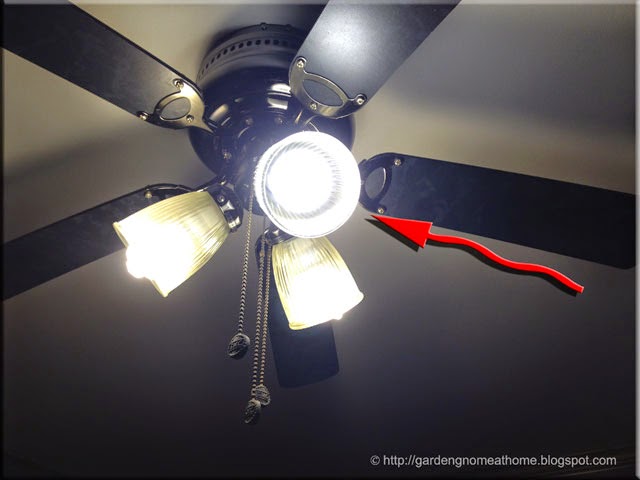
We are planning on replacing the ceiling fan in the kitchen with a solar tube.  That will be after we finish the deck.  If we put a roof on the beck, it will change the roof line so the solar tube is on hold until we decide what we are doing. 

It is a bit hard to see here but the back two bulbs are CFL and the front one (red arrow) is an LED.  The difference in lighting is significant!  The LED bulbs put out a nice bright, crisp, clean light in comparison to the CFL bulbs.  They really light up the kitchen while saving us 10.5 W total.  We are getting more light for less hydro.  We have even questioned whether we still want a solar tube. 

We are replacing most of the lights in our house with LEDs.  Some are the basic ones like these while others will be part of our home automation project.  These basic LED bulbs will be moved to fixtures not tied into our home automation system.  I talk more about that system when it is up and running.  LEDs really are the way to go with respect to lighting.  The greatly reduced energy usage makes them suitable for solar applications.  They can be used with dimmers as well.  You can even get colour changing LED bulbs for use in home automation so you can simulate dawn, dusk and personalized settings.  I bought two colour changing LED strips to replace the kitchen florescent strips.  I'll  discuss that as well when they are installed.  In the big picture, we will be reducing our lighting from 4% of our overall hydro usage to less that 2% which isn't bad but the payback period will be about 5 years at current hydro rates and replacement bulb costs.


Monday, March 25, 2013

LED Lighting

LED Christmas and nightlights quickly took over more energy inefficient versions and they cost pennies to operate.  Solar LED lights have become very popular because not only do you get the effect you want they only cost the price of the light itself with no further operating costs.  Over the past several years we have seen a move away from energy inefficient incandescent light bulbs CFLs and now LEDs for daily household use.  A 60W incandescent light bulb can be replaced with a 13W CFL bulb effectively saving 47W of power or an 11W LED bulb saving 49W of power.  Unlike CFLs, there is no mercury in LED bulbs and their lifespan is considerably longer (more than double) than CFL bulbs so they really are environmentally friendly.  Currently, the main deterrent to switching to LED bulbs is price at $19 to $24 for incandescent style bulbs and $26 for the prong type to replace halogen bulbs.

Sylvania Utra High Performance Series LED bulb
I bought a Sylvania Ultra High Performance Series LED light bulb to use in our new range hood.  This 8W bulb is the equivalent to an 11W CFL bulb or a 40W incandescent bulb.  It is dimmable, compatible with dimmers.   The bulb lasts 25,000 hours or 23 years based on 3 hours operation per day.  At a cost of 11¢ per kWh the bulb will cost 96¢ per year based on 3 hours operation per day.  If the bulb were left on 24 hours per day, it would last 1,041 days or 2.9 years at a total cost of $22.27 (96¢ x 8 x 2.9) or $7.68 per year making it a frugal if you have a location where a light needs to be on 24 hours a day, 7 days a week.  Under most household applications, an average of 3 hours per day is a reasonable estimate.  I paid $24.99 for the bulb so if the bulb lasts 23 years, it cost just over $1 per year plus the hydro use so in reality about $2 per year.

The new LED bulbs have a few features I really like.  The bulb contains no mercury which is a real plus over CFL bulbs.  Another plus is the base which does not have a transformer so it will fit any standard light fixture just as an incandescent bulb would.  The nice thing is there is no warm up period like there is with a CFL when first turned on.  There is no notation that LED bulbs are best in locations where they won't be turned on and off all the time as there is with CFL.  LED bulbs contain no toxic substances, they can be disposed in normal household waste but since they last so long, even that is of little concern. 

I can't wait for the price to come down on the LED bulbs!  I remember when the CFL first came out.  The transformer base was big and bulky so the bulbs could only be used in certain fixtures, mainly lamps or to replace a bare ceiling bulb.  I think I paid somewhere around $20 for the first CFL.  Now, we can buy an 8 pk of 13W CFL for $9 at Sam's Club.  As the LED bulbs become more popular, the price will go down.  There are less expensive ones already on eBay so I may order a couple of different styles just to try them. 

The LED lights have a lot of potential.  They can be used indoors or outdoors, in damp locations and at temperatures ranging between -20°C and 40°C (-4°F and 104°F).  The energy savings switching from CFL  to LED is not the huge difference it is when switching from incandescent to LED but it is still an energy savings.  Every watt saved reduces our energy usage as well as our hydro bill so the LED lights do look very promising.


Sunday, February 10, 2013

Energy Conservation Incentive Programs

Yesterday, I wrote about our so far nasty experience with our municipal hydro provider setting up the PeakSaver program.  The premise is, the municipal hydro provider wants you to give up a bit of control over your hydro usage if needed and in return they give you an incentive for signing up.  So far, the municipal hydro provider is winning and we are left with a pile of electronic junk thanks to BlueLine.  Seriously, with out experience using the BlueLine Monitor and the BlueLine WiFi Bridge, I wouldn't wish either on my worst enemy!  Talk about crap and I do mean crap!  Now, at the moment I am not naming our municipal hydro provider (although they claim to be all about integrity but so far I've seen none of that) but I will and I have every intention of going through my MP (already contacted) and the BBB as well as reporting BlueLine to the BBB.  Seriously, pissing off consumers is not the way to go about getting them interesting in energy conservation.

Energy conservation programs rightly executed are awesome as it was done through Ontario Hydro.  Everyone was a winner.  We got a new programmable thermostat and they got a customer who didn't mind them cycling our hydro during the summer if needed.  So incentive programs do work. We knew what the incentive was through Ontario Hydro but not through our municipal hydro.  That was our mistake or my mistake because I am the primary with respect to energy conservation especially grants and that type of thing.  I should have came right out at asked the municipality hydro provider what the incentive was and then did the research before saying we wanted it.  This serves as a reminder BEFORE you sign up to any energy conservation program, do your research first.  It will save you a lot of headaches in the end.


Saturday, February 9, 2013

The New PeakSaver Goodies - A MAJOR FAIL!

When we moved into our fifth purchased home in 2007 our goal as with all of the houses we have owned was to make it as energy efficient as possible.  At that time we were dealing with Ontario Hydro, who supplies municipal hydro companies and is by far a lot nicer to deal with than the municipal ones.  We signed up for their PeakSaver program which gave us a $25 rebate off our hydro bill and a new Honeywell Programmable Thermostat.  We bought our sixth (actually seventh if you count our vacation home) in 2011 so I immediately called the municipal hydro company to sign up for the PeakSaver program.  What this program does is allow the hydro company to remotely adjust your thermostat by 3 degrees during the heavy air conditioning usage during the summer months if there are brown out conditions.  Honestly, I think they only did it three times in the four years we owned that house.

peaksaver gifts
My husband was very excited that he was going to get a new thermostat.  NO!  What they gave us as an incentive was a BlueLine WiFi Bridge, a PowerCost Monitor and a Coby tablet so we can monitor and control our hydro use online.  Now the real problem is, the technician installed the remote on the AC unit and the sensor on the meter but then just handed me the boxes and the rest has turned into a bloody nightmare!

The WiFi Bridge if working properly would allow us to remotely control our furnace and AC from the cloud (online program accessible anywhere).  Since we are away a lot, this would be a nice cost saving and energy conservation feature BUT after several failed attempts at installing it, several reboots, disabling my firewall and two and a half days on the phone with BlueLine customer support I have nothing but a piece of junk!  The BlueLine PowerCost Monitor is rather nice as you can see the power usage and cost as you are using it BUT it doesn't work properly.  The numbers are off as it right now it is telling me it is 60°F outside when in fact it is 29°F and the dang thing keeps going into sleep mode.  It would be a very nice visual if it worked properly.  I have to tell you I am really not impressed with BlueLine products.  It has been two weeks trying to get this figured out and settled so Monday morning I will be calling my hydro company and ask them to remove the PeakSaver and give them back all their pieces of crap.

You know this really does tick me off.  They want you to conserve energy and set up programs to help you conserve energy then give you a crappy incentive that doesn't even work!  It would be bad enough if one of the pieces of equipment they gave us didn't work, but none of them do.  Oh wait a minute, the Colby table works but it isn't anything I couldn't do on my iPad to begin with.  At least the thermostat they gave us as an incentive last time worked!  In terms of customer loyalty and energy conservation this particular program through the municipality hydro company is a huge FAIL!!!!!!!!!!!!!


Tuesday, August 7, 2012

Energy Costs of Home Computers

My husband recently bought me an iPad so of course I had to compare energy usage to other types of home computers.  We have TOU hydro pricing so anytime we can reduce our energy usage, we do so not only for financial savings but as part of our energy conservation efforts.  I found Saving Electricity to be quite helpful.

On average the annual cost to operate:

  • typical desktop - as high as $631
  • iMac G5 20" - $5.50
  • laptop - $8
  • iPad - $1.36
  • iPhone - 25¢
I replaced the old typical desktop with CRT monitor a number of years ago with an iBook G3 which was replaced with an iMac G4 17" so the annual cost to operate the iMac is a little lower than $5.50.  We each have a laptop which costs a bit more to operate annually but offer greater mobility and they still work during power outages.  My husband has an iPhone with a data plan and I have an iPad equipped with Wi-Fi.  Both of these products offer mobility with low energy use.  All but the typical desktop can be set up to be operated on solar power or for solar charging. 

During high peak pricing, the frugal way for us to access online is the iPad or the iPhone but the iPad is actually cheaper because it connects to our router, not using up the data plan on the phone but using the iMac is rather frugal as well.  We also take advantage of charging laptops, the iPhone and iPad when traveling longer distances in the car.  Since moving into town we do a lot less traveling but charging mobile devices while traveling is cost effective.  We have essentially reduced out energy usage for home computing about as low as we can get. 

Now here is something to consider.  A lot of newer televisions are equipped to be connected to a laptop to be used as a monitor.  I know we can with our Magnavox 37" television as well as the smaller twin Phillips in the games room.   A big screen television can cost you as much as $100 possibly more to operate depending on your usage and age of television.  Using the television screen as a computer monitor adds extra energy cost for no reason if using for home computing.  The extra cost may be warranted if watching a movie or television show via computer using the television as a monitor but not on a daily basis.  However, if watching television and movies via the computer using your television meets your needs you may be able to eliminate satellite tv or cable realizing a substantial annual savings.  Just be aware if using this set up for home computing it does coast more in energy usage.


Saturday, July 28, 2012

Ten Water Conservation Tips

We are surrounded by many beautiful lakes, rivers and supporting waterways in beautiful Ontario, Canada.  Yet freshwater is getting scarcer.  Our last two homes were semi-rural and rural on waterfront properties.  A lot of our summer activities involve water what with swimming and boating.  Water conservation has always a concern for us.  Our water and wastewater (sewage) charges come on the same bill as our hydro.  The breakdown for water usage is: water service charge, water usage, wastewater service charge and wastewater charge.  The cost of wastewater (sewage) is determined by the amount of water used.  Now our water costs us 95¢ per cubic metre with an additional 81¢ per cubic metre for wastewater pluse to two service charges ($14.50. $18 respectively).  So even if we use no water we would still have to pay our provider a minimum of $32.50. 

  1. cooking -  We seldom boil vegetables.  Steaming vegetables uses a lot less water than boiling them and results in more nutritious vegetables. 
  2. water off - When hand washing dishes, fill the second sink about half full with hot clear water to rinse dishes.  Don't let the water run when brushing teeth. 
  3. showers -  We have energy efficient flow restrictors on the showers which means we get nice pressure for showering with less water being used.
  4. conservative pool usage - Pools can waste a lot of water and they are costly between water usage, hydro and chemical but at the same time, a pool provides low cost entertainment.  We use Heatsavr™ (a liquid solar blanket) in the pool to reduce evapouration and help keep the water temperature.  A solar blanket can be just as effective.  We only backwash when absolutely necessary.  We watch the radar so as to not add water if rain is imminent.  
  5. toilets - The recommendation is to add a brick in the tank of older toilets.  We have low flush models in both bathrooms.  We also have a kit (not installed yet) to further reduce the amount of water per flush.
  6. dishwasher - The dishwasher is an energy efficient model that is only run when completely full.  Never run a partial load in the dishwasher as that wastes both hydro and water.
  7. washer - Our washer is an HE large capacity model, something I highly recommend if you are replacing yours.  It is run only at full capacity and always on cold unless running a white load.
  8. gardens - We have gardens around the perimeter of the yard, the perimeter of the house and three raised vegetable beds as well as many container plants.  I conserve water in the garden by using a rain barrel and self-watering planters rather than use municipal water.  We don't have a sprinkler system and we don't water our lawn.  
  9. vehicles - We live in beautiful Ontario, Canada where salt is used as a de-icer on roads during the winter months.  Salt causes vehicles to rust prematurely costing money in repairs and replacement vehicles.  Our local car washes use recycled water so we use those in the winter.  In the nicer weather we power wash the vehicles once a month in the driveway.  A powerwasher is more effective at removing dirt and grim from the vehicles using a lot less water.  
  10. floors - We have hard flooring throughout the entire house, no carpeting at all.  The mop and bucket method for cleaning floors wastes a lot of water.  I use a steam mop which uses about 2 c of water per refill.  It does a nicer job of cleaning the floors without chemicals while conserving water.

Garden Gnome
©2006-2012


Wednesday, June 27, 2012

Lock Those Windows to Reduce Air Infiltration

Our first home was a duplex with fairly decent windows then we bought our turn of the century home.  It had old wood windows with no locks on them and storm windows to make them a bit more energy efficient.  By storm windows, I mean storm windows.  We took the glass storms off when the nicer weather hit, replacing them with screens and visa versa when the cooler weather hit.  Now this was the way it was when I was growing up so I thought that was the norm.  We lived there for eleven years, tolerating all of the drafts.  When we bought our next house, a back-split in a nice subdivision, I discovered windows don't need to be drafty.  Fast forward to this house, built in 1994.  The windows have built-in locks.

Window locks are more than providing security.  I have a lot of problems with my ears so aside of the intense itching, certain noises seriously hurt my ears and they don't have to be loud either.  Think, the low hum of the refrigerator or that low whistling of air coming in a window just cracked open.  Shortly after moving in, we had the AC on and all the windows shut.  I could hear a whistling that almost drove me nuts trying to find where it was coming from.  Eventually I tracked it down to our bedroom where we had shut but not locked the window.  What was happening is the AC was causing a small amount of air to be sucked in that window.  I locked the window and the noise went away.  Most would not ever have noticed the slight whistle but because my ears are so sensitive, I noticed it. 

Locking your windows when using your HVAC system saves you money.  The lock pulls the window tighter, creating a more effective seal preventing air leakage or air infiltration.  If your windows do not have locks and they should for security purposes, it is quite an easy and inexpensive DIY project.  So do take advantage of window locks to help save a bit of energy and money using your HVAC system.

Garden Gnome
©2006-2012


Sunday, June 24, 2012

Ten Home Improvements That Reduce Air Conditioning Costs

There is no doubt about it, the cost of electricity is continuing to climb.  We now have TOU pricing with the highest rate falling between 11 AM and 5 PM from May 1 to October 31.  Unfortunately, this covers the hottest time of the day (12 PM to 4 PM) precisely when air conditioning is needed the most.  There are several low to moderate cost home improvements that can help reduce your air conditioning costs.  Here are a few of them:

  1. If your HVAC is older than 20 years the recommendation is to replace it with new, energy efficient models that use less electricity.  There are grants available in Ontario to help offset the cost of replacement if doing both at the same time. (about $7,000 to $15,000)
  2. If your furnace is working fine and under 20 years old, you can replace the AC unit only. (about $2,000 to $3,000, professionally installed)
  3. If your HVAC is newer than 20 years old but has the older style blower motor, it is possible to replace the motor with a new, energy efficient one that uses less electricity. (about $100 to $350, DIY)  Savings on this replace will be about $500 per year.
  4. Plant shade trees strategically to help shade the house.  (about $50 to $1,000 depending on size of tree).  Larger trees will need a backhoe to plant them (about $200 for one man, 2 hours labour)
  5. Plant non-invasive flowering vines (eg. clematis, climbing roses) on trellises on the east and west walls of your home.  (about $50 per trellis, $15 per plant) This will help shade the walls keeping the interior of your house cooler.  Do not plant invasive or damaging vines like English ivy or Trumpet vine on your house as both attract mosquitoes and spiders.  Both damage exterior surfaces of your house and English ivy in particular attracts rodents.
  6. Install solar window film to lessen solar gain in the summer and thermal loss during the winter.  (about $300, DIY to $1,000, installed depending on number of windows and sizes).
  7. Seal your house to prevent cooled air from leaking out or hot air from entering into your home.  (about $2 per tube of caulk, DIY)  Weather strip doors and windows to prevent air leakage. (about $10 to $30 per door, $5 per window)
  8. Replacement windows can greatly reduce both your heating and cooling costs.  If you can't retrofit your windows with weather stripping, caulk or second pane of window, consider replacing them with energy efficient, double or triple pane windows.  Whole house window replacement (about $3,000 to $5,000) can be a DIY project or you have have them professionally installed usually in one day.  
  9. Install awnings on your windows and doors.  This is an age old method of shading windows and doors.  They can be wood, aluminum or fabric and some are retractable.  You can install them on all your windows if you want a uniform look although awnings installed on north facing windows will make those rooms considerably darker, or install just on problem windows and doors like an south, east or west facing patio door.  Not only does an awning installed on a patio door shade the room indoors, it creates a shaded outdoor sitting area as well.  (about $200 per window depending on size)
  10. Install a seasonal gazebo off your patio doors.  This will shade the patio giving you a nice outdoor dining or sitting area while also shading the interior of the room.  (about $400, DIY)
Garden Gnome
©2006-2012


Friday, June 22, 2012

Ten Ways to Save on Air Conditioning

Our previous home was rural, on waterfront property with fairly dense shade cover and good cooling breezes so we only turned the air conditioning on when the humidity levels were high.  This house in in an urban subdivision backing onto a small field.  There is virtually no shade that affects the house other than when the sun hits noon and later the deck on the east side of the house gradually gets shadier.  The attached garage likely helps on the entrance level as it shades from the morning sun as while it is warm it is not a hot as the sun would be.  We have had a couple of weeks of rather hot weather with temperatures reaching a high of 32ºC/90ºF range but with the humidex feeling like 38ºC/100ºF and UV index 8 (very high) and smog alerts.  That means the air conditioning is really working over time.  Here are ten things we are doing to save on our air conditioning costs:

  1. We close the window treatment on any window receiving sun until the sun is completely off the window.
  2. The temptation is to keep the main entrance door open and screen door close but that lets in a lot of heat so we have been keeping the main entrance door closed.
  3. We closed the HVAC registers on the lower level that is partially below grade and always cooler.
  4. We have all lights turned off during the day with the exception of the bathroom as there is no natural light source but only when absolutely needed.
  5. Cooking has been kept to on the outdoor grill, very minimally indoors (eg. toaster) but only if absolutely needed.
  6. We have been making low or no cook meals (eg. BLTs, meal style no cook sandwiches, meal sized no cook salads)  on the extremely hot days.
  7. Any home canning that has to be done (and that's inevitable) has been done on the odd cooler day, earlier in the morning when I could open the patio doors and the hot water from the BWB canner dumped immediately after processing was complete.
  8. We have refrained from using heat producing appliances like the blow dryer, curling iron, clothes iron, dryer, oven and anything else that produces heat on the extremely hot days as well a very minimally during the recent heat wave.
  9. We keep our thermostat set to 24ºC/75ºF which is quite comfortable without the humidity in the house.
  10. We minimize opening any exterior door during the heat of the day (12 PM to 4:00 PM).

Garden Gnome
©2006-2012


Tuesday, December 13, 2011

Windows

We live in beautiful Ontario, Canada and own vacation property in Florida.  Windows are an odd thing.  You need windows in your home and yet if you try selling your home you won't recoup the costs of replacement windows.  Buyers expect windows but most don't care about having energy efficient windows.  That little tid bit came directly from our real estate agent.  When I was growing up we had the old double hung wood, single pane windows with wood storm windows.  The storm windows were supposed to make the windows more efficient.  Well they didn't help much but the did help I suppose.  At some point my Mom had aluminum storm windows installed.  They were a bit more efficient but not by much.  There are still many homes in Ontario that have the older wood windows with wood or aluminum storms.  They can be made a bit more efficient using caulk and weatherstripping.

Newer homes tend to have double or triple pane windows.  Our new house has double pane, energy efficient windows.  So far I have not found any air leaks.  Double and triple pane windows save on both heating and cooling costs while eliminating the work of putting up and taking down storm windows.  At the same time they greatly reduce outdoor noise from entering the house.

Our vacation home has what I basically would consider aluminum storm windows or at least that's what they would be considered in Ontario.  These single pane windows do little to buffer outdoor noise or prevent thermal loss/gain.  Our vacation home is in a very quiet resort so dampening noise is not a real issue.  What has become an issue since we bought the house is telemarketers trying to sell us upgraded windows.  I'm not kidding!  The problem is our vacation home is a manufactured home built in October of 2006, erected here in the spring of 2007.  The payback period for replacement windows at this time is not worth the expense especially when we rent the house out when we aren't there so it is either rented or empty.

Garden Gnome
©2006-2011


Wednesday, November 30, 2011

Sources of Air Leaks in a House

The cost of energy is consistently rising so energy efficiency is ever more important.  Air leaks in your home can cost you hundreds of dollars a year in energy costs and yet they are one of the easiest to remedy with low cost materials and DIY projects.  For example, a 4  x 300 ml package of 25 year durability interior/exterior acrylic caulk costs $8.97 at Home Hardware.  Simply using one of the tubes to seal cracks could save you the cost of the caulk in less than a month during the heating season.  Just imagine the savings if you used all four tubes!  Chances are good that you may not have to use all four tubes of caulk depending on how well sealed your house is already.  For example, I likely used four tubes of caulk in our third house but closer to twenty tubes in our last house, and I estimate this house will need less than four.  The difference being the age and design of the houses as well as whether the previous owner did any sealing. 

Cracks and crevices are not the only source of air leakage in a house.  Improperly weather stripped door and windows can cause a significant amount of air leakage.  Faulty seals on refrigerators or freezers can cause air to leak out of either which causes the appliance to use more energy which translates into paying more on your hydro bill.  Electrical outlets, switches, and ceiling/wall fixtures can all be sources where cold air can leak into the house.  Our hydro panel was located on an outside wall in main living area.  On a windy day, enough wind came in to move the mirror hung over it!  Fireplaces can literally suck heat air from the room, ultimately costing you more in heating costs.  Gaps around wires, cables and pipes entering the house can be a significant source of air leakage.  A gas pipe had been installed in our fourth house but had not been sealed properly allowing a gap big enough that rodents could get in!  Bell installed our satellite tv here and I specifically asked the technician if he had caulked around the cable.  He said he had but he obviously didn't as I found out the first windy day where the wind was hitting that side of the house.  Exhaust fans and clothes dryers both can let in a significant amount of cold air.  One solution to this problem is to replace regular vent covers with the Braun Eco-Vent.  This specialized insulated vent cover has a ball closure that opens to allow exhaust air out but seals when not in use to prevent cold air from entering the vent.  Your HVAC ductwork may have seams and joints that aren't sealed causing the loss of hot or cold air when in use.  Seal any you can with aluminum foil duct tape.

It is possible to use temporary air leakage blockers such as door snakes, removable caulk, heavy quilts or blankets, towels, shrink plastic, and cardboard secured with removable tape.  These are ideal when you discover a bad air leak that can't be immediately repaired.  For example, today it is extremely windy with driving torential rain.  I discovered the range hood that desperately needs replacing is pouring in very cold, damp air.  I taped a piece of carboard to the filter just to stop the cold air from coming it.  It is only a very temporary measure that quickly solves the problem until the wind dies down and obviously one that can't remain if using the stove.  What this means though is the flapper on the range hood that prevents cold air from entering the house is broke.  Since we are replacing the range hood the problem will be solved anyway.  If using a temporary blocker, do not create a fire hazard or block exit routes from your home in the event of an emergency. 

Before embarking on sealing your house, be aware that a house can be sealed too tightly creating problems with indoor air quality and the proper operation of combustible appliances (eg. gas fireplaces, gas furnace, gas water heater, gas ranges).  Be sure all combustible appliances are venting properly before and after sealing.  Under normal daily activities, there should be enough fresh air entering a house via outside door during entry and exit.  A tightly sealed house may require an air exchanger.  Our new house has a Lifebreath HRV (model 150Max) that is set on a 40/20 cycle.  For twenty minutes each hour the HRV brings in fresh air from outside while exhausting stale air.  Also be aware that in tightly sealed homes it is even more important to avoid using toxic household cleaners and anything containing VOCs (eg. some paints, household cleaners).  It is important to use controlled air exhaust (eg. range hoods, bathroom exhaust fans, HRV,) methods to reduce indoor air pollution, ensure sufficient fresh air entering the house and to ensure combustible appliances have ufficient oxygen for proper operation.  It is a good idea to have an air pressure test done on your home before and after sealing as well as have any combustible appliances checked for proper venting before and after sealing.

Garden Gnome
©2006-2011


Saturday, November 5, 2011

Our First Hydro Bill for Our New Home

I mentioned in another house that it is very difficult to compare energy usage between two houses even if they are identical home.  There are a lot of factors that affect energy usage.  We just received our first hydro bill for our new home.  We moved in on September 1 and the billing period ended October 5.  We used a total of 523 kWh with 336 kWh at off peak rate.  The good news is a good portion of our hydro usage is during off peak hours.  The bad news is the consumption is up from September of last year at our old house.  I certainly was not impressed to see that 79.86% of neighbouring homes used less hydro than we did for that month.  We are used to being on the lower end of hydro use.  Given we were away for two weeks during September of each year, I would have expected our usage at the new house to be lower but instead it was higher.  One month is not enough usage to determine if our hydro usage will remain higher here especially since there was higher usage due to the actual move (eg. AC on but doors constantly opening to bring things in, power tools, charging lawn mower batteries, and etc.).  However, I am speculating over the course of a year our overall consumption will be about the same.  Here are some of the changes from our last house to this one.  The ones that will save us money are in green while the ones that will cost us money are in red.  Hopefully, there will be enough in the green to keep us on track.

  • cooking - We used hydro for cooking at our last house but using natural gas for cooking here.  This is a big change as natural gas is about a third of the cost of hydro here so we should see a difference on hydro usage.
  • lighting - By design it was necessary to have 8 to 12 lights on even during the day at our old house from the time we got up to late evening.  This house has plenty of natural light so at most one or two lights are on but only on the dull, dreary days or briefly when in the laundry room or pantry.  Ceiling lighting in the games room and our bedroom is halogen and one bathroom has the narrow base incandescent bulbs.  The games room lights are recessed so would be a pain to change out and they are only on when the room is being used for larger gatherings so we will likely leave them as is.  Neither bathroom has a window meaning the lights are on when in use.  We are installing a solar tube in the upper level bathroom in the spring.
  • air conditioning - Our old house was on waterfront property (natural cooling effect) with a good cross air current.  The main living was on the lower level that was mainly below grade so was always cool in the summer.  As a result the air conditioning was only used on the uncomfortably humid days.  Our new house is wide open on one side and the back but lacks the natural cooling effect of a larger body of water.  We anticipate having to run the central air more often here.  The unit is likely as old as the house, almost 14 years.  The central air at our last house was only 4 years old so more efficient.  Clogged floor vents were discovered here and the furnace filter was blocked that would make the AC work harder but we did get them cleared out so the HVAC should work more efficiently
  • televisions - We had a television in the family room, game room and master bedroom of our last house, each with satellite receivers.  Two of the tvs were in regular usage almost daily and quite often I would have the family room tv on during the day for the noise.  In this house we still have three tvs.  Two are brand new Phillips LCD 32" screen to replace the two older CRT (tube) televisions.  These are hooked to one satellite receiver rather than two, eliminating one hot box.  They are EnergyStar® certified and are only on when the games room is being used, about once a month.  We eliminated the television from our bedroom entirely and I've returned to not having the television on during the day.
  • refrigerators - We had a Whirlpool ED2FHXSQ02 22 cubic foot side-by-side refrigerator and an Igloo Party refrigerator (4.6 cubic feet) at our last house.  We brought both with us but the Igloo is not plugged in and the Whirlpool is now the games room refrigerator.  We have a 26 cubic foot Maytag MZD2666KEB in the kitchen.  Both the Whirlpool and Maytag refrigerators are EnergyStar® certified but obviously running two larger fridges will cost us a bit more.  Of note, the Maytag was so blocked underneath with dust and hair that it clogged the vacuum twice while trying to clean out the clog.  This was costing in terms of higher energy usage but now we have it cleaned out so the cost should be reduced.
  • dishwasher - Our old house had a Bosch SHE44C02UC bought in 2007 when we moved into our last house.  It was a nice machine and I have no complaints but I chose a Whirlpool Gold Quiet Partner Esquire GU2475XTVB1 for this house.  The Bosch is super energy efficient but we got an excellent deal on the Whirlpool because we bought the natural gas stove at the same time.  It is EnergyStar® certified using 40% less energy than older models because it has a low wattage motor but it is not as energy efficient as the Bosch.  It says that some loads can average 2 to 3 hours but I have not experienced that yet.  The loads are running the normal hour or so.  The nice feature is there is a 4 hour delay so I can load the dishwasher then set it to run during off-peak hours something I could not do with the Bosch.
  • swimming pool - We had swimming pools in our first two houses but not our last three so we are aware of the associated costs.  Right now there is no way of telling how much hydro the pool will use but it is newer equipment so shouldn't be too bad.  There is no doubt it will cost though for the months of June through September.
Garden Gnome
©2006-2011


Friday, October 14, 2011

Compariing Utility Usage

It is quite common amongst frugal circles to try and compare utility usage (eg. home heating fuel, electricity, water) but the reality is this comparison serves no purpose.  You can have two identical houses side-by-side and their energy usage will differ due to family lifestyle.  In any given neighbourhood, the houses may be of different ages as well as upgrades so the energy usage with differ significally.  Our natural gas provider has a comparison app to compare our energy usage to the average energy usage in our neighbourhood.  At our old house we were coming in at one third of the energy usage when compared to the neighbourhood average for natural gas and electricity.

Our recent move will result in less electricity usage but an increase in gas usage given that we are now cooking with natural gas rather than electricity.  The overall natural gas usage may decrease without the natural gas outdoor grill and fireplace.  I printed out our natural gas usage chart from the last house.  While I know I can't compare the two houses in terms of energy usage since this house was built in 1997 while our last house was built in 1945, it will still give me an idea of where we need to focus for energy reduction.  Overall, we should see a total reduction in our actual energy usage in this house in comparison to our old house.  My goal is to keep our usage to the one third mark of neighbourhood average, hopefully less than what we were paying at our last house.

Garden Gnome
©2006-2011


Sunday, November 21, 2010

Electricity Conservation

Originally the TOU electricity pricing came into effect in Ontario to promote energy conservation.  The concept was rather simple.  Shifting certain electricity usage to off-peak hours it would lessen the strain on the aging electrical grid in Ontario as well as to help phase in green sources of energy.  In light of this I thought I would share a few electricity conservation tips:

  • lighting - In Ontario lighting comprises 4% of the electricity used portion of the bill which 43% of the total bill or $1.72 but in reality with service charges lighting costs $4 per month.  In the big picture aside of switching to CFL and/or solar there really is very little that can be done with respect to lighting to save money.  The mantra as always is off is better than on but quite frankly there will be little noticeable difference if you forget to turn off a CFL.  Now every little bit helps so get into the habit of turning off lights.  An alternative is to install solar tubes wherever possible in your home.  Candle light is nice at night but it does cost about 3X as much as electricity so while it is nice for atmosphere it is not a practical substitution.  
  • washer - Switching running the washer using cold water from on-peak to off-peak hours with save 5¢ per load.  At one or two loads per week there isn't much incentive but at 5 loads that's 25¢ or $13 per year.
  • dryer - If you have a gas dryer the electricity used is miniscule likely less than a penny per load if that.  If you have an electric dryer the best bet is to use air drying of some sort either by hanging the clothes indoor or outdoors to dry eliminating the electric dryer use entirely.  There are a number of outdoor and indoor drying devices, even fold up ones that take up little space when not in use. 
  • in the kitchen - Some small electric kitchen appliances earn their keep while others are a waste of electricity.  Barring motility issues an electric can opener is a waste of electricity.  When it comes to cooking choose the least expensive piece of equipment or electrical appliance to get the same results.  Based on our previous prices that have gone up but comparisons remain the same, a table top roaster costs 18¢/kWh while an the oven costs 31¢, the slow cooker 4¢ and the large burner 25¢ per kWH.  On the surface the slow cooker looks to be the best deal but consider a slow cooker running for 8 hours costs 32¢ (almost doubled with new rates running between 7 AM and 9 PM weekdeays) while the same meal can be cooked in a pressure cooker in 40 minutes or about 18.75¢.  A table top roaster will give the same great results as an oven while using almost half the electricity.   A stand mixer is cheaper to run than a breadmachine and more versatile.  Manual options exist for a lot of small kitchen appliances so these are always an option.
  • large kitchen appliances - Refrigerators need to be kept clean and decluttered to allow good air flow.  Use a refrigerator thermometer to ensure the cabinet temperature is set to the safe zone.  Freezers waste a lot of energy unless kept about three quarters full.  It's better to have 2 small chest freezers rather than one large one.  Use the second to take any seasonal overflow then allow it to dwindle down and leave unplugged until the next influx of freezer food.  The oven should be maximized for energy efficiency when using.  Cook the entire meal or multiple dishes it it at one time.  Unless baking, pre-heating is a waste of electricity.  When cooking on the stovetop match the size pan to the burner to prevent heat wastage.  Use a lid.  Choose steaming over boiling for vegetables.  The dishwasher should only be run wihen completely filled and during off-peak hours if at all possible. 
  • the furnace - If you have a furnace that runs on natural gas it still takes a significant draw on electricity to run the fan.  If you have a natural gas fireplace it is cheaper to run it for radiant heat than the furnace in the cool but not cold months.  Solar heating is good for supplemental heat as well.  Radiant wood heat is also another good supplemental source of heat providing you can get wood for less than the cost of electricity.  
  • hot boxes - Hot boxes include cable and satellite receivers, game consoles, and those types of electrical items.  They produce heat when they are running costing much more in electricity than you would think.  Even when they are off these boxes are using electricity.  These should be put on a power bar to be turned off when not in use. 
  • phantom drains - A lot of little things add up to electrical enery wastage.  These include night lights, appliances with displays, alarm clocks, phone set adapters, programmable thermostats, battery charges, some small appliances and those types of things use a trickle of electricity on a constant basis.  Unplug and eliminate what you can.  Replace nightlights with flashlights and electric alarm clocks with wind-up models.  Unplug appliances especially those with lit displays when not in use. 

Garden Gnome
©2006-2010


Tuesday, November 9, 2010

A Few Tips For Saving on Electricity

I have been focusing on our use of electricity over the last few posts.  The reason for this is many in Ontario are having a hard time adjusting to the new TOU pricing combined with the additional HST of 8% that has brought hydro bills to a total of 17% higher.  The TOU pricing per kWh is 5.3¢ off-peak, 8¢ mid-peak and 9.9¢ on peak.  The reality is the cost per kWh is only 43% of the total hydro bill so the actual cost per kWh is more than double the stated cost.  In short during on-peak hours the actual cost per kWh including all the service charges is 23¢.  Hydro One Networks gives a few pithy tips for conserving electricity like running the dishwasher and washer during off-peak hours.  If you run the dishwasher during off-peak hours you will save 17¢ and if you run the washer during off-peak hours you will save 5¢.  Quite frankly this is not much of an incentive to alter your daily routine and it certainly will not make much of a difference in the additional 8% due to the HST.  There are however a few more ways I've discovered to help save a little electricity.  None by themselves will are enough to cover the $8 in HST on an average $100 hydro bill but every little bit does help.

  • dishwasher - While the savings is only 17¢ per load by switching to running the dishwasher during off-peak pricing the average family with 5 loads per week will save 85¢ per week or $3.40 per month which is a good chuck of savings towards what the HST costs.
  • washer - Switching to off-peak hours saves 5¢ per load.  An average family at 5 loads per week saves 25¢ or $1 per month.
  • furnace -  I have been taking advantage of the milder weather by using the gas fireplace during the day which stops the furnace from coming on.  Currently natural gas is considerably less expensive than electricity so I'm saving there as well as not paying for the furnace fan to run.  Ideally, our plans are to switch the furnace fan to solar which will eliminate any electricity being used by the furnace.
  • off is better than on - I have gone through the house unplugging anything that doesn't need to be plugged in.  The premise is off is better than on and unplugged is even better because there can be no phantom electricity use.
  • timed, auto-shut off and programmable appliances -  Years ago I went to an auto-shut off iron and curling iron.  The nice thing about auto-shut off is these appliances shut off automatically removing the threat of overheating.  I also experimented with home automation and while the system itself does use trickle electricity the money it saves outweighs the cost.  This house due to design does not warrant using home automation so I have all my modules safely tucked away for the next house.  Timers and programmable appliances are a must with the new TOU pricing especially small kitchen appliances.  My largest slow cooker has been slowly dying so I replaced it with a programmable, auto-off model bought on sale of course.  I now know this appliance will not be on any longer than absolutely necessary and it will turn off by itself if I happen to forget.
  • being conscious - I'm paying attention to the TOU pricing that is currently in the winter cycle meaning the on-peak hours (highest cost) are from 7 AM to 11 AM and 5 PM to 9 PM during the week.  The morning hours are easy to reduce electricity usage since we seldom have a hot breakfast during the week and the most we have on extra is the percolator, a few CFL lights due to the layout of our house and my iMac (energy efficient).  The evening hours are a bit more difficult to adjust what with cooking dinner and the television on but I'm making a few cutbacks there as well.  The busiest of the canning season has passed as well so I have been able to switch canning sessions to off-peak hours usually on the weekends.  I should be able to get through most of the winter using this strategy but in fairness I save so much by canning that if I had to run the canners during on-peak hours I would without thinking twice.  The same can be said for meals cooked at home.  The only thing I've cut down a bit on is dehydrating via electrical means.
Garden Gnome
©2006-2010


Monday, November 8, 2010

Let's Talk About the Logistics of Saving Electricity

Energy conservation is on everyone's minds with the rising costs of electricity.  In Ontario we have the new TOU pricing combined with an addition 8% tax due to the HST.  Despite energy conservation and paring down electricity usage as well as switching higher energy using appliances to off-peak hours, many Ontarians are seeing an increase on their electric bills.  The bottom line is no amount of energy conservation can compensate for the increased rates and new tax.  The media is even referring to this period as Ontario's dark days or dark ages as more simply refuse to use any more electricity than needed at home.

Many take electricity for granted but it's only been around since the late 18th century and it was slow to spread from urban to rural communities.  There are still many areas in Canada where electricity is not easily available and if it is quite costly to set up.  So while many in densely populated areas are used to flicking that switch those of us who have had experienced with more remote areas know that hydro from the grid cannot be take for granted.

In the 18th century and early 19th century electricity was still a novelty.  Sure there were the gas lanterns, coal oil lights and candles but even then folks knew enough to conserve their light source.  They went to bed earlier and got up at the crack of dawn basically working with the natural daylight hours.  Every room in the house wasn't lit and they weren't constantly bombarded with televisions, electronics and other electricity sucking devices. 

From a logistical point, going without hydro is quite doable.  All across North America folks are taking the initiative to move off the grid and become self sufficient.  The Amish and Mennonites in Ontario manage to live quite nicely without using electricity at all.  Many Ontarians have unplugged their televisions and media out of personal choice.    We camped with full amenities in a self-contained unit that included a refrigerator with freezer (run on propane), shower, running water, heat, cooking facilities and lighting for a number of years.  We could get 11 days of comfortable living while practicing energy conservation off our batteries but that increased when we added solar back-up.  Solar has been used for years in cottage country so going totally solar for normal home use is also feasible.  My husband's aunt and uncle were 100% solar so they were off the grid entirely yet they had all the amenities including internet, television and all major appliances.  Solar allows us to move forward in the 20th century without remaining slaves to Hydro One or other electricity providers.  What is quite interesting though with moving to solar there are Wi-Fi hotspots and wireless connections so you can still have internet and even television via internet as well.   It's not as if we have to regress to the 18th century to be able to do what we need and want to do in the 20th century.

The alternative is moving back into the dark ages, going to bed when it is dark and getting up at dawn.  If we continue to follow Dalton McGuinty's government and Hydro One we will be moving back to the dark ages.  It is time to take action and move towards solar as well as any alternative methods of heating and cooling.   It is time to send a strong message to the Ontario government and Hydro One to say enough is enough, we can get what we want without you!

Garden Gnome
©2006-2010


Thursday, September 9, 2010

We Are Now on Hydro One's TOU Pricing

We received a letter from Hydro One mid-August that said our Smart Meter would switch over to Time of Use (TOU) pricing on September 8.  We've had the meter since February 4, 2008 then activated on May 5, 2010.  The period between May and September was likely a testing period for Hydro One to make sure all meters installed at that time were working properly before switching over to TOU pricing.  Now that we are on TOU pricing we can go to Hydro One's website, sign into our account then check out electricity usage which is rather interesting.

The home page for the TOU pricing shows a pie graph of your electricity usage for the last 30 days.  I'm pleased to say that 55% of our electricity usage over the last 30 days has been in the off-peak hours at the cheapest cost per kWh of 5.3¢.  Twenty-seven percent of our electricity usage was in the mid-peak hours (8¢ per kWh) and the remaining 18% was at the on-peak hours (9.9¢ per kWh).  Really this is rather good considering we had to have our air conditioning on a few times over the last month.  Clicking a tab took me to the hourly electricity usage which is again quite interesting.  I noticed a spike between 8 and 9 pm when I decided to deep fry chicken wings for an evening spike.  It wasn't a big or costly spike just noticeable.  The next tab shows a bar graph of daily electricity use and the following tab show the monthly bar graph both divided into the three peak hour designation.  These visuals will help bring awareness to energy usage. 

In all honesty not much will change here in the way we use electricity because we have been energy conscious for quite some time.  We are part of the every kWh counts challenge and we are constantly looking at ways to reduce our electricity consumption.  We are gradually moving towards solar with a goal of being off the grid within 5 years.  Over the last 30 days we used a total of 653 kWh and that's with the AC on a few times.  The average house hold use is a little over 1,000 kWh each month so we are well below that level making us very good candidates for going solar. 

Garden Gnome
©2006-2010


Tuesday, August 10, 2010

Replacing Metal Single Use Canning Lids with Tattler Reusable Lids

home canned green beans
Home Canned Organic Green Beans
August 6, 2010 

Food preservation and reducing energy consumption are two ongoing household activities here.  August tends to be one of the busiest months for home canning although it spills over into September as well.  A few days ago I canned organic green beans purchased from a local organic farm.  The white lids are a special type of reusable canning lid called Tattler.  I bought 3 dozen to run several tests before committing to making a larger purchase.  If I am pleased with results of the Tattler lids and preliminary results have been quite impressive I will be phasing out the metal single use lids for all canning except jars intended for gift giving.  Each Tattler lid is 8 X the cost of the metal lids at my lowest price which means each lid will have to be reused at least 8 times before I realize a payback.  Why is this important?
  • Concern has been expressed that at some point the metal single use Snap lids will not be available.  Like many home canners I am concerned about this problem.  Switching to a reusable lid ensures I have a way to can even if the metal lids become unavailable.
  • All canning lids in North America are coated with a plastic that contains Bisphenol-A (BPA).  The reusable lids while made of a heavy plastic aare BPA free.
  • Using reusable lids will greatly reduce the metal and packaging for coming into our house.  I can somewhere between 1,000 and 1,400 jars of food each year.  All my jars are reusable which means I keep that amount of plastic and metal food containers from coming into the house.  A reusable lid simply makes a lot of sense.  I question why this hasn't caught on before especially since the company has been in business since 1976.
  • The regular metal Snap lids weigh about half that of the Tattler reusables.  However, since Tattler lids are reusable they are only shipped once unlike the shipping costs involved with keeping a supply of Snap lids on hand.  The shipping costs are built into the Snap lids but because they are an ongoing purchase the effects of shipping adds to our carbon footprint.
  • I estimate I will need at least 500 Tattler reusable lids but in reality will buy 600 to provide a safety net.  While I can 1,000 and 1,400 jars of food each year there is not that number of jars just sitting on the shelves waiting to be used.  The reason for this is the food is rotated and once I get a box or two of empty jars during the off season I will fill them with something else.  Now the beauty of this is as the jars become empty so too will the lids and rubber rings so I won't have to worry about.  The lids and rubber rings can go right into the box so the reusable lids won't create a storage problem.  If anything they will reduce the number of disposable metal lids I need to keep on hand.
  • Switching to reusable lids adds one more level of self-sufficiency.  I won't be dependent on the stores to carry the lids or having to find a supplier.
  •  Cost is always a factor in home canning.  I pay on average $150 annually for canning lids that are single use.  A 500 pack size of the Tattler reusable lids will cost me $300 plus what I've already spent.  On the surface that looks like a pay back period of 2 uses but it isn't as I figure it will take 8 uses to realize the payback which really means about 2 years of use.  I will still have to buy a few packages of metal lids each year for jars given as gifts but that should reduce my cost to under the $10 mark.
Garden Gnome
©2006-2010


Thursday, July 8, 2010

Taking the Power Pledge

image courtesy of: Ontario Power AuthorityOM and WWF-Canada

I check HydroOne's website on a fairly regular basis looking for new ways to conserve electricity as well as new incentive programs.  They have online tools to help you become more aware of your energy usage like the PowerSaver Pluse Energy Audit Tool and the Appliance Calculator.  Yesterday I checked their site and noticed the Power Pledge incentive for energy conservation so I decided to take the pledge.  There are six simple questions that when clicked to expand there are check boxes to choose the ones most suitable for your electricity usage.  As an incentive for taking the pledge you 20 FREE AIR MILES® reward miles and another 10 AIR MILES® reward miles is donated to the participating charity of your choice.

Garden Gnome
©2006-2010


Wednesday, July 7, 2010

peaksaver® Program in Action

I posted in may that we enrolled in Hydro One's voluntary electricity Demand Response peaksaver® program.  This program is designed to ease critical strain on the electricity system in Ontario on hot summer weekdays.  Once enrolled in the peaksaver® program, a new programmable thermostat with a special chip will be installed at your residence.  Hydro One can remotely turned up the central air by two degrees Celsius.  The central air unit is turned off remotely for 15 minutes, once per 1 hour period up to a maximum of 4 hours.  At most this may raise the room temperature a couple of degrees but because the fan continues to run in most cases there won't be a noticeable difference in room temperature.  The peaksaver® program can only be activated on weekdays from May 1 to September 30 typically between 2 p.m. and 6 p.m. for a maximum of four hours. The program cannot be activated more than ten times in a year and yet 2008 had 5 activations and 2009 only had 1 activation.

The lower level of our house is mainly below grade.  Combined with our waterfront location that serves to cool the air, we only use the air conditioner on very hot, humid days.  We are currently experiencing a heat wave in Ontario that is predicted to last through next Friday.  Yesterday my husband asked why it was getting warm in the house.  I hadn't noticed any temperature change so figured it must be from the way the sun was hitting the lower windows.  A few minutes later he made the comment that the furnace fan hadn't turned off so it must be quite warm out for the air conditioner to cycle that long.  Upon checking the thermostat he saw that it was in the recovery phase of the peaksaver® cycle.  What we didn't realize is when the peaksaver® cycle is triggered out thermostat fan setting of auto is remotely changed to on to keep the already cooled air circulating through the house.  I found it quite interesting that we had not even noticed the peaksaver® cycle activation until it had almost fully run the cycle.  The nice thing is yesterday we saved a bit of money while doing our part to help conserve electricity without it really having an effect on our comfort level.  I am quite impressed! I'm sure the peaksaver® cycle will be triggered again today with this heat so I will be watching for it. 


Garden Gnome
©2006-2010