What does a Garden Gnome do when she is not gardening, in the kitchen or doing genealogy? Well the answer might just surprise you so read the entries to find out more. This blog focuses on everything we do to make our house a home. There will be a strong emphasis on home energy efficiency and do-it-yourself (DIY) projects. At the same time there will also be crafts, knitting and crocheting projects along with any other little tips we do to create that down to earth, I want to be here home. Please enjoy your visit :)


Showing posts with label water. Show all posts

Saturday, July 28, 2012

Ten Water Conservation Tips

We are surrounded by many beautiful lakes, rivers and supporting waterways in beautiful Ontario, Canada.  Yet freshwater is getting scarcer.  Our last two homes were semi-rural and rural on waterfront properties.  A lot of our summer activities involve water what with swimming and boating.  Water conservation has always a concern for us.  Our water and wastewater (sewage) charges come on the same bill as our hydro.  The breakdown for water usage is: water service charge, water usage, wastewater service charge and wastewater charge.  The cost of wastewater (sewage) is determined by the amount of water used.  Now our water costs us 95¢ per cubic metre with an additional 81¢ per cubic metre for wastewater pluse to two service charges ($14.50. $18 respectively).  So even if we use no water we would still have to pay our provider a minimum of $32.50. 

  1. cooking -  We seldom boil vegetables.  Steaming vegetables uses a lot less water than boiling them and results in more nutritious vegetables. 
  2. water off - When hand washing dishes, fill the second sink about half full with hot clear water to rinse dishes.  Don't let the water run when brushing teeth. 
  3. showers -  We have energy efficient flow restrictors on the showers which means we get nice pressure for showering with less water being used.
  4. conservative pool usage - Pools can waste a lot of water and they are costly between water usage, hydro and chemical but at the same time, a pool provides low cost entertainment.  We use Heatsavr™ (a liquid solar blanket) in the pool to reduce evapouration and help keep the water temperature.  A solar blanket can be just as effective.  We only backwash when absolutely necessary.  We watch the radar so as to not add water if rain is imminent.  
  5. toilets - The recommendation is to add a brick in the tank of older toilets.  We have low flush models in both bathrooms.  We also have a kit (not installed yet) to further reduce the amount of water per flush.
  6. dishwasher - The dishwasher is an energy efficient model that is only run when completely full.  Never run a partial load in the dishwasher as that wastes both hydro and water.
  7. washer - Our washer is an HE large capacity model, something I highly recommend if you are replacing yours.  It is run only at full capacity and always on cold unless running a white load.
  8. gardens - We have gardens around the perimeter of the yard, the perimeter of the house and three raised vegetable beds as well as many container plants.  I conserve water in the garden by using a rain barrel and self-watering planters rather than use municipal water.  We don't have a sprinkler system and we don't water our lawn.  
  9. vehicles - We live in beautiful Ontario, Canada where salt is used as a de-icer on roads during the winter months.  Salt causes vehicles to rust prematurely costing money in repairs and replacement vehicles.  Our local car washes use recycled water so we use those in the winter.  In the nicer weather we power wash the vehicles once a month in the driveway.  A powerwasher is more effective at removing dirt and grim from the vehicles using a lot less water.  
  10. floors - We have hard flooring throughout the entire house, no carpeting at all.  The mop and bucket method for cleaning floors wastes a lot of water.  I use a steam mop which uses about 2 c of water per refill.  It does a nicer job of cleaning the floors without chemicals while conserving water.

Garden Gnome
©2006-2012


Tuesday, March 29, 2011

Frozen Downspout

frozen downspout
Frozen Downspout
March 28, 2011


Winter is refusing to let go of its frigid grip on our area.  Despite the beautiful sunshine it is quite cold out and there is still snow on the ground.  The warmer day temperatures have caused a bit of thawing with melting snow that freezes into long and rather impressive icicles.  One of our downspouts froze up and if you look closely it is from the water coming down then freezing upwards until it met then froze solid.  At the same time melting snow from the roof continued to come down the spout and freeze.  It looks pretty but is a sign of water damage.  As soon as it turns nice this downspout will need replacing as the freezing caused the seam to rupture.  This is an easy and low cost DIY repair.

Garden Gnome
©2006-2011


Sunday, October 25, 2009

The Ultimate in Winterizing Water Pipes

Sometimes winterizing involves closing up a house or cottage for the winter months and this is typically the time for doing that winterizing. When it comes to dealing with winterizing there really are two options available. The first is to leave some type of heat source on or use a pipe heater and hope there is no power failure. This option has the downside of costing money while the house or cottage is not being used as well as the possibility of frozen pipes that could lead to considerable damage if they burst. We had our pipes freeze at one our previous houses and I will tell you that definitely was not a lot of fun. The second option is to shut off the water and blow out the lines with pressurized air. The former owner of this house chose to put in a multi-shutoff water system so the house could be shut down for the winter months.

multi-shutoff water systemMulti-Shutoff Water System

Pictured is our multi-shutoff system. The green arrow is the in house water meter. When we moved in there was an outdoor sensor for reading it but they have since changed that out for an indoor sensor that they can read from the main road! This system looks a bit more complicated than it is. Basically each faucet in the house has both a hot and cold water shutoff as does the washer. Each toilet has a shutoff as does the outside water taps. Some are knows while others are levers. The top main with the red knobs is hot while the bottom with blue knobs is cold. Some of the knobs are hooked to nothing so the system can be expanded.

We are not currently using the multi-shutoff system for winterizing purposes. A huge benefit to this type of system is when we are working on anything water related we can simply turn the water off to that faucet using the centralized system. There's no need to turn off the supply to the entire house something that many do not appreciate until they have done plumbing in your home or had a plumbing problem. Basically the water is shut off to only the pipes you are working one with this system. The downside of this system and this is specific to this house is the hot water has to travel about 70 feet to get to the kitchen. Our work around for this is we are planning to install an under the counter electric tankless water heater in the kitchen to service the sink and dishwasher. This will eliminate the long run decreasing energy wastage. The water heater tank that services the rest of the house will be changed out for a natural gas tankless water heater. The tankless water heaters will end up be eco-friendly while letting us enjoy a bit more energy efficiency.

Garden Gnome
©2006-2009


Thursday, May 28, 2009

Energy and Water Conservation Pays Off!

Energy conservation is something that is on everyone's minds today. The driving force for many is simply a desire to save money on their utility bills. However, many more including ourselves have a desire to reduce our carbon footprint and put less of a strain on the environment. The primary method I use to determine if we are lowering our water, natural gas and electric consumption is to analyze the utility bills.
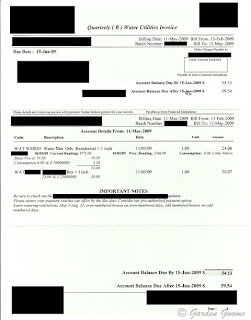
water usageWater Bill

Water plays a large part in our lives because we are surrounded by the Great Lakes. So not only do we use water for our daily living, we live on waterfront property and we use water for entertainment. We have always been concerned about water conservation and water pollution. Despite raising a somewhat larger family our water bills have always hovered between $40 and $50 per month. Our water bills consist of a charge for water consumption as well as a sanitation charge for sewage. As consumption increases so to does the sanitation charge.

According to Environment Canada, the average household uses 10 to 25 cubic meters of water per month1. One cubic meter of water equals 1,000 L or 220 gallons. So the average household uses 2,200 to 5,500 gallons of water per month. Our current water bill came in at 6 cubic meters or 1,320 gallons of water for a 3 month period or 440 gallons per month. The total cost went from an average of $33 per month to less than $18 per month. This 3 month bill was $54.13 and the previous 3 month bill was $43.88 or $16.34 per month over the last 6 months. How did we do it?

What's working for us to conserve water:

  • high efficiency front loading washer used only with full load
  • high efficiency dishwasher used only when full
  • 5 minute showers with energy efficient shower head
  • replaced boiling vegetables to steaming, less water and nicer results
  • vegetable/cooking water is saved for watering potted plants
  • left-over tea or coffee is also used to water plants
  • one toilet is a low flush model
  • rain barrels for watering gardens
  • being conscious of how we use water
One of our toilets is not low flush so will be replaced with a 4L/6L dual flush when we renovate. We further save on water costs by not buying or using bottled water if at all possible. We use refillable water bottles instead. In terms of water usage, we are likely about a low as we can get but will still look for other ways to reduce our water consumption.
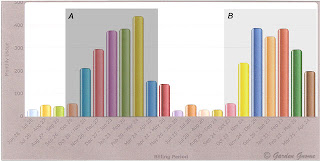
natural gas graphNatural Gas Usage Graph

We have the following natural gas appliances: outdoor grill, hot water tank, fireplace, dryer and furnace. The outdoor grill is used year round as is the dryer. The hot water tank is old so we are planning on replacing it before summer with 2 on demand water heaters. One will eliminate a long run of about 70 ft to the kitchen. The other will service the two bathrooms.

On first glance our natural gas usage graph is not all that impressive and it really doesn't look like we have changed our usage at all. In comparing A (2007-08) heating season to B (2009-09) heating season there are a couple of notables though. First you will notice in A a steady climb in natural gas used followed by a sharp decrease. In B there is no steady increase but rather a large jump in natural gas used. In the summer of 2008 we suspected a small gas leak at the meter. We called the gas company who checked it and painted the meter. They told us the meter was fine and wasn't scheduled for replacement for a couple more years. Still we suspected a problem. The first week of February 2009 the gas company called wanting to change the meter (story here) and while they never did say there was a leak I can't help wonder at the apparent jump in gas usage. The graph gives a lovely visual of our gas usage and is great for troubleshooting. If there is a spike where there shouldn't be then immediately we know there is a problem. However, the graph does not tell the whole picture.

natural gas chartNatural Gas Usage History

Highlighted in red is the 2007-08 heating season while the 2008-09 heating season is in blue. Essentially our heating season is 7 months long. Total natural gas used for the 2007-08 heating season was 1,914.657 cubic metres while we used 1,903.634 cubic metres for the 2008-09 heating season. Essentially we used 11.023 cubic metres less during the 2008-09 heating season. Well that doesn't seem like much, does it? Let's look a bit closer though.

During the 2007-08 heating season the average monthly temperature was 2.428ºC. In comparison the 2008-09 heating season averaged 1.143ºC per month. In short, the 2008-09 heating season was colder than the 2007-08 heating season yet we used less natural gas despite a suspected small meter leak! Immediately this tells me we are doing something right. All of the caulking and sealing we have done since moving here in 2007 is paying off. The tighter we get the house sealed the lower the temperature we can keep it at. The house itself is well sheltered with the main level mainly below ground making it quite energy efficient. The programmable thermostat was set to 19ºC during the day and 15ºC at night. On extra damp days we supplemented using the natural gas fireplace for a few hours. We also used the fireplace in place of the furnace on milder days, shutting off rooms not being used.

Despite these encouraging results, I feel there is still a lot more we can do. We discovered more drafts during this past heating season, some that could not be fixed until nicer weather. We are planning on adding storm doors and replacing one large window. The entire 1 foot deep wells around the lower patio doors and one large lower window will be opened, sealed with expandable foam then closed. All window weatherstripping will be replaced this spring. As always we will be sealing any cracks allowing drafts as we discover them. We will also be tackling the problem of the gas fireplace installed in the opening of the original wood fireplace but not correctly sealed or insulated. We currently put plastic up on the 3 season upper sunroom for the winter. This acts as an excellent windbreak as well as creating a solar heat sink on sunny winter days where we can open the upper patio doors letting the free heat into the house. I'm working on a few more solar ideas for heating as well so will write more on solar heating in a separate post.

Electricity: Our electric bills average $100 per month with about 56% of that in service charge and the rest actual usage. The average household uses 1,000 kWh per month. We consistently come in just under the 600 kWh per month range. Much of what we change now as far as reducing electricity usage is not going to have much of an impact in terms of kW used. The design of our house means there are lights on in the lower, main living level basically from the time we get up until the time we go to bed. They are all CFL lights in the daytime spectrum. The majority of our outdoor lighting is solar supplemented with CFL only when absolutely needed. Our range is electric and the new smoothtop cartridges are more energy efficient than the coil cartridges (story here). This will save a little for daily cooking but the key thing is every time we can save a little it is an environmental plus! At the same time we are changing a few bad habits like leaving the energy efficient main computer on 24/7 unless away. Off means 0 kW used! So we really are going in a couple of directions with respect to electricity. We are incorporating more solar inside while practicing conservation. In terms of costs with the ever increasing cost of electricity we likely won't seen much of a cost savings but what we should see is a continuing decline the the amount of kWh used.

Garden Gnome
©2006-2009


Wednesday, January 30, 2008

conserving our resources


Garden Path
Cypress House
January 16, 2008

I apologize for not making an entry sooner. Somehow with respect to homemaking aspects I had a serious case of writer's block. It's not like I didn't have ideas, I just couldn't get them to come out right in writing. So winter preparations gave way to Christmas then we were off on our winter vacation. Energy conservation is weighing heavily on my mind as so it was while on vacation so I thought I would share some of my observations and our recent changes.

We vacationed at Cypress House in Key West, Florida for part of our vacation then rented a condo at Hallandale, Florida for the remainder. There seemed to be a huge difference in terms of energy conservation. There were no CFL bulbs at Cypress House in the rooms however there was a friendly tag asking us to conserve electricity by turning it off when not in the room and there were recycling bins. They also asked that we be conservative in our use of water and re-use towels if at all possible. Walking around the area of Cypress House and Duval Street seemed dark compared to what we are used to in even smaller towns. There were street lights but the streets themselves appeared to be quite dark. Even Duval Street is not bright and glittering but more of a quiet ambiance. One reason for this is electricity is expensive and water resources are being stretched. In a region surrounded by a lot of water, water is becoming precious. This should serve as a warning to all. On our way to the Fort Lauderdale area we stopped at my husband's aunt and uncle's home on No Name Key.

Their house is beautifully located, looking very much like a home one might find in a subdivision except this house is very different. It is 100% solar and let me tell you I am in awe! Not only that under the large covered porch entrance was their water storage. This space had to be a good 10' x 10' x10' for water storage alone. Both just absolutely amazed me. Here they supplied their own electricity and water subsidizing only a bit of heat by propane as needed. So of course I looked for energy efficient appliances, CFLs and other signs of saving. Aside of using a laptop as the primary computer there were none! The washer and dryer were old (>15 yrs old) models and the fridge was a normal likely older than 10 years old. I saw no CFL bulbs but only one television instead of more. I didn't see a dishwasher or chest freezer either. What they would save in freezer costs would more than be made up in traveling to a grocery store and in fact it would likely be more expensive factoring in the traveling.

Onward to the condo in Hallandale. The condo was on the 14th floor overlooking the ocean with a view of the intercostal waters. All cars were valet parked. Each floor had a laundry room with energy efficient washer and dryers. That is where it ended. There were no recycle bins anywhere. This was a one bedroom condo with two baths. The main bath drove me completely nuts because when you turned on the lights three 150 W flood lights blared down but if you turn on both switches five of these flood lights would light up. That's 600 W total for one rather small room just for lighting! None of the appliances (all GE) were EnergyStar rated. Now this doesn't see like a real problem for one unit but given that in this building alone we caluculated there were 300 units not factoring in the common areas. This one building is a huge source of energy wastage! Now times that by the number of buildings just like this one we could easily see and that amount would increase almost by 10x. See where I'm going here? As a single family homeowner (single family) we are encouraged to save as much as possible yet a unit that could easily sit on our property with perhaps a bit of our neighbour's yet instead of an impact of two families could have an impact of 300 families and there is no incentive for those 300 families to conserve at all? It's this kind of thing that does really bother me. Conserving seems to be left up to the little guy with multi-family units and industry doing little to conserve.

Yesterday our Smart meter was installed. When fully functional we will be paying for electricity according to time of use (TOS). For the time being until the new rates become effective (yet to be announced) we are still paying the winter rate of 5 cents per kWh but when you factor in the service charges the real rate is about 11 cents per kWh. The new rates will be 3.4 cents per kWh off-peak, 7.1 cents per kWh mid-peak and 9.7 cents per kWh on-peak hours. One thing is for certain, the little guy who takes the measures to conserve will be taken advantage of by the mult-family units and industry. Mark my work on this one. While I am a bit bitter that those who use more electricity continue to do so without any seeming measures of conservation, I for one will continue to conserve and move towards the time we can move off the electrical grid.

Garden Gnome
© 2007