What does a Garden Gnome do when she is not gardening, in the kitchen or doing genealogy? Well the answer might just surprise you so read the entries to find out more. This blog focuses on everything we do to make our house a home. There will be a strong emphasis on home energy efficiency and do-it-yourself (DIY) projects. At the same time there will also be crafts, knitting and crocheting projects along with any other little tips we do to create that down to earth, I want to be here home. Please enjoy your visit :)


Showing posts with label energy efficiency. Show all posts

Tuesday, February 24, 2015

Loving Our Eclipse California Shutters

Window treatment always presents a problem when you first move into a new home.  You either have no window treatment at all or what was left behind is not to your liking.  The former owners of our home left behind vertical blinds in the kitchen, office and games room.  There were mini blinds in the master bedroom and two lower level bedrooms, and sheers on the Great Room window.  There were no window treatments on the two half circle windows or one bedroom.  All window treatment left was at best suitable for a bit of privacy until replacing.

California shutters in Great Room
We live in southern Ontario so energy efficient window treatment is a must during the heating and cooling seasons.  The uncovered half circle windows presented a bit of a problem as far as treatment but I had visions of California shutters in mind for the Great Room before we even moved into the house.  About this time last year, we had California shutters installed on the Great Room windows and half circle window over the entrance door.

We chose Eclipse 2 1/2 - inch ultra satin with gears in cotton (white).  We had them professionally installed.  They transformed the room with the clean, crisp lines.  More importantly we quickly realized these shutters were quite energy efficient.  There are ten sections on the window pictured.  Each can be controlled individually giving a lot more options than other types of window treatment. 

games room California shutters
Last week, we had the same shutters installed on the games room windows on the lower level.  These windows originally had vertical blinds with one missing vane.  Each window has four sections that can be controlled individually.  The look is clean and crisp,  amplifying the natural light into the room when opened.  They increase the privacy level and energy efficiency.  The California shutters are basically maintenance-free other than dusting.  They won't shrink, warp or fade and never need painting.

Overall, I am very pleased with our California shutters.  Not only do they look good while saving on heating and cooling costs, they have increased the value of our house!  We have one on order to be installed in the soon-to-be completed home gym and we plan on installing California shutters in the three upper level bedrooms.  When all is said and done we will have invested about $8,500 in shutters for all but the patio door and pantry window, all professionally installed.  Now, that sounds like a lot of money and it is but consider that these blinds will be saving us money year round in both heating and cooling costs AND they have already increased the value of our house.  If we average an energy savings of $30 per month, the payback period is 283 months or 23 years, not exactly good but better than no payback.  However, the payback period will actually be less than that given the ever rising cost of heating and cooling.  If we were to sell in the near future, we should recoup the entire amount of the shutters according to the realtor we spoke to.  She said the shutters should also help our house sell quicker.  I say 'should' because there are never any guarantees with real estate.  As long as we own the house, the California shutters will make our experience more enjoyable.  In short, the California shutters are more of an investment that started paying off as soon as they were installed!


Tuesday, January 13, 2015

Converting to LED Bulbs

Ontarians currently pay the highest hydro rates in Canada despite the fact that we produce natural sourced, inexpensive electricity.  Apparently our government deems it prudent to send our cheap hydro to the US then turn around and charge us premium prices, but that is a whole other story.  At any rate, our hydro rates are high.  We have always been fairly energy conscious because it is both frugal and environmentally responsible. Supplementary lighting is a necessity even if you are blessed with an abundance of natural lighting especially task and security lighting.  Lighting actually only comprises about 4% of hydro usage so there isn't a lot of savings even if not using hydro powered lighting.  The reality is every kWh not used is a good thing.

led bulb packaging showing wattage and lumens
Several years ago, I was excited to buy our first CFL bulb.  The base was big and bulky, limiting what fixtures it could be used in and at $30 was cost prohibitive to use in any number.  A few years later, smaller, spiral CFL that fit in most fixtures became available.  In comparison to incandescent light bulbs, the spiral CFL used less than half the wattage. 

Lowes had LED light bulbs on sale for $4.98 which is still more expensive than CFL but quite reasonable.  The price of LED bulbs is quickly coming down.  The key thing to look for is the lumens, the brightness of the bulb.  This will be the new value replacing wattage according to some sources.    I bought four of the 800 lumen bulbs (9.5 W = 60 W).

led compared to cfl bulbs
CFL bulbs have come down in price to as low as 70¢ per bulb and while they do save hydro, they have their own unique problems.  CFL take a few minutes to come to full brightness  They emit mercury when broken as the glass shatters in a million tiny, very sharp pieces.  CFL still don't fit in all fixtures and they perform poorly outdoors in cold weather.  Many complain there is a slight flickering to the CFL bulbs.  They can also interfere with other frequencies like garage door openers.

It's easy to see that the LED bulbs are lower wattage thus reducing hydro usage saving money.  They are by far the most energy efficient, cleanest and most eco-friendly light bulbs.  One of the CFL replaced was a 26 W bulb in the great room that is left on 24/7 when we are away.  It didn't behave nicely with the timer so we just left it on.  The three kitchen bulbs replaced were 13 W.

The LED bulbs are very similar in shape and size as the old incandescent light bulbs.  Aesthetically, they are a bit more appealing than the spiral CFL.  The A10 base will fit in most light fixtures but smaller based LED bulbs are available for specialty lighting.  LED bulbs contain no toxic materials and are 100% recyclable which is a huge improvement over CFL bulbs.  They produce little infrared light, close to no UV emissions and the operate in extremely cold or hot temperatures.  The light is instant with no warming period to reach full brightness. 

We are planning on replacing the ceiling fan in the kitchen with a solar tube.  That will be after we finish the deck.  If we put a roof on the beck, it will change the roof line so the solar tube is on hold until we decide what we are doing. 

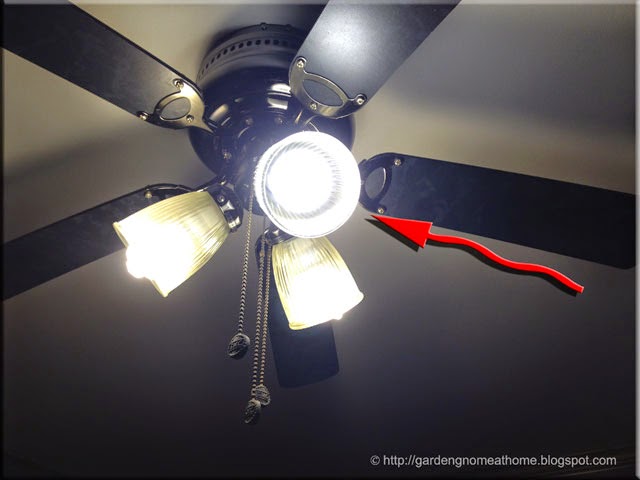
It is a bit hard to see here but the back two bulbs are CFL and the front one (red arrow) is an LED.  The difference in lighting is significant!  The LED bulbs put out a nice bright, crisp, clean light in comparison to the CFL bulbs.  They really light up the kitchen while saving us 10.5 W total.  We are getting more light for less hydro.  We have even questioned whether we still want a solar tube. 

We are replacing most of the lights in our house with LEDs.  Some are the basic ones like these while others will be part of our home automation project.  These basic LED bulbs will be moved to fixtures not tied into our home automation system.  I talk more about that system when it is up and running.  LEDs really are the way to go with respect to lighting.  The greatly reduced energy usage makes them suitable for solar applications.  They can be used with dimmers as well.  You can even get colour changing LED bulbs for use in home automation so you can simulate dawn, dusk and personalized settings.  I bought two colour changing LED strips to replace the kitchen florescent strips.  I'll  discuss that as well when they are installed.  In the big picture, we will be reducing our lighting from 4% of our overall hydro usage to less that 2% which isn't bad but the payback period will be about 5 years at current hydro rates and replacement bulb costs.


Tuesday, August 7, 2012

Energy Costs of Home Computers

My husband recently bought me an iPad so of course I had to compare energy usage to other types of home computers.  We have TOU hydro pricing so anytime we can reduce our energy usage, we do so not only for financial savings but as part of our energy conservation efforts.  I found Saving Electricity to be quite helpful.

On average the annual cost to operate:

  • typical desktop - as high as $631
  • iMac G5 20" - $5.50
  • laptop - $8
  • iPad - $1.36
  • iPhone - 25¢
I replaced the old typical desktop with CRT monitor a number of years ago with an iBook G3 which was replaced with an iMac G4 17" so the annual cost to operate the iMac is a little lower than $5.50.  We each have a laptop which costs a bit more to operate annually but offer greater mobility and they still work during power outages.  My husband has an iPhone with a data plan and I have an iPad equipped with Wi-Fi.  Both of these products offer mobility with low energy use.  All but the typical desktop can be set up to be operated on solar power or for solar charging. 

During high peak pricing, the frugal way for us to access online is the iPad or the iPhone but the iPad is actually cheaper because it connects to our router, not using up the data plan on the phone but using the iMac is rather frugal as well.  We also take advantage of charging laptops, the iPhone and iPad when traveling longer distances in the car.  Since moving into town we do a lot less traveling but charging mobile devices while traveling is cost effective.  We have essentially reduced out energy usage for home computing about as low as we can get. 

Now here is something to consider.  A lot of newer televisions are equipped to be connected to a laptop to be used as a monitor.  I know we can with our Magnavox 37" television as well as the smaller twin Phillips in the games room.   A big screen television can cost you as much as $100 possibly more to operate depending on your usage and age of television.  Using the television screen as a computer monitor adds extra energy cost for no reason if using for home computing.  The extra cost may be warranted if watching a movie or television show via computer using the television as a monitor but not on a daily basis.  However, if watching television and movies via the computer using your television meets your needs you may be able to eliminate satellite tv or cable realizing a substantial annual savings.  Just be aware if using this set up for home computing it does coast more in energy usage.


Tuesday, June 12, 2012

Levolor® PanelTrac™ Patio Door Treatment in the Kitchen

Patio doors are always a bit more difficult to choose some type of covering.  It is a big expanse of glass that can cause considerable thermal loss at night especially during the winter months and yet during the summer months the solar gain can be enough to make the room unbearably hot.  In both cases, patio doors can end up increasing your heating and cooling costs.  We had two sets of patio doors in our last house but chose not to cover them so we could enjoy the gorgeous view.  Privacy wasn't an issue and the property was very shaded in the summer so leaving them bare wasn't a problem.  We have patio doors at our vacation home with the standard vertical blinds.  This house has patio doors in the kitchen with the summer sun being problematic in the morning and one of our neighbour's windows looking directly into.  So far privacy has not been an issue.  I wanted something to lessen the solar gain during the summer while providing a bit of privacy when desired.  At the same time I didn't want the standard vertical blinds.

Levolor woven weaves totem pole panel
I decided to order custom treatments for the patio doors and the large living/dining room window.  Unfortunately, the living/dining room window treatment turned out to be a nightmare AND they brought out the wrong fabric panels for the patio doors.  Although the living/dining room window treatment remains unsettled, we finally got the patio doors finished in the panels we had ordered.  This is precisely why on any custom window treatment being installed by the company, you should never pay more than a deposit until they are installed and you are satisfied with the install. 

We chose Levolor® PanelTrac™custom made for our patio doors in woven weaves 23501 Totem Pole.  The colours match nicely with the kitchen and if you look close the colours of the rest of the house (taupe, moss green, navy blue) are in the weave as well.   Ours is a four panel, one way draw, light filtering covering.  Each panel attaches to the carrier on the head rail via Velcro strips making them easy to change and clean.  When opened with the auto wand, each panel stacks one behind the other.  Unlike the standard vertical blinds, these panels do not turn so cannot be adjust in that manner.  They simply slide back and forth.

view when PanelTrac is closed during the day
Levolor® offered a wide range of panels to choose from.  The solar panels don't completely block out the view but rather block the solar gain during the day and the heat loss at night.  The opacity is noted for each fabric so you can get panels offering no opacity to those with 95% opacity.  The higher the opacity the less you can see out or others see in. 

During the day, we can still see out somewhat but our neighbours can't see in.  This is perfect in the mornings when we are still in pajamas and sporting bed head.  They are working quite nicely to control the solar gain during the mornings.  By lunchtime, I can open them fully to take advantage of the natural light without the solar gain.

view when PanelTrac is closed at night
At night, the light filtering works in reverse so if there is a light on in the kitchen, the neighbours could see in.  However, we chose a heavy enough weave (95% opacity) they would likely only be able to see shadows, nothing clearly.  Without lights on, you can't see through them, perfect in the event of an attempted break-in and when we are on vacation.  We are used to this as the panels work very much like the SolarGuard window film we installed in one of our houses where solar gain was a huge problem during the summer months.

I really like the way the PanelTrac™ looks.  We may put a custom wood valance on it but haven't decided yet.  All around though, dealing with this particular local business has left a rather nasty taste in our mouths.  We won't deal with them again!  It took them almost three weeks to get the PanelTrac™ to what we ordered and the living/dining room (Eclipse shutters) still has the old sheers after they installed incorrectly without the necessary parts.  The shutters could not be opened and when I tried, one fell off and hit me.  I finally told them to take the shutters down and take them back.  They 'said' they would make it right but we've heard nothing from them since being home from vacation.  In case you are wondering, the PanelTrac™ cost us $680.26 plus $25 for installation.  There is a lifetime warranty against manufacturing defects and a 5 year on the panels themselves.

Garden Gnome
©2006-2012


Tuesday, December 13, 2011

Windows

We live in beautiful Ontario, Canada and own vacation property in Florida.  Windows are an odd thing.  You need windows in your home and yet if you try selling your home you won't recoup the costs of replacement windows.  Buyers expect windows but most don't care about having energy efficient windows.  That little tid bit came directly from our real estate agent.  When I was growing up we had the old double hung wood, single pane windows with wood storm windows.  The storm windows were supposed to make the windows more efficient.  Well they didn't help much but the did help I suppose.  At some point my Mom had aluminum storm windows installed.  They were a bit more efficient but not by much.  There are still many homes in Ontario that have the older wood windows with wood or aluminum storms.  They can be made a bit more efficient using caulk and weatherstripping.

Newer homes tend to have double or triple pane windows.  Our new house has double pane, energy efficient windows.  So far I have not found any air leaks.  Double and triple pane windows save on both heating and cooling costs while eliminating the work of putting up and taking down storm windows.  At the same time they greatly reduce outdoor noise from entering the house.

Our vacation home has what I basically would consider aluminum storm windows or at least that's what they would be considered in Ontario.  These single pane windows do little to buffer outdoor noise or prevent thermal loss/gain.  Our vacation home is in a very quiet resort so dampening noise is not a real issue.  What has become an issue since we bought the house is telemarketers trying to sell us upgraded windows.  I'm not kidding!  The problem is our vacation home is a manufactured home built in October of 2006, erected here in the spring of 2007.  The payback period for replacement windows at this time is not worth the expense especially when we rent the house out when we aren't there so it is either rented or empty.

Garden Gnome
©2006-2011


Wednesday, November 30, 2011

Sources of Air Leaks in a House

The cost of energy is consistently rising so energy efficiency is ever more important.  Air leaks in your home can cost you hundreds of dollars a year in energy costs and yet they are one of the easiest to remedy with low cost materials and DIY projects.  For example, a 4  x 300 ml package of 25 year durability interior/exterior acrylic caulk costs $8.97 at Home Hardware.  Simply using one of the tubes to seal cracks could save you the cost of the caulk in less than a month during the heating season.  Just imagine the savings if you used all four tubes!  Chances are good that you may not have to use all four tubes of caulk depending on how well sealed your house is already.  For example, I likely used four tubes of caulk in our third house but closer to twenty tubes in our last house, and I estimate this house will need less than four.  The difference being the age and design of the houses as well as whether the previous owner did any sealing. 

Cracks and crevices are not the only source of air leakage in a house.  Improperly weather stripped door and windows can cause a significant amount of air leakage.  Faulty seals on refrigerators or freezers can cause air to leak out of either which causes the appliance to use more energy which translates into paying more on your hydro bill.  Electrical outlets, switches, and ceiling/wall fixtures can all be sources where cold air can leak into the house.  Our hydro panel was located on an outside wall in main living area.  On a windy day, enough wind came in to move the mirror hung over it!  Fireplaces can literally suck heat air from the room, ultimately costing you more in heating costs.  Gaps around wires, cables and pipes entering the house can be a significant source of air leakage.  A gas pipe had been installed in our fourth house but had not been sealed properly allowing a gap big enough that rodents could get in!  Bell installed our satellite tv here and I specifically asked the technician if he had caulked around the cable.  He said he had but he obviously didn't as I found out the first windy day where the wind was hitting that side of the house.  Exhaust fans and clothes dryers both can let in a significant amount of cold air.  One solution to this problem is to replace regular vent covers with the Braun Eco-Vent.  This specialized insulated vent cover has a ball closure that opens to allow exhaust air out but seals when not in use to prevent cold air from entering the vent.  Your HVAC ductwork may have seams and joints that aren't sealed causing the loss of hot or cold air when in use.  Seal any you can with aluminum foil duct tape.

It is possible to use temporary air leakage blockers such as door snakes, removable caulk, heavy quilts or blankets, towels, shrink plastic, and cardboard secured with removable tape.  These are ideal when you discover a bad air leak that can't be immediately repaired.  For example, today it is extremely windy with driving torential rain.  I discovered the range hood that desperately needs replacing is pouring in very cold, damp air.  I taped a piece of carboard to the filter just to stop the cold air from coming it.  It is only a very temporary measure that quickly solves the problem until the wind dies down and obviously one that can't remain if using the stove.  What this means though is the flapper on the range hood that prevents cold air from entering the house is broke.  Since we are replacing the range hood the problem will be solved anyway.  If using a temporary blocker, do not create a fire hazard or block exit routes from your home in the event of an emergency. 

Before embarking on sealing your house, be aware that a house can be sealed too tightly creating problems with indoor air quality and the proper operation of combustible appliances (eg. gas fireplaces, gas furnace, gas water heater, gas ranges).  Be sure all combustible appliances are venting properly before and after sealing.  Under normal daily activities, there should be enough fresh air entering a house via outside door during entry and exit.  A tightly sealed house may require an air exchanger.  Our new house has a Lifebreath HRV (model 150Max) that is set on a 40/20 cycle.  For twenty minutes each hour the HRV brings in fresh air from outside while exhausting stale air.  Also be aware that in tightly sealed homes it is even more important to avoid using toxic household cleaners and anything containing VOCs (eg. some paints, household cleaners).  It is important to use controlled air exhaust (eg. range hoods, bathroom exhaust fans, HRV,) methods to reduce indoor air pollution, ensure sufficient fresh air entering the house and to ensure combustible appliances have ufficient oxygen for proper operation.  It is a good idea to have an air pressure test done on your home before and after sealing as well as have any combustible appliances checked for proper venting before and after sealing.

Garden Gnome
©2006-2011


Tuesday, November 9, 2010

A Few Tips For Saving on Electricity

I have been focusing on our use of electricity over the last few posts.  The reason for this is many in Ontario are having a hard time adjusting to the new TOU pricing combined with the additional HST of 8% that has brought hydro bills to a total of 17% higher.  The TOU pricing per kWh is 5.3¢ off-peak, 8¢ mid-peak and 9.9¢ on peak.  The reality is the cost per kWh is only 43% of the total hydro bill so the actual cost per kWh is more than double the stated cost.  In short during on-peak hours the actual cost per kWh including all the service charges is 23¢.  Hydro One Networks gives a few pithy tips for conserving electricity like running the dishwasher and washer during off-peak hours.  If you run the dishwasher during off-peak hours you will save 17¢ and if you run the washer during off-peak hours you will save 5¢.  Quite frankly this is not much of an incentive to alter your daily routine and it certainly will not make much of a difference in the additional 8% due to the HST.  There are however a few more ways I've discovered to help save a little electricity.  None by themselves will are enough to cover the $8 in HST on an average $100 hydro bill but every little bit does help.

  • dishwasher - While the savings is only 17¢ per load by switching to running the dishwasher during off-peak pricing the average family with 5 loads per week will save 85¢ per week or $3.40 per month which is a good chuck of savings towards what the HST costs.
  • washer - Switching to off-peak hours saves 5¢ per load.  An average family at 5 loads per week saves 25¢ or $1 per month.
  • furnace -  I have been taking advantage of the milder weather by using the gas fireplace during the day which stops the furnace from coming on.  Currently natural gas is considerably less expensive than electricity so I'm saving there as well as not paying for the furnace fan to run.  Ideally, our plans are to switch the furnace fan to solar which will eliminate any electricity being used by the furnace.
  • off is better than on - I have gone through the house unplugging anything that doesn't need to be plugged in.  The premise is off is better than on and unplugged is even better because there can be no phantom electricity use.
  • timed, auto-shut off and programmable appliances -  Years ago I went to an auto-shut off iron and curling iron.  The nice thing about auto-shut off is these appliances shut off automatically removing the threat of overheating.  I also experimented with home automation and while the system itself does use trickle electricity the money it saves outweighs the cost.  This house due to design does not warrant using home automation so I have all my modules safely tucked away for the next house.  Timers and programmable appliances are a must with the new TOU pricing especially small kitchen appliances.  My largest slow cooker has been slowly dying so I replaced it with a programmable, auto-off model bought on sale of course.  I now know this appliance will not be on any longer than absolutely necessary and it will turn off by itself if I happen to forget.
  • being conscious - I'm paying attention to the TOU pricing that is currently in the winter cycle meaning the on-peak hours (highest cost) are from 7 AM to 11 AM and 5 PM to 9 PM during the week.  The morning hours are easy to reduce electricity usage since we seldom have a hot breakfast during the week and the most we have on extra is the percolator, a few CFL lights due to the layout of our house and my iMac (energy efficient).  The evening hours are a bit more difficult to adjust what with cooking dinner and the television on but I'm making a few cutbacks there as well.  The busiest of the canning season has passed as well so I have been able to switch canning sessions to off-peak hours usually on the weekends.  I should be able to get through most of the winter using this strategy but in fairness I save so much by canning that if I had to run the canners during on-peak hours I would without thinking twice.  The same can be said for meals cooked at home.  The only thing I've cut down a bit on is dehydrating via electrical means.
Garden Gnome
©2006-2010


Saturday, July 3, 2010

Replacing a New Light Fixture

On March 30 I posted about replacing the light fixture over my desk.  It was an easy DIY project.  The beveled fixture was aesthetically appealing perfect for adding a bit of pizzaz while trying to sell the house.  Despite the fact that the fixture used 25 W specialty bulb at a cost of $3.99 for 4 we went ahead and installed it.  The layout of the house means lights are on most of the time on the lower level that is the main living area and mostly underground.  The first week we went through 4 of the bulbs.  Thinking it was just a fluke we bought more bulbs and replaced the burnt out bulbs.  We replace bulbs again before going on vacation mid-May and again in June.  Finally I had enough!  First we were spending more in kWh just to have this light on but the price of replacing bulbs every other week was getting rediculous!

new CFL fixture
A couple of days ago we picked up an eco-friendly light fixture to replace the fixture we had installed in March.  We opted for a more utilitarian fixture that would hold CFL bulbs.  We put two 14W CFL bulbs  for a total of  28W compared to the 100 W of the other fixture so we are saving at least 72W when the light is on.  The reality is had we not replace this fixture in the first place for resale value we would have put an energy efficient fixture in instead of a fluff fixture.

I love the new fixture! It is energy efficient, low cost to operate and has an excellent light output.  The two CFL bulbs put out the same light as two 60W bulbs.  It's nice and bright without costing a lot of money to turn on and I fully expect to get a good 5 years worth of use out of the CFL bulbs in comparison to the under 2 weeks for the 25W designer bulbs.

Garden Gnome
©2006-2010


Friday, May 7, 2010

Home Energy Audit in Ontario, Canada

In Ontario there are* were two homeowner retrofit programs providing rebates for improving home energy efficiency in an effort to help conserve energy.  In order to qualify the home must be a single family home and have a home energy audit conducted by a certified home energy advisor whose company is licensed by Natural Resources Canada.  A home energy audit is a detailed survey of your home's energy use.  It includes an attic to basement assessment of your home's insulation, heating and cooling systems as well as other energy uses.  It also includes a blower door test to detect air leaks and drafts as well as a personalized Energy Efficient Evaluation Report with recommendations on how you can improve your home's energy efficiency.  Many of the recommended energy-saving upgrades identified for the Government Canada’s ecoEnergy program* and the Ontario Home Energy Savings Program retrofit rebates.

In this short video by the Ontario Ministry of Energy and Infrastructure energy advisor Vince Hughes walks homeowner Sheilah Doherty through her home’s comprehensive home energy audit.  Energy leaks found in the home are highlighted. 


Even without the available rebates, having a home energy audit done is a good idea.  Most homeowners know there is room for improvement when it comes to energy efficiency and conservation.  They also know the major retrofits needed.  For example we know the furnace is old but it is efficient and we were told not to replace it until it dies given the condition.  We also know the hot water tank needs replacing which we are planning to do if we decide to stay here.  A home energy audit can help identify those little air leaks and other problems you might overlook.  At $300 it is a worthwhile investment in your home.

*On March 31, 2010, the federal government suddenly and unexpectedly announced funding cuts to the ecoEnergy Retrofit Homes Program. It is unknown if the program will be re-instated and how it will affect the Ontario Home Energy Savings program.  At this time the Ontario government continues to pay a $150 rebate for a home energy audit and provide up to $5,000 in rebates.

Garden Gnome
©2006-2010


Tuesday, May 4, 2010

Compact Fluorescent Light Output Equivalency Chart


Compact fluorescent lights (CFL) have changed dramatically from the early days of large ballasts that would only allow the bulbs to fit into certain style fixtures.  Not only are the ballasts small the lights themselves are compact and come in a variety of shapes for both indoor and outdoor use.  The lights CFL spiral bulbs are available in a range of wattages and light outputs (lumins) ranging from cool natural light to soft white light.  They are even available in red, green, blue and yellow!  Where you use these bulbs really determines the type of light output your want.

Pictured is the light output equivalency chart for CFL bulbs.  My rule of thumb is to go to lower wattage where possible so most of our bulbs are in the 9 - 13 W range equivalent to 40 W incandescent bulbs.  Notice that both 9 W and 13 W CFL put out the same lumins?  There is no difference in light output to go to 13 W if a 9 W bulb is available and going to 9 W saves 4 W in energy use.  Given the design of our house (main living area including kitchen below grade) I use 15 W CFL bulbs on the lower level because it does need the extra light.  The colour of the light output does make a difference.  The softer lights tend towards a yellowish tone.  I switched out the lower level soft white CFL for daylight CFL and what a huge difference it made.  The light is cleaner and crisper. 


Garden Gnome
©2006-2010


Sunday, October 25, 2009

The Ultimate in Winterizing Water Pipes

Sometimes winterizing involves closing up a house or cottage for the winter months and this is typically the time for doing that winterizing. When it comes to dealing with winterizing there really are two options available. The first is to leave some type of heat source on or use a pipe heater and hope there is no power failure. This option has the downside of costing money while the house or cottage is not being used as well as the possibility of frozen pipes that could lead to considerable damage if they burst. We had our pipes freeze at one our previous houses and I will tell you that definitely was not a lot of fun. The second option is to shut off the water and blow out the lines with pressurized air. The former owner of this house chose to put in a multi-shutoff water system so the house could be shut down for the winter months.

multi-shutoff water systemMulti-Shutoff Water System

Pictured is our multi-shutoff system. The green arrow is the in house water meter. When we moved in there was an outdoor sensor for reading it but they have since changed that out for an indoor sensor that they can read from the main road! This system looks a bit more complicated than it is. Basically each faucet in the house has both a hot and cold water shutoff as does the washer. Each toilet has a shutoff as does the outside water taps. Some are knows while others are levers. The top main with the red knobs is hot while the bottom with blue knobs is cold. Some of the knobs are hooked to nothing so the system can be expanded.

We are not currently using the multi-shutoff system for winterizing purposes. A huge benefit to this type of system is when we are working on anything water related we can simply turn the water off to that faucet using the centralized system. There's no need to turn off the supply to the entire house something that many do not appreciate until they have done plumbing in your home or had a plumbing problem. Basically the water is shut off to only the pipes you are working one with this system. The downside of this system and this is specific to this house is the hot water has to travel about 70 feet to get to the kitchen. Our work around for this is we are planning to install an under the counter electric tankless water heater in the kitchen to service the sink and dishwasher. This will eliminate the long run decreasing energy wastage. The water heater tank that services the rest of the house will be changed out for a natural gas tankless water heater. The tankless water heaters will end up be eco-friendly while letting us enjoy a bit more energy efficiency.

Garden Gnome
©2006-2009


Tuesday, August 18, 2009

Why Install a Broan® EcoVent?


Broan® EcoVent
August 16, 2009

One question immediately arises with the final installation of our Jenn-Air® down draft system and that is why use a Broan® EcoVent? In the winter of 2006 we installed our Jenn-Ai® slide in range (more on my range here) with down draft system in our previous house then moved it here in June of 2007. At the same time we installed our front loaders in the old house in February 2007 and also moved them here. All three appliances are high efficiency appliances but what we noticed as a flaw was the venting on both the dryer and the range. Both had regular vent covers. Cold air despite everything we did came back up through the vent! I actually resorted to placing a folded up towel over the down draft grate of the range.

When we moved here we looked for an eco-friendly, energy efficiency dryer vent (more here) and found it in the Broan® EcoVent. This is a Canadian made vent cover designed for Canadian winters. It is larger than regular vents because it is insulated preventing cold transfer. It has a unique floating ball check valve that prevents back draft as well as insects entering and the design also prevents rodents from getting in. It definitely solved our dryer vent problems. I decided I wanted this vent for the Jenn-Air® down draft even though it meant reducing the air flow from 5" to 4". The problem is and there has been complaints over the vent cover meant for the Jenn-Air® down draft ranges which includes both back draft and rodents getting in. We live on water front property so rodents are a huge concern! We also live in Canada so cold back drafts is a major concern in terms of energy efficiency. Reducing the air flow but using an energy efficient vent cover made a lot of sense. First the reduction would actually create a stronger flow of air from the range increasing it's efficiency. Second using this vent cover virtually eliminates the back draft and rodent problems making this vent cover an extremely eco-friendly choice for the down draft system. It meets all of our needs as well as providing energy efficiency!

Garden Gnome
©2006-2009


Wednesday, April 29, 2009

The Changing Faces of My Stove

I do a lot of cooking and canning so it comes as a surprise to some that I don't have professional style gas burner range. There's really a couple of reasons that boiled down to space limitations and wanting something different. In late 2005 we bought a new but almost stripped Jenn-Air JES9860AC downdraft slide-in range that needed several additional parts including grill cartridge, burner cartridges and the downdraft system. We did a bit of research after seeing it to find out what the parts would cost and went back the next day buy it. What I really like about this stove is parts are easily available for DIY repairs. Despite having to buy parts we ended up with an excellent customized kitchen stove considerably cheaper than if we had bought it fully ready-to-use. We bought most of the replacement parts online through RepairClinic. We ordered the cartridges and big burner element through a local appliance store. The stove was not fully installed until January 2006. A little over a year later we moved here and brought our range with us.

Jenn-Air JES9860ACEnergy efficiency is a high priority for us so one selling feature of this stove was the large capacity convection, self cleaning oven with 3 adjustable racks. The annual cost to run the self clean cycle is less expensive than oven cleaners. The self clean function does not use toxic chemicals or contribute to land fills so it is an eco-friendly choice. An optional half oven rack is available that I will add at some point. Another selling feature was the downdraft system (centre vent) that is capable of moving a lot of air allowing even smokeless indoor grilling. The downdraft system is attached to the floor and vented to the outside via flexible metal vent pipe. This means the range cannot simply be pulled out and makes installation a bit trickier because the stove has to be lifted up and over the downdraft system then attached to it. There is no storage drawer under the stove but the cover can be removed to empty the grease cup for the grill as well as accessing the downdraft system. If you decide to sell your house and want to bring your range with you, you will have to have that included as an exemption in the listing because it is attached.

Pictured to the left is the 1427 W grill cartridge with a custom made wood cutting board one of our kids made for me. The cutting board gives me a bit of extra horizontal space when needed. The two burner cartridge to the right has an optional specialty 2100 W big pot element (A145A) that is interchangeable with the regular 2100 W large coil element and a small 1250 W element. Already you can see how I can do a bit of plug and play.

Jenn-Air cartridgesThe big pot element is used when I'm canning or using similarly large sized pots and pans (1). This element is reinforced to handle the extra weight and it is raised to prevent radiating heat build-up under the larger pots that could damage the surface area and cause premature failure of the cartridge. The grill cartridge is normally covered unless in use (2). If I am doing a larger dinner where all four elements may be needed I can put in the other coil cartridge (3). Just recently I decided to buy the glass-ceramic cooktop radiant cartridges (A122). They are rather expensive but I was able to find two for almost the price of one online at Appliance Zone. Compared to the coil cartridges, the radiant cartridges (4) are quite impressive looking! The ability to plug and play with the cartridges allows me to have a customizable cooking experience with very little effort.

Jenn-Air radiant cartridgeI wanted the radiant cartridges for ulterior motives as smoothtop ranges always look so sleek and clean. The whole issue of dirty or stained drip trays is totally eliminated! We couldn't use a smoothtop because of the canning I do. The radiant cartridges are a way to get the look for those times I want it.

I love the look of the new radiant cartridges! Aren't they gorgeous? The large element is 1800 W while the smaller element is 1200 W so both less wattage than the coil elements. This means a bit of kW savings right there. I quickly found I had to change my cooking style using the radiant cartridges as they are instant heat and they take awhile to cool down. This means the burner can be turned off sooner while the food continues to cook on the residual element heat. Another energy saving feature is the elements cycle on and off on all but the high setting. So for normal daily cooking I will be using less kW!

If I ever had to buy another stove which I hope I never do, this is exactly the way I would do it again. Simply being able to customize the stove as I choose according to what I am cooking at the time is a hugh plus. Knowing that parts are easily available for DIY repairs is nice too. This eliminates worrying about after warranty repairs. It also allows you to buy a few spare parts to keep on hand for emergency repairs.

Garden Gnome
©2006-2009


Sunday, January 25, 2009

Solar Tube (Alternative Lighting)

Lighting is an integral part of any home. It creates ambiance as well as allows the you to enjoy your home the way you want. At the same time lighting has created environmental concerns through rising energy usage of the incandescent light bulb that has now ceased being manufactured. Incandescent bulbs use a considerable amount of energy while adding heat to the room, something that is undesirable. In short incandescent bulbs were not energy efficient bulbs even though they were cheap. Fluorescent tube lights are cheaper to operate but not aesthetically as nice although I have seen some nice applications creating diffused wall lighting and lighted ceilings. When the first CFL bulbs came on the market they had bulky transformers in the base that prevented these bulbs from being used in all light fixtures but it was a start. Now CFL bulbs come in all shapes, sizes and types of light. They are inexpensive to buy and considerably less expensive to operate than the old incandescent bulbs. What we are seeing now is a trend towards solar with the most advances being made in outdoor solar lighting. It's incredibly inexpensive to set up outdoor solar lighting and requires little or no tools. Just coming onto the market but still a bit to expensive and needs fine tuning yet are LED bulbs that fit a normal light socket yet will use even less energy than CFL bulbs.

Our main living area is mainly below ground with one wall facing the water that opens onto the backyard. Natural light is at a premium outside of the kitchen and front part of the family room. In the summer the shade trees that save us so much on cooling keep the main level darker than it would be if located on the upper level. The design of the house means that even during the summer we have lights on during the day to prevent the main level from feeling like it is mainly below ground. We have 7 CFL 15 watt daylight bulbs on during the day most days that if on for an average of 10 hours per day cost us 6.4¢ or $23.44 per year. IIn addition to this we have various CFL lights on the main level that are used as needed. While this is a necessary cost due to the house design and while we make up for it in reduced heating and cooling costs, I'm always looking for ways to reduce our energy consumption for lighting.

Solar Tube
image source: Solar Tube Daylighting System

I think it was three houses ago (about 12 years) that I first saw this solar lighting called a Solar Tube. I've wanted one of these ever since I saw it. A solar tube gives you all the benefits of a skylight without all the problems. The principle is quite simple. A small dome allows light to enter into a highly polished pipe where it is amplified by bouncing off the mirrored surface and reflected into the house. To soften the light on the inside there is a diffuser. On the outside of the house there is little to see other than a small, clear dome on the roof. On the inside of the house the finished light looks like a larger flush mount pot light. Once the solar tube is installed which can be a DIY project there is no further cost of operation. You get beautiful, bright natural light in your home without costing anything! Environmentally this is a wonderful way to get that extra light without increasing your carbon foot print.

Solar Tube Installed

We just spent a lovely week away in the sunny south. The first house we stayed in was the guest house. The second was a rental house in the same resort. You can read more about the resort here and the food here. The rental house was a triple wide, manufactured home that gives a whole new meaning to trailer living! What caught my eye was two solar tubes, one in the guest bathroom and the other in the kitchen. Pictured is the kitchen with the red arrow pointing at the solar tube. As you can see it blends right in with the recessed lighting. What was very impressive was the amount of light the solar tubes let in even on cloudy days!

I really liked the solar tubes. They made both rooms quite bright and airy feeling. I think it would be great to be able to tone down this brightness if need be as they were quite bright even though it was cloudy outside. My husband could not quite get over the fact there is no switch to turn the thing off. I guess it was a mindset thing turning off the lights but there is no switch for the solar tube. There is a way to shut it off using the same type of mechanism as a camera lens if you install that option. Then you simply shut the shutter that might be a benefit on really sunny days.

Installing solar tubes are on my list of do the research this spring and possibly installing one early summer. Ideally I can find three spots that would be good for the solar tubes but only one location for sure will lend itself to the installation for on the main level. If installed it will not eliminate all 7 lights but possibly 4 of the lights. A total cost of installation from the prices we have seen doing it ourselves would be about $500 making the total payback time about 37 years. As an energy saving device the payback doesn't really warrant the change other than knowing once installed it will not cost anything. So this ends up being an aesthetic, decor type of improvement that will save your money but in terms of energy use you might not recoup the costs. The solar tubes are EnergyStar® rated so there may be rebates available offsetting at least the sales tax. At best this improvement will improve the enjoyment of your home and while it will save you money over the years, it is likely best to look at it as a decor enhancement.

Garden Gnome
©2006-2009


Tuesday, December 2, 2008

Analyze Your Energy Consumption

When I was growing up we heated with two radiant natural gas heaters on the main floor. Heat rose to the upstairs through a vent in the floor. During the winter months the bedroom windows were iced over and many a morning a scorched by toosh sitting on one of the heaters to warm up enough to get dressed. When we got married we lived in an apartment where heat and electricity was provided but the seeds of being energy efficient had already been firmly implanted. We were young when we bought our first home that was heated with wood as was our next home. The next house we bought was heated by forced gas as was the next one. This house and likely our last is also heated by forced gas.

When we moved here in 2007 we were a lot wiser as far as saving energy and resources. The design of the house meant it would be cheaper to heat The first thing I did was set up a file to track our electric, gas and water usage. Within days the caulk guns were in high gear and most of the lights had been changed out for compact fluorescent bulbs. All of our major appliances are higher end EnergyStar® rated so there would be no further savings that way. The computer and laptop are also energy efficient so short of leaving them off, there would be no further savings. The house itself is brick with the main living area on the lower level mainly below ground. The lower walls are 12 inch thick for most of the living space. The windows are older Dashwood® double pane and are in good condition. The furnace is a Clare MegaSave I that has a secondary heat exchanger that saw very little use other than in the fall as the former owner shut down the house to vacation in the sunny south during the winter. The hot water tank is a 40 gal standard gas tank that while older would not warrant changing out because of its condition. We also have a gas fireplace, gas dryer and gas outdoor grill. We put plastic up on the upper level sunporch that serves as an excellent windbreak on that upper level wall.

I spent some time on the PowerSaverPlus website today. This is an excellent online resource for users of HydrOne in Ontario, Canada. Through a series of questions this calculator determines your annual cost of energy use by appliances and gives you a comparison of how your home energy use is in relation to similar homes in your area. The nice thing about this calculator is it takes into consideration both your electricity and natural gas usage. Other energy sources such as wood and heating oil can also be factored in. The site then analyzes how you are using the energy resources and give you tips as to where you can save more money. The tips include an estimated cost to complete that recommendation as well as the projected savings so you can focus on those modifications that will have the greatest impact on reducing your energy consumption. You can calculate the pay back period for the modification from this information. A surprising number of the tips cost nothing other than effort to put into action.

Note: The following two graphs courtesy of PowerSaverPlus are from the energy analysis I did for our house today.

Monthly Energy Cost Comparison

The calculator assesses your energy usage base on the information you give it. For best results you will need the last 12 months for electricity and gas bills. The electric bill will give you a kWh and an adjusted kWh number. Use the adjusted kWh as that is what Hydro One determines you use. Enter each month into the calculator. Now look at the natural gas bill and it will give you an amount of gas you used in cubic metres. Enter each month of that into the calculator. When both sets of numbers have been entered press next then go to the section for appliances and fill that out. The last section is for tips or you can hit report. The report will give you this graph and the following graph but on the home page when you log in again you will see a pie chart of your energy usage breakdown and a linear chart for similar home comparison in dollars.

The monthly energy cost compares your energy usage to similar homes in your area. As you can see we (pink) use a fair amount less energy than similar homes (purple) in our area. On the home page our comparison chart shows we are just over the half way mark by about $20 of what others use in our area. That means we are basically using half the electricity and natural gas than others are using. This data does have to be used as only a guideline. Houses differ in energy usage based on location, insulation and how well they are sealed as well as the personal comfort levels of the residents. Identical houses can vastly differ in all these factors even if they are side by side. So this chart is best used to note the trends.

First we are well under others most months for energy use but look at January to March. When others were decreasing their overall energy use ours was increasing. I'm still trying to figure out why and can't recall anything major that would have caused the increase overall energy use. One explanation with us being in a rural area is the metres were estimated instead of being read resulting in a bit of catch-up that skews the graph.

Annual Cost Appliances

The annual cost of energy use by appliances is a very useful graph. At a glance is gives you a visual as to where you are using the most energy. That is where you should put the greatest effort to reduce. However, when answering the questions it doesn't give you the options to indicate how long a particular appliance is on. For example it would appear our AC costs are second to heating but that is not the case. This past summer our AC was on for about a total of 5 days because we only put it on when the heat and humidity levels get too uncomfortable. Our main living space is mainly below ground so is naturally cool in the summer greatly reducing the need for using the AC. I also think the computer energy usage is not accurate as they are both very energy efficient and one is only used occasionally. Something that isn't showing in the energy usage is the hot boxes - satellite receivers, adapters, router, and those types of things that are plugged in all the time using energy 24/7.

At the end of the analysis I printed off the 8 page report for our energy files. We are at the point where there is very little major to do to reduce our energy consumption. There are several minor things to do that will save energy. We will be focusing on the following points for energy reduction over the next couple of weeks. You will notice that some of the most commonly recommended tips are not on the list. That is because they have already been completed or in some cases as the dryer vent the recommendations have been exceeded. Other things like air sealing is an ongoing process that you need to be doing year round.

  1. turn computer off at night - This really is not going to save us much but if it ends up being 10¢ per day for the computer, router and satellite box in energy savings it would be an annual savings of $36.50.
  2. seal air leaks in ducts - This is an inexpensive, DIY task that has the potential to save $70 to $117 per year. It pays for itself in well under one heating season
  3. install heat traps in hot water tank - This is another inexpensive, DIY project that can save $45 to $75 per year. It pays for itself in about 3.5 years.
  4. install low flow shower heads - This is a very inexpensive, DIY project that can save $13 to $22 per year in energy savings but at the same time they save on the amount of water used.
These types of energy calculators are extremely beneficial. While they cannot possibly give you a 100% analysis, they can give you a fairly good idea of where your energy dollars are going. At the same time they can give you tips for how to improve your energy consumption. There is no charge for the service either so you can update and reassess your progress as often as you would like.


Garden Gnome
©2006-2008


Friday, November 14, 2008

The Dryer Vent Dilimna

If you have been following this blog you will know that we bought this house in 2007 so last winter was our first winter in this home. All of our renovations for this home are reflective of the importance of saving energy. As with the other homes we have owned the first priority was sealing to make the house more energy efficient. In today's economy this is even more important in terms of energy savings but this is not the only reason. It is very important to do whatever we can to reduce our carbon footprint.

Our laundry room is in between the family room and furnace room on the lower level of the house. Last winter I noticed that our gas dryer was abnormally cold when not in use. Since our dryer was less than a year old and an energy efficient model I knew the problem had to be the dryer vent. The dryer vent is not exactly in a convenient location but once we remove the brush it will be fine. Upon investigation we found an old dryer vent cover that was very brittle with half of the cover missing and the flap barely working. This vent cover obviously needed to be replaced but we wanted to do an energy efficient replacement.

A quick online search showed us that there were energy efficient vent covers on the market. We opted for the Broan® EcoVent because of its design and the fact that it was Canadian made. Our winters are cold so we felt that a Canadian company understood the problem that normal vent covers tend to be drafty. At the same time while some are designed to keep rodents and larger insects out, smaller insects can still get in.

Pictured is the Broan® EcoVent as compared to a normal dryer vent cover (1, 2, 3). The first thing you will notice is the size. The EcoVent is larger because it is insulated and the plastic is heavier! That means there is a lowered conduction of cold air from the vent cover to the duct. The second thing you will notice is the ball (1, 3). The floating ball check valve creates an airtight seal with no back draft. When the dryer is turned on the exhausting air will cause the ball to float up, opening the vent so the air can exhaust outdoors. When the dryer is finished exhausting the ball will fall back into its resting position preventing air leakage. Unlike other vent covers the Broan® EcoVent is noiseless even in strong winds so you won't hear any flapping either. We also opted to change out the existing vent pipe for a thicker walled one (4) meant to go with the Broan® EcoVent but this was optional.

The first step for preparation was removing the remaining vent cover and the existing vent pipe. This was actually a bit more work than anticipated. We used a large flat head screw driver to bend the pipe on the outside and on the inside then tapped it out. We were left with a clean opening outside and inside.

After the old vent cover and vent pipe were removed we cleaned up the old caulk from the outside wall. Inside there was very little clean-up but you may find a bit more clean-up if you decide to do this project. There should be no caulk on the inside wall around the vent exit. The reason for this is practical both in terms of access and redecorating. Instead the vent cover should be properly caulked on the outside making it airtight.

Our installation was on an existing concrete wall just above grade. Now ideally with our snowfall this is not the best location however, this is in a very protected location that has very little snow accumulation. In locations where snowfall could be a problem the dryer vent should be located at least 3 feet above ground level. My husband drilled pilot holes in the concrete (5). The vent pipe was put into the vent cover, secured with self tapping screws and then sealed with caulk. Then a heavy bead of concrete caulk was placed around the inside perimeter of the vent cover (6). The vent cover was attached to the vent opening using concrete anchors (7).

The installation resulted in a clean and neat outside appearance. In our location it really wouldn't have mattered what the installation looked like but really if you are going to do it, do it right. Make it look neat and tidy even if you are the only one who will ever see it. On a scale of 1 to 10 this project would rate a 10 as far as easy installation for anyone with the proper tools. In respect to energy savings this project would rate a 9 or a 10 depending on the location.

Garden Gnome
©2006-2008


Wednesday, January 30, 2008

conserving our resources


Garden Path
Cypress House
January 16, 2008

I apologize for not making an entry sooner. Somehow with respect to homemaking aspects I had a serious case of writer's block. It's not like I didn't have ideas, I just couldn't get them to come out right in writing. So winter preparations gave way to Christmas then we were off on our winter vacation. Energy conservation is weighing heavily on my mind as so it was while on vacation so I thought I would share some of my observations and our recent changes.

We vacationed at Cypress House in Key West, Florida for part of our vacation then rented a condo at Hallandale, Florida for the remainder. There seemed to be a huge difference in terms of energy conservation. There were no CFL bulbs at Cypress House in the rooms however there was a friendly tag asking us to conserve electricity by turning it off when not in the room and there were recycling bins. They also asked that we be conservative in our use of water and re-use towels if at all possible. Walking around the area of Cypress House and Duval Street seemed dark compared to what we are used to in even smaller towns. There were street lights but the streets themselves appeared to be quite dark. Even Duval Street is not bright and glittering but more of a quiet ambiance. One reason for this is electricity is expensive and water resources are being stretched. In a region surrounded by a lot of water, water is becoming precious. This should serve as a warning to all. On our way to the Fort Lauderdale area we stopped at my husband's aunt and uncle's home on No Name Key.

Their house is beautifully located, looking very much like a home one might find in a subdivision except this house is very different. It is 100% solar and let me tell you I am in awe! Not only that under the large covered porch entrance was their water storage. This space had to be a good 10' x 10' x10' for water storage alone. Both just absolutely amazed me. Here they supplied their own electricity and water subsidizing only a bit of heat by propane as needed. So of course I looked for energy efficient appliances, CFLs and other signs of saving. Aside of using a laptop as the primary computer there were none! The washer and dryer were old (>15 yrs old) models and the fridge was a normal likely older than 10 years old. I saw no CFL bulbs but only one television instead of more. I didn't see a dishwasher or chest freezer either. What they would save in freezer costs would more than be made up in traveling to a grocery store and in fact it would likely be more expensive factoring in the traveling.

Onward to the condo in Hallandale. The condo was on the 14th floor overlooking the ocean with a view of the intercostal waters. All cars were valet parked. Each floor had a laundry room with energy efficient washer and dryers. That is where it ended. There were no recycle bins anywhere. This was a one bedroom condo with two baths. The main bath drove me completely nuts because when you turned on the lights three 150 W flood lights blared down but if you turn on both switches five of these flood lights would light up. That's 600 W total for one rather small room just for lighting! None of the appliances (all GE) were EnergyStar rated. Now this doesn't see like a real problem for one unit but given that in this building alone we caluculated there were 300 units not factoring in the common areas. This one building is a huge source of energy wastage! Now times that by the number of buildings just like this one we could easily see and that amount would increase almost by 10x. See where I'm going here? As a single family homeowner (single family) we are encouraged to save as much as possible yet a unit that could easily sit on our property with perhaps a bit of our neighbour's yet instead of an impact of two families could have an impact of 300 families and there is no incentive for those 300 families to conserve at all? It's this kind of thing that does really bother me. Conserving seems to be left up to the little guy with multi-family units and industry doing little to conserve.

Yesterday our Smart meter was installed. When fully functional we will be paying for electricity according to time of use (TOS). For the time being until the new rates become effective (yet to be announced) we are still paying the winter rate of 5 cents per kWh but when you factor in the service charges the real rate is about 11 cents per kWh. The new rates will be 3.4 cents per kWh off-peak, 7.1 cents per kWh mid-peak and 9.7 cents per kWh on-peak hours. One thing is for certain, the little guy who takes the measures to conserve will be taken advantage of by the mult-family units and industry. Mark my work on this one. While I am a bit bitter that those who use more electricity continue to do so without any seeming measures of conservation, I for one will continue to conserve and move towards the time we can move off the electrical grid.

Garden Gnome
© 2007


Wednesday, November 14, 2007

Winterizing Project #4 - Door Snakes

Door thresholds can be chilly even if the door is well sealed and insulated. Not only does cold air fall to the threshold area, thresholds are often made of metal that is a good conductor of cold. The simple solution to this problem is a door snake aka draft stop. I prefer to not call these draft stops because ideally there will not be any drafts around the door or at the threshold.

Door snakes can be purchased to fit average sized doors. Some are plain Jane but there are some really cute ones that have faces on or are made to look like animals. However, finding door snakes for patio doors or off sized doors can be a problem. The easiest solution is to make your own. That way you will have a custom made door snake that meets your needs.

Method

This is an ideal project whether you own your home or are renting. It is one of those things you can easily take with you when you move. The first step is to measure the spot where you are putting the door snake (1). If it is an inside application as here, add 2 inches to the end plus the seam allowances to give a bit of bend to fit both doors. If the application is for a single door, measure from the edge of the trim furthest from the door. Cut a length of fabric this length and 16 - inches wide. Fold the fabric in half along the long side.

You will need a sewing machine for this project. Mine happens to be a very loved, well maintained, older Brother (2) that my Mom gave me for my thirteenth birthday. It works as well as the day I got it. The only thing that has changed is the skill of the user! Start at one open end and working along the long side, sew a seam 5/8 - inch wide (3), reinforcing at each end. Repeat along the bottom open end and up the remaining long side. Cut across from the short end to the long end about 1/4 - inch from the reinforced corners to reduce the seam bulk when you turn the tube. Turn the tube and fill leaving about 2 inches. Turn 5/8 - inch inwards. Sew the end closed.

Filling the tube is rather easy but choose your filling based on your circumstances. Dried corn, rice or peas are cheap fillers but should not be used if you have a rodent problem or a potential rodent problem. If the door snake will be in an area where it may get wet, grains my mold too. Aquarium gravel can be used that will eliminate both problems but is more expensive. I decided to use kitty litter that will eliminate any rodent problems and is less expensive but can be a slight problem if it gets wet. Drying out well should solve any wetting problems. A layer of plastic can be sewn into the tube if moisture is a concern.

Finished Door Snake

The finished door snake for a patio door is quite heavy. It is higher than a store bought door snake so it comes up higher on the door. The extra length allows for a bend for patio doors. Using the door snake is quite easy. Lay it along the doors creating any bends as necessary. Once in place, lightly kick the snake to snug up against the doors.

On an unused patio door, the door snake will not get dirty enough to worry about. At the end of the season, gather up the snake and store as is. If the snake has become dirty, you can remove the end stitches, empty and wash the covering or you can simply make a new slip covering for the snake to fit into, much like a miniature, elongated pillow case.

DIY Skills: beginner level with beginner level sewing skills

Materials:

length of firm woven fabric
filler

Garden Gnome
© 2007


Tuesday, November 13, 2007

Winterizing Project #3 - Window Sill Insulator

Window sills, especially wider ones, can be cool even if the window is well sealed. The reason this happens is because the window pane itself is always colder than the frame or wall. Cold air is heavier than warm air so falls to the window sill where it pools. If the window frame happens to be metal, the sill can be even cooler. On narrow window sills this effect is counteracted by using window treatments however on some windows, heavy window treatment is not desirable during the day, usually because of a great view. These include bay windows, picture windows and larger sliding windows.

Our walls are about 18 - inches thick on the lower level so we have deep window sills. We would prefer leaving those widows with the water view uncovered. We've all seen it where the homemaker tries to compensate this cooling effect by rolling up a towel or sheet and placing it along the window sill. While this can be low cost and effective, aesthetically it isn't very appealing. I came up with a simple window sill insulator that is inexpensive, easy to make and looks nicer than a rolled up towel. With care, it can be used for several years. The fabric covering is optional but I think it will protect the insulator and it can easily be changed to suit your decor.

Before (1) & With Foam (2)

Measure the area you want to insulate (1). Transfer the measurements to the sheet of foam. Draw the lines in using the Sharpie marker. Using the utility knife carefully cut outside the line. This way you will be able to make small adjustments as necessary. Fine cut along the edges until the foam fits snugly into the spot (2).

Attaching Fabric

Remove the foam and lay good side up on the wrong side of the fabric you are using . Working on the wrong side of the fabric cut around the foam leaving 3-inches on each side (3). Along each edge of the foam, fold the fabric up and secure at intervals using push pins. The corners need to have a square cut out then one side of the corner folded and hot clued before gluing the other portion of the corner (4). This eliminates too much bulk on the corners. Once the corners are secured, hot glue each short end. Then glue one long end, working from one push pin to the next and removing each push pin as the fabric is secured. Repeat along the other long end but pull the fabric slightly and secure by hot gluing (5). If you wish, you can cut another piece of fabric to fit just the bottom then secure by hot gluing but this is not really necessary. Now turn the insulator over and pop into place.

Finished Insulator

The finished insulator in place looks quite nice. I like that it can be popped in and out when needed and can be customized with other fabrics. Slight wrinkles may occur at inner corners if you have them. It will take a day or two for these wrinkles to flatten or they can be carefully flattened using a medium warm iron. If using this method you may have to weigh the insulator down for a few minutes after ironing.

DIY level: beginner level skills

Total Cost: approximately $10

Materials

1 half sheet Styrospan R 5 foam board
piece of firm material of your choice
Sharpie marker
measuring tape
utility knife
straight edge
scissors
push pins
hot glue gun
multi-temperature glue sticks

Garden Gnome
© 2007


Monday, October 22, 2007

Winterizing Project #1 - Creating a Windbreak Enclosure

Sheet plastic is a good way to winterize three season sunrooms, porch areas, entrances and under decks. It is an inexpensive DIY project that can save considerably on your heating costs by blocking the effects of cold winds. While this is an inexpensive, one season solution it need not look cheap. Take your time to do a nice finishing then enjoy the energy savings.

This project is especially useful for creating air blocks, keeping the cold air from cooling poorly insulated walls and entrance ways. It will not provide insulation but the enclosed area can act as a solar heat sink depending on the location. You can maximize the heat gain by adding home made solar heaters. I'll do an article shortly on how to make these yourself. The entire area need not be enclosed to get a benefit either as long as the portion where the winter winds hit is blocked. You can also modify the application for providing a wind block for problematic windows. You can add another layer of plastic on the inside of the closure if desired. This will create a somewhat sealed air enclosure giving a little insulation value. One roll will be enough for applying for two or three years. You will need to use a fresh application but the plastic from the previous year can be used as drop cloths or recycled in other ways. Material, tools and method follow.


Interior Before & After

Our house is a two level, semi-earth bermed house on waterfront property. The first level enclosed sunporch faces west, spans almost the entire upper west wall and covers the lower level open patio. We suspect there is little insulation in that wall that will be corrected when we renovate the sunporch. We wanted to use this room for entertaining as a smoking area during the winter months. At the same time we wanted to preserve the view (1) but want to wait until spring before we start any renovations on the sunporch. So we really wanted a temporary, inexpensive winterizing solution.

We enclosed all three sides of the sunporch including the door on the outside. Once the plastic was up (2) there was a small effect on the view but for the most part it isn't intrusive. We may put a second layer of the plastic inside that would affect the view more if we feel it will help. Essentially this was installed as an effective windbrake to prevent the cold winds from hitting the upper west wall. This wall will get the late afternoon sun so the space will provide solar heat gain for that area. The patio doors leading to the sunporch can be left open during sunny spells allowing the heat into the upper level.

Outside

The plastic (green arrow) was installed around the outer three walls of the sunporch using a staple gun. The door was covered separately so it could still be used during the winter months. Once the plastic was secured, strips of 1" x 2" (red arrow) were screwed around the perimeter of each wall of the sunporch. This will prevent the plastic tearing from the staples during higher winds and give the plastic a finished look.

The overall effect was immediate. It was a very windy day when the guys were on ladders installing the plastic. The games room opens into the sunporch via patio doors. Just by blocking the wind, the games room warmed up even though the furnace wasn't on. However, the real effect came when the sun hit the sunporch. We opened the patio doors to let the free heat pour into the house. As the temperature drops we will be able to enjoy the free solar gain and energy savings.

DIY: A novice DIYer could complete this project.

Materials:
1 roll medium mil clear plastic
1" x 2" x 8' wood strips
1 ¾" screws

Tools:
utility knife
screw driver (cordless works nicely!)
ladder (depending on location)
hand saw
pencil
tape measure

Garden Gnome
© 2007