If you have been following this blog you will know we installed a high efficiency Bosch SHE44C02UC (more here) dishwasher shortly after moving here. You will also know that energy conservation and energy efficiency is a huge concern to us. I vary between using dissolvable dishwasher tabs (not the individual wrapped kind) and am currently in the process of switching over to using phosphate free Green Earth tabs for use during the hotter, humid months. During the dryer winter months I use a non-phosphate powdered dishwasher detergent. In terms of detergent, the cost is ranging from 9¢ to 29¢ per load. Electricity costs 13¢ per load and that includes the cost of the flow through water heater in the dishwasher. The water is pre-heated by natural gas comes in at about 6¢ per load and water less than 5¢. Total cost to operate the dishwasher per load come out to 33¢ to 53¢ without adding in the cost of the rinse agent. The manufacturer is very specific that a separate rinse agent must be used even if the detergent has a rinse agent included. The reason for this is the dishwasher dries by convection rather than using a heating element. A separate rinse agent ensures proper drying.
Brand Name Rinse Agent
I started off using a brand name rinse agent (JetDry®) at 7¢ per load then switched to their new TurboDry® formula. A 200 ml bottle cost me $4.99 for 64 loads or 8¢ per load. This brought my total costs to run the dishwasher per load up to 41¢ to 61¢. In the big picture the total cost for the brand name rinse agent worked out to be $16.64 so saving on rinse agent was not going to be a big cost savings but it would still be a savings. Part of being frugal is to never pay more for a product if you can find a less expensive product that gives you the same results.
The biggest problem I had with buying brand name rinse agents aside of the cost was availability. The regular JetDry® was usually available but the TurboDry® was not. Another problem I had was rinse agent is not something I could find on sale.
Store Brand Rinse Agents
On day I was in NoFrills® and rinse agent was on my grocery list. There wasn't a bottle of JetDry® to be found so I tossed a bottle of their no name® brand into the cart. It was $2.99 for 250 ml. I immediately thought I'm getting 50 ml more for $2 less so as long as it worked the same as JetDry® I knew I would be switching. This would reduce my cost to 4¢ per load, not bad! I filled the rinse agent reservoir then waited to see the results. There was no noticeable difference between JetDry® and the no name brand®! It worked just as the same and it was a made in Canada product.
A few weeks later I discovered rinse agent at our local dollar store. It was 250 ml for $1, made in Canada and phosphate free! So I bought a bottle to try. This brought my rinse agent cost down to 1.3¢ per load so a savings of 6.7¢ per load. The key thing that I liked was the product was phosphate free. Eliminating any phosphates in the products we use is also important. Once again I did a few test runs over the period of one full loading of the rinse agent reservoir. This product performed just as good as the brand name without the phosphates so I went back to do a stock up. There is no expiry date on the rinse agent and unlike powdered detergent it does not lose its effectiveness.
When shopping at a dollar store think of it as a liquidation store. If you find a product that you like that works to your expectations, stock up then. Their stock is determined based on availability and don't forget some of this availability is due to buying up stock from other stores that went under. Once they are sold out a different product will replace that product. So do keep that in mind.
Garden Gnome
©2006-2009
Wednesday, June 3, 2009
Saving on Dishwasher Rinse Agent
Friday, May 29, 2009
Natural Gas Factored Over Entire Heating Season
Yesterday I wrote about how energy and water conservation pays off (here). Wouldn't you know that this morning the notice that our gas bill was available online so I had to check to see if adding in the periods of April 22 to May 26, 2008 and April 24 to May 25, 2009 would affect the overall natural gas comparison. Including the 2009 month that was not available when I wrote the article, did make a significant difference although it did not change the final trend. Rather than re-write the entire article I will give the comparison with including the additional month's data.
Eight Month Comparison
The data being compared is for the 2007-08 and 2008-09 heating period. Specifically this is from Sep. 26, 2007 to May 26, 2008 and Sep. 24, 2008 to May 25, 2009 totaling 8 months in each heating period. Adding that extra month to each heating period changed the average monthly temperatures and total gas used for both periods. The average monthly temperature in the 2007-08 heating season was 3.5ºC. A total of 2055.856 cubic meters of natural gas was used. The average monthly temperature in the 2008-09 heating season was 2.625 ºC. A total of 1971.58 cubic meters of gas was used. We actually used 84.276 cubic meters less of natural gas in the 2008-09 heating season despite it being a colder period and with the suspected small gas leak. That is even more encouraging than when I first wrote the article. The important thing is even if we had used the same amount of gas it would have been an indication the house was sealed tighter than the year before. Actually being able to reduce our consumption showed the effectiveness of the sealing we have done to this point. Including the extra month showed that using the gas fireplace rather than the furnace as the weather warmed really did make a difference. If we use this method a bit more on each end of the 2009-10 heating season along with additional sealing, I expect to see a further reduction in cubic meters of natural gas used!
Garden Gnome
©2006-2009
Thursday, May 28, 2009
Energy and Water Conservation Pays Off!
Energy conservation is something that is on everyone's minds today. The driving force for many is simply a desire to save money on their utility bills. However, many more including ourselves have a desire to reduce our carbon footprint and put less of a strain on the environment. The primary method I use to determine if we are lowering our water, natural gas and electric consumption is to analyze the utility bills.

Water Bill
Water plays a large part in our lives because we are surrounded by the Great Lakes. So not only do we use water for our daily living, we live on waterfront property and we use water for entertainment. We have always been concerned about water conservation and water pollution. Despite raising a somewhat larger family our water bills have always hovered between $40 and $50 per month. Our water bills consist of a charge for water consumption as well as a sanitation charge for sewage. As consumption increases so to does the sanitation charge.
According to Environment Canada, the average household uses 10 to 25 cubic meters of water per month1. One cubic meter of water equals 1,000 L or 220 gallons. So the average household uses 2,200 to 5,500 gallons of water per month. Our current water bill came in at 6 cubic meters or 1,320 gallons of water for a 3 month period or 440 gallons per month. The total cost went from an average of $33 per month to less than $18 per month. This 3 month bill was $54.13 and the previous 3 month bill was $43.88 or $16.34 per month over the last 6 months. How did we do it?
What's working for us to conserve water:
- high efficiency front loading washer used only with full load
- high efficiency dishwasher used only when full
- 5 minute showers with energy efficient shower head
- replaced boiling vegetables to steaming, less water and nicer results
- vegetable/cooking water is saved for watering potted plants
- left-over tea or coffee is also used to water plants
- one toilet is a low flush model
- rain barrels for watering gardens
- being conscious of how we use water
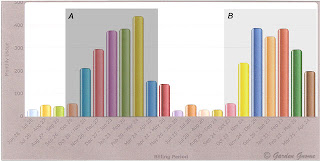
Natural Gas Usage GraphWe have the following natural gas appliances: outdoor grill, hot water tank, fireplace, dryer and furnace. The outdoor grill is used year round as is the dryer. The hot water tank is old so we are planning on replacing it before summer with 2 on demand water heaters. One will eliminate a long run of about 70 ft to the kitchen. The other will service the two bathrooms.
On first glance our natural gas usage graph is not all that impressive and it really doesn't look like we have changed our usage at all. In comparing A (2007-08) heating season to B (2009-09) heating season there are a couple of notables though. First you will notice in A a steady climb in natural gas used followed by a sharp decrease. In B there is no steady increase but rather a large jump in natural gas used. In the summer of 2008 we suspected a small gas leak at the meter. We called the gas company who checked it and painted the meter. They told us the meter was fine and wasn't scheduled for replacement for a couple more years. Still we suspected a problem. The first week of February 2009 the gas company called wanting to change the meter (story here) and while they never did say there was a leak I can't help wonder at the apparent jump in gas usage. The graph gives a lovely visual of our gas usage and is great for troubleshooting. If there is a spike where there shouldn't be then immediately we know there is a problem. However, the graph does not tell the whole picture.
Natural Gas Usage HistoryHighlighted in red is the 2007-08 heating season while the 2008-09 heating season is in blue. Essentially our heating season is 7 months long. Total natural gas used for the 2007-08 heating season was 1,914.657 cubic metres while we used 1,903.634 cubic metres for the 2008-09 heating season. Essentially we used 11.023 cubic metres less during the 2008-09 heating season. Well that doesn't seem like much, does it? Let's look a bit closer though.
During the 2007-08 heating season the average monthly temperature was 2.428ºC. In comparison the 2008-09 heating season averaged 1.143ºC per month. In short, the 2008-09 heating season was colder than the 2007-08 heating season yet we used less natural gas despite a suspected small meter leak! Immediately this tells me we are doing something right. All of the caulking and sealing we have done since moving here in 2007 is paying off. The tighter we get the house sealed the lower the temperature we can keep it at. The house itself is well sheltered with the main level mainly below ground making it quite energy efficient. The programmable thermostat was set to 19ºC during the day and 15ºC at night. On extra damp days we supplemented using the natural gas fireplace for a few hours. We also used the fireplace in place of the furnace on milder days, shutting off rooms not being used.
Despite these encouraging results, I feel there is still a lot more we can do. We discovered more drafts during this past heating season, some that could not be fixed until nicer weather. We are planning on adding storm doors and replacing one large window. The entire 1 foot deep wells around the lower patio doors and one large lower window will be opened, sealed with expandable foam then closed. All window weatherstripping will be replaced this spring. As always we will be sealing any cracks allowing drafts as we discover them. We will also be tackling the problem of the gas fireplace installed in the opening of the original wood fireplace but not correctly sealed or insulated. We currently put plastic up on the 3 season upper sunroom for the winter. This acts as an excellent windbreak as well as creating a solar heat sink on sunny winter days where we can open the upper patio doors letting the free heat into the house. I'm working on a few more solar ideas for heating as well so will write more on solar heating in a separate post.
Electricity: Our electric bills average $100 per month with about 56% of that in service charge and the rest actual usage. The average household uses 1,000 kWh per month. We consistently come in just under the 600 kWh per month range. Much of what we change now as far as reducing electricity usage is not going to have much of an impact in terms of kW used. The design of our house means there are lights on in the lower, main living level basically from the time we get up until the time we go to bed. They are all CFL lights in the daytime spectrum. The majority of our outdoor lighting is solar supplemented with CFL only when absolutely needed. Our range is electric and the new smoothtop cartridges are more energy efficient than the coil cartridges (story here). This will save a little for daily cooking but the key thing is every time we can save a little it is an environmental plus! At the same time we are changing a few bad habits like leaving the energy efficient main computer on 24/7 unless away. Off means 0 kW used! So we really are going in a couple of directions with respect to electricity. We are incorporating more solar inside while practicing conservation. In terms of costs with the ever increasing cost of electricity we likely won't seen much of a cost savings but what we should see is a continuing decline the the amount of kWh used.
Garden Gnome
©2006-2009
Wednesday, April 29, 2009
The Changing Faces of My Stove
I do a lot of cooking and canning so it comes as a surprise to some that I don't have professional style gas burner range. There's really a couple of reasons that boiled down to space limitations and wanting something different. In late 2005 we bought a new but almost stripped Jenn-Air JES9860AC downdraft slide-in range that needed several additional parts including grill cartridge, burner cartridges and the downdraft system. We did a bit of research after seeing it to find out what the parts would cost and went back the next day buy it. What I really like about this stove is parts are easily available for DIY repairs. Despite having to buy parts we ended up with an excellent customized kitchen stove considerably cheaper than if we had bought it fully ready-to-use. We bought most of the replacement parts online through RepairClinic. We ordered the cartridges and big burner element through a local appliance store. The stove was not fully installed until January 2006. A little over a year later we moved here and brought our range with us.
Energy efficiency is a high priority for us so one selling feature of this stove was the large capacity convection, self cleaning oven with 3 adjustable racks. The annual cost to run the self clean cycle is less expensive than oven cleaners. The self clean function does not use toxic chemicals or contribute to land fills so it is an eco-friendly choice. An optional half oven rack is available that I will add at some point. Another selling feature was the downdraft system (centre vent) that is capable of moving a lot of air allowing even smokeless indoor grilling. The downdraft system is attached to the floor and vented to the outside via flexible metal vent pipe. This means the range cannot simply be pulled out and makes installation a bit trickier because the stove has to be lifted up and over the downdraft system then attached to it. There is no storage drawer under the stove but the cover can be removed to empty the grease cup for the grill as well as accessing the downdraft system. If you decide to sell your house and want to bring your range with you, you will have to have that included as an exemption in the listing because it is attached.
Pictured to the left is the 1427 W grill cartridge with a custom made wood cutting board one of our kids made for me. The cutting board gives me a bit of extra horizontal space when needed. The two burner cartridge to the right has an optional specialty 2100 W big pot element (A145A) that is interchangeable with the regular 2100 W large coil element and a small 1250 W element. Already you can see how I can do a bit of plug and play.
The big pot element is used when I'm canning or using similarly large sized pots and pans (1). This element is reinforced to handle the extra weight and it is raised to prevent radiating heat build-up under the larger pots that could damage the surface area and cause premature failure of the cartridge. The grill cartridge is normally covered unless in use (2). If I am doing a larger dinner where all four elements may be needed I can put in the other coil cartridge (3). Just recently I decided to buy the glass-ceramic cooktop radiant cartridges (A122). They are rather expensive but I was able to find two for almost the price of one online at Appliance Zone. Compared to the coil cartridges, the radiant cartridges (4) are quite impressive looking! The ability to plug and play with the cartridges allows me to have a customizable cooking experience with very little effort.
I wanted the radiant cartridges for ulterior motives as smoothtop ranges always look so sleek and clean. The whole issue of dirty or stained drip trays is totally eliminated! We couldn't use a smoothtop because of the canning I do. The radiant cartridges are a way to get the look for those times I want it.
I love the look of the new radiant cartridges! Aren't they gorgeous? The large element is 1800 W while the smaller element is 1200 W so both less wattage than the coil elements. This means a bit of kW savings right there. I quickly found I had to change my cooking style using the radiant cartridges as they are instant heat and they take awhile to cool down. This means the burner can be turned off sooner while the food continues to cook on the residual element heat. Another energy saving feature is the elements cycle on and off on all but the high setting. So for normal daily cooking I will be using less kW!
If I ever had to buy another stove which I hope I never do, this is exactly the way I would do it again. Simply being able to customize the stove as I choose according to what I am cooking at the time is a hugh plus. Knowing that parts are easily available for DIY repairs is nice too. This eliminates worrying about after warranty repairs. It also allows you to buy a few spare parts to keep on hand for emergency repairs.
Garden Gnome
©2006-2009
Wednesday, April 22, 2009
Natura Kitchen Compost Caddy
Today is Earth Day 2009 so in spirit of doing something extra in celebration of living green, I am sharing one of my green tools. As a gardener I know how valuable compost can be not only for vegetable gardens but for flower beds, as a lawn conditioners and houseplant fertilizer. As someone who enjoys cooking from scratch I also realize that fruit/vegetable peelings, coffee grounds, tea bags and egg shells all represent money spent. You pay for them as part of the cost per kilogram when you buy produce and part of packaging when you buy tea bags and eggs. Throwing kitchen waste away is as good as throwing away money. Worse than that is these items end up in landfills something we can no longer afford.
In some areas of Ontario (Guelph, Kitchener, Waterloo, GTA) kitchen waste is put to the curb in special green bags or bins for collection. This is an ideal solution for those living in townhouses and apartments where they don't have the need for a lot of compost. We do not have that luxury here and in fact the recycling efforts in our area are what I consider a token bandage as very few things can be curb side recycled. Some municipalities allow you to take kitchen waste to the dump but the cost of the trip in terms of CO2 produced by driving to the dump really defeats the effort. Backyard composting is the only eco-friendly way of dealing with kitchen and yard waste in our area. The municipality encourages this but only for those who ask by providing inexpensive ($25) compost bins.
One problem a lot of people have with collecting kitchen waste is getting enough to make the trip to the compost bin. In the cold, wintery months no one wants to make that trip for a cup or so of vegetable peels! The general solution is to use some type of small pail to collect waste until there is enough to empty into the compost bin. The problem with this has been two fold. Decaying fruit/vegetable peels attract flying insects and it smells.
Natura came up with this effective compost caddy that solves both problems. It has a tight fitting lid with a charcoal filter eliminating any odours that might be offensive as well as attract insects. The filters are good for 4 to 6 months. I was extremely surprised at how much this compost caddy holds! It's only 30 cm x 18 cm x 17 cm so it isn't huge. I think it is too big to sit on the counter but the caddy will easily fit in an under the counter cabinet for easy access. I discovered that the food does compact as you add more, something to be expected but as the food decays it packs down further so the caddy only needs emptying about ever week and a half depending on use. It is a sturdy, green plastic that should stand up to a lot of use. I don't know how much the filters are but if they are expensive then a similar filter can be found in pet stores meant for aquariums.
Happy Earth Day!
Garden Gnome
©2006-2009
Sunday, April 12, 2009
Tuesday, April 7, 2009
Spring Cleaning (1)
Note: This is one of a series of three on the importance of spring cleaning followed by both chemical and natural pest control.
I started spring cleaning today. I'm a bit behind what with being away waiting for the birth of our newest grandbaby. From my earliest memories, spring cleaning was a family ritual. This was nothing like the spit & polish cleaning because company is coming by any stretch of the imagination. My Mom would watch the gardens. The first crocus blooms signaled the cleaning frenzy. It started in the attics with everything hauled out, floors swept and contents gone through. Mothballs were replaced then the boxes and trunks rearranged. Next was the upper floor consisting of two bedrooms. Cleaning began at the ceiling and worked its way down. There wasn't so much as a corner left untouched. Unused and too small clothing was cleaned out during the process. Following that was the main floor that housed the kitchen, bathroom, bedroom and two living rooms separated by an arch. Once again it was from ceiling to floor with all cabinets emptied, everything cleaned. Windows sparkled greeting the sun and promise of warm weather. Finally we were onto to the basement. I dreaded that! It was a dirt floor basement full of spiders and the occasional snake or mice. We lived on the water so also had muskrats and snapping turtles get in along with skunks and raccoons. My job was always to remove the jars from the canning shelves so they could be dusted down (although heaven knows why), the jars wiped down again then replaced where they belonged. Invariably a mouse would skittle across my hands or feet and that just wasn't a good thing!
When I got married I continued the ritual spring cleaning and to a lesser degree the fall cleaning never really understanding why just knowing that's what needs to be done. Now thanks to my genealogy research I understand why spring cleaning came about and because of my scientific background I understand why spring cleaning is a good habit. If you look back as to how our ancestors lived spring cleaning accomplished a lot more than making the house sparkle. It was a practical solution to the living conditions our ancestors had to endure. It was a way to rid the house of the dirt and grim accumulated over the winter but more importantly it was a way to rid houses of rodent droppings and insects both that could mean sickness and disease. Our ancestors knew a bit more about keeping homes clean than some give them credit for!
Fast forward to 2009, spring cleaning is an eco-friendly approach to pest control as well as providing the opportunity to find air leaks or ports of entry. This is a good time to find any leaks and seal them! Insects that over winter in the house become active in the spring and begin laying eggs. That is the time to take action! Do a thorough vacuuming to remove any insect eggs, manually remove any adults you see and if necessary do an complete kill. Insects are attracted to cool drafts (spiders), moisture (centipedes, millipedes, sow bugs, pill bugs), wood rot (carpenter ants) and other desirable habitats. Spring cleaning is one way to be able to troubleshoot any of these types of conditions, remove any insects and correct the problem. Generally this means sealing them out and killing off what is left indoors. It is very, very important after any kill off to vacuum up any carcasses otherwise they will attract other scavenger insects. Rodents can be another huge problem and remember if you see droppings they have urinated somewhere as well which is one good reason to wash your walls and baseboards down.
Spring cleaning also gives you the opportunity to create a check list of what needs being done around your house. If you find an insect, rodent or moisture problem while spring cleaning that means you need to take action immediately to prevent further damage to your home. If you find even the smallest air leak you need to seal to help with energy conservation. Spring cleaning means you are on top of home maintenance so you can catch problems before they cost you money! It also means you are protecting your investment.
next: spring cleaning using chemical pest control
Garden Gnome
©2006-2009