What does a Garden Gnome do when she is not gardening, in the kitchen or doing genealogy? Well the answer might just surprise you so read the entries to find out more. This blog focuses on everything we do to make our house a home. There will be a strong emphasis on home energy efficiency and do-it-yourself (DIY) projects. At the same time there will also be crafts, knitting and crocheting projects along with any other little tips we do to create that down to earth, I want to be here home. Please enjoy your visit :)


Showing posts with label crafts. Show all posts

Wednesday, January 2, 2013

A Novel Way to Recycle a Plastic Clamshell Salad Container


During our December stay at our vacation home in sunny Florida, our resort held a couple of craft shows.  I seldom buy much at craft shows since I do a lot of crafts myself but I like going to them to discover new crafts.  I bought this Florida Favorites in a plastic clam shell because it was just a very unique presentation I had not seen before and immediately knew it could easily be adapted.

Our vacation home is in a 55+ gated retirement resort.  Aside of the multitude of amenities, it is important to know how the resort is used.  About 25% of the population live there year round.  The rest are snowbirds from the northern states and Canada, staying for part or all of the winter months ( late October through April).  Out of country owners such as ourselves, rent out our home during the peak season (January through April)  if we are not using it.  That means we can have upwards of 4 different renters, usually a couple during that time period.

Renters, much like us tend to use a few convenience products and the local grocery stores certainly cater to that.  Take-out salads are extremely popular because they are inexpensive, come with all the fixings including the dressing and large enough for four servings eliminating the waste of having to toss a bottle of salad dressing because you couldn't use it up before leaving.  The grocery store salads come in two piece clam shell plastic containers.  One of the ladies at our resort came up with a novel way to recycle them.

She made these really cute gift packs called Florida Favorites.  The cleaned clam shells were lined with tissue paper then three wooden seashell themed were placed on top.  She added a small tag printed from her computer and a bow to add a bit of pizazz.  The contents of the clam shell could not have cost her more that $2 at a dollar store and the container was recycled so she was making a profit of $2 for every container that she sold.  Oh, and she wasn't profiting personally as all profits went to the Make A Wish Foundation.  The neat thing is, these recycled clam shells could be filled with just about anything for gift giving!


Friday, November 23, 2012

Craft Markets or Shows

A few days ago, I went to a local craft market.  I seldom spend money at these types of events being an avid crafter myself.  I basically go to get the ideas of what to make for holiday gift giving.  Every once in awhile I will buy something, knowing full well I can easily make my own version of it myself or at the very least find out how to make it.  If you are crafty, this is definitely the time to be spending a bit of time at craft markets or shows!

Craft markets or shows are rather interesting.  The crafts tend to be textile (eg. knitter or crocheted  items), wood items, hand crafted jewelry, homemade candles and homemade baked goods.  In my experience, vendors tend to have their prices on the high side but you are getting something unique and they do have to pay for their table along with all associated costs so they really are making nothing off of what they sell.  As a crafter, I am well aware of this so have no problem supporting fellow crafters especially during the holiday season.  It spreads a bit of good cheer :)

At the same time, I know and know where to find the resources these very same crafters are selling.  It doesn't matter that I'm not a competitor, it matters that I can make the very same thing myself at a fraction of the cost for gift giving.  Not only that, many crafters are very generous with sharing their suppliers and how they do things especially if they don't view you as being the competition.

While I am a avid crafter I don't sell my crafts.  They are created for my family, friends and our enjoyment.  I honestly don't think there is much of a market in many hand crafted items, certainly not enough to pay for the materials and time.  Rather, I craft out of the love of crafting and as a way to keep my hands busy while watching television.  Knitting and crocheting tend to help me relax as well, most times unless it is a poorly written pattern. Still, craft markets can be a mecca for supporting other crafters while getting a few new ideas of crafts you would like to make for gift giving.


Tuesday, January 3, 2012

Easy Decorative Candle Centerpiece

I love decorative accents that can easily be co-ordinated with other accents yet the elements can be dismantled to be re-used in future projects.  With only two days to prep the house for Christmas this year, I did not have the time to get really fancy.  I needed a couple of simple accents that I could whip up without much time or effort.

materials for decorative candle centerpiece
I needed a simple, holiday theme centerpiece for the diningroom table.  This table was only going to be used for breakfast then it would hold trays of various goodies for snacking while giving a spot to sit and enjoy coffee.  I decided on using a charger as the base.  A charger is the decorative plate that a dinner plate sits on.  We don't burn paraffin candles in our home but I do keep a few on hand for decorative purposes only so I brought out three ivory candles from my craft supplies.  I used the same glittery red, green and gold ribbon as I did making the decorative accent vase and sprigg I didn't use making the vase.  I raided the bathroom cabinet for epsom salts.  While epsom salts is used mainly in the bathroom, it is an excellent crafting medium to work with as well.

finished decorative candle centerpiece
This centerpiece was about a simple and low cost as you can get.  It took me about 5 minutes to put together.  I tied the candles into a grouping of three then placed slightly off centre on the charger.  I sprinkled epsom salts around the base then tucked in the artificial sprigg.  The centerpiece was complete.  That's it, nothing fancy just a bit of a festive touch to the table and one that could easily be dismantled after the holiday season. I like how this simple centerpiece came out. 

Decorative accents do not need to not need to be expensive or fancy, they just need to add that little bit of something special.  In fact, sometimes simplicity wins out when it comes to decorative accents especially during the holiday season. 

Garden Gnome
©2006-2012


Monday, January 2, 2012

An Easy and Inexpensive Decorator Accent Vase

Quite often when decorating especially for the holidays, that little extra something is needed.  While the stores are filled with a multitude of decorations to choose from, it is nicer to create a custom-made decoration or accent piece.  We arrived home from our vacation home on December 22nd, leaving only two days to get the house ready for Christmas.  I turned to my extensive craft supplies along with the purchases I made at Hobby Lobby.  Goodness that is a crafter's mecca!

craft materials to make decorator vase
I bought a tall, straight sided vase, glittered twigs, glass beads and Santa Ice Crystals at Hobby Lobby.  I had never seen the ice crystals spray before.  This is a temporary spray frost that can be sprayed on windows, mirrors or any glass surface to create a Jack Frost effect.  The spray contains no CFCs or other ozone-depleting substances.  It can be remove using window cleaner.

The glitter twigs are quite easy to make at home using twigs collected from trees in your yard or along your daily walk.  Allow them to dry until hard then spray with spray adhesive and sprinkle with glitter colour of choice.  I bought them simply because with the move I did not collect any twigs this past fall.  The artificial sprigg and glittery ribbon came from my craft supplies.

vase sprayed with Santa Ice Crystals
I don't have a specific crafting area established in our new home so simply used the counter in the kitchen.  I wan't worried about getting any of the ice crystal spray on the counter as it can easily be removed.  Still, I protected the counter with newspaper. 

I washed and dried the vase then turned it upside down on the newspaper.  Pictured is the vase just after being sprayed with the ice crystals spray.   I held the can about a foot from the vase when spraying.  The spray is quite thin, just sheeting the glass.  The spray is not tacky but it does have a bit of an odour .  It takes a few minutes for the ice crystals to start forming.

ice crystals forming
I sprayed from the top of the inverted vase to the bottom open end.  The instructions said the ice crystals would form within a half hour but I found they started forming within ten minutes.  As the spray dried the ice crystals formed giving a unique, Jack Frost look very similar to the frozen ice crystals that used to appear on our windows during the winter in my childhood home.  The picture does not do the effect justice.  It is a rather pretty look giving the vase a unique look.

I let the vase dry for about an hour until the entire vase was covered with ice crystals.  Then I removed it from the newspaper so I could begin decorating it.

Pictured is the finished decorator accent vase.  I decided against using the sprigg and chose the glittery ribbon with red, green and gold tones rather than the solid gold glittery ribbon.  I used the ribbon, a dollar store find, to further accent a candy bowl and candle centerpiece for a co-ordinated look.  I poured the glass beads into the vase first before adding the glittery twigs.  This hid the ends giving a snowy effect to compliment the frosted ice crystal effect.  It was simple and very inexpensive at under $2.

What I really like about this type of craft is after the event, the craft can be dismantled with the components put back into my craft supplies to be re-used in another craft at some point.  I really enjoyed working with the ice crystals spray.  We have side windows on each side of our entrance door.  I'm thinking of spraying them just to see if I like the frosted look rather than sheers.  The nice thing is the spray can be left as long as I like so if I don't like the look I can simply wash it off!  This crafting product gets two-thumbs-up in my book for versatility.

decorator vase on display
I placed the decorator accent vase in the dining room atop the vintage cabinet I refinished years ago.  The reindeer was made several years ago when I was heavily into ceramics.  The painting is one in our collection of painting from a local artist.  We have known this artist for several years.  Each painting is numbered, signed and comes with a story.  They are very unique!  The look of each painting does change with the lighting conditions taking on it's own persona.  This particular one reminds me of the sand dunes at Pinery Provincial Park in Ontario, Canada where we spent many a weekend camping with the kids.

The decorator accent vase just gave that little extra to that spot for the holiday season.  I might leave it as is for awhile before changing out the look for one that will work elsewhere.  It was an interesting, fun little project that was easily finished in just a little over an hour but the actual work time was only about 10 minutes if that.  I hope you like it!

Garden Gnome
©2006-2012


Friday, December 17, 2010

Do-It-Yourself Snowglobe

This time of year I am always on the look-out for unique craft projects. Craft stores and departments stores are filled with all kinds of great do-it-yourself craft projects perfect for gift giving.  Many of the projects require basic craft skills suitable for children and beginning crafters.  What I really like is these can be personalized for a unique gift.

do it yourself snowglobe
I discovered  do-it-yourself snowglobes in the photo section of Wal-Mart.  They had two styles, this shape and a larger round shape.  I immediately thought they would make cute unique and personalized Christmas gifts for our grandkids.  I'm going to edit a picture of each of them to include the year and instead of printing the photos on white paper I'm going to print on acetate to give a clear background.  

Each of the small dome shaped globes are about 4½ inches tall.  The black base comes off to replace the instructions and photo with a photo of your choice.  Your photo is simply cut to fit and inserted into the plastic sleeve that holds the photo in place in the slot.  Once the photo is in place, the black base is replaced ready for the snow globe to be enjoyed.  Each globe cost $3.88.  Printing on regular white card stock would cost about 6¢ (ink and paper) while printing on acetate at a print shop will cost about 50¢.  Either way this is a very low cost, easy to personalize craft project perfect for Christmas gift giving.

Garden Gnome
©2006-2010


Tuesday, November 2, 2010

Scherenschnitte (German Paper Cutting)

scherenschnitte paper cutting
Mother and Child

I do a lot of arts and crafts in a wide range of materials.  A few years ago I was looking for that extra special something to use for a scrapbook I was working on.  I came across scherenschnitte which translates from German into English as cutting with scissors.  What I found so appealing was the intricacy of the designs.  In many ways they are a type of silhouette that may or may not be cut from the traditional black paper used in silhouettes.  Some as the design (pictured) I chose were symmetrical for the border but asemmetrical for the inner portion while others were entirely symmetrical.  By default the paper snowflakes everyone learns to make in elementary school is a form of scherenschnitte.  The snowflake is symmetrical and cut with scissors. 

The design I chose was one of mother and child.  It was on the intricate side of designs.  I used a variety of materials to create the end result.

Materials:

1 sheet ivory card stock
1 sheet navy blue card stock
Fiskar's rotary cutter
Fiskar's narrow point craft scissors
manicure scissors
craft knife
craft cutting board
pattern
printer
two sided scrapbooking tack tape

Free scherenschnitte and silhouette patterns can be found online and many more are available for purchase.  If looking for a free pattern use the term free silhouette clip art along with a specific term like mother and child to narrow down what you are looking for.  I found a pattern I liked and downloaded it.  I resized the pattern to leave a ¾- inch border when placed on an 8½ - inch by 11 - inch sheet of cardstock.  I then rotated the image 180ยบ CW so the pattern was reversed.  I set the printer to draft mode so it would print in a very pale grey and printed the image on the ivory card stock.  I was then ready to do my paper cutting.

The printed side with the pattern is the back side of the work.  For the entire cutting process the piece is worked from the back.  Once you start cutting it is extremely important to go slow and use considerable patience as a misplaced cut will ruin the design.  This would especially annoying if the piece was almost finished.  Be warned that this is not a project that can be finished in one day either.  The grey portion printed on the back side is the portion you want to keep.  The unprinted portions are what you will be cutting away.  The first step is to cut away any border portion before the design starts using a rotary cutter or straight edge and craft knife.  The piece will be too delicate to cut this portion away after the design has been cut.  For best results when cutting use the craft knife to cut cleanly from an inner corner of a shape to the outer portion.  It the piece being cut away is large start with the craft knife for clean inner cuts and use the narrow point craft scissors to cut away the larger portion.  This works nice for large background pieces (eg. the background space around mother and child in my pattern).  Work slowly to prevent any miswanted cuts.  Once all of the non-printed sections have been cut away, the remaining grey on the back is the reverse of the right side.  Flip the piece over and mount as desired on another piece of cardstock.  Use two sided scrapbooking tack tape to secure the piece to the cardstock.  Place the finished piece in a picture frame or in a page protector if using for scrapbooking.

Garden Gnome
©2006-2010


Sunday, July 11, 2010

Third Experiment Using SoilMoist™ for Craft Project

I posted earlier about using SoilMoist™ granules for craft projects.  This product is meant for use as a water management system for houseplants and outdoor potted plants.  However it has the potential to be used as a craft product for making interesting centerpieces, room fresheners and so much more.  I did two experiments with the granules to see how they would perform.  The granules took the food colouring well so that opens up being able to create custom colours to fit your decor.  I also tested to see how well the granules would absorb then release a scent like vanilla.  They hold and release the scent well again increasing the possibilities for a craft project.

Once I found that the SoilMoist™would take up food colouring and scent, I was interested in finding out whether the granules could have the colour and scent removed so they could be used in other craft projects.  I started with  granules that had been dyed blue with blue food colouring and scented with 100% pure white vanilla (1).  I poured the granules into a strainer then poured water over them to cover (2).  Once the water took on a good colour I poured it outside not down the drain just in case there were any small pieces of the granules in the water that could cause problems in the drain.  After three water changes the granules had lost most of their colour (3) and after the fourth water change the granules were back to crystal clear.  This means that I can now reuse those granules for other craft projects!  In order for this to work the dye and the scent must be water soluble but that still opens up a lot of possibilities.  I can see using herbal infusions such as lavender, mint and lemon balm for scent and with a bit of inexpensive food colouring the colour possibilities are endless!

Garden Gnome
©2006-2010


Friday, June 25, 2010

Candle in a Jar

I make most of the candles we burn in our home using either soy wax or 100% beeswax.  Both of these are natural products that do not contain any colourants or scents.  There are two reasons I like using these waxes for candle making.  First the are natural waxes not petroleum based wax like paraffin wax is.  Second unlike paraffin wax both soy wax and beeswax burn clean.  Beeswax has additional properties as well.  It has a mild honey scent that smells lovely but burning beeswax candles is said to actually clean the air.   Burning beeswax candles is also said to have health benefits such as reducing the severity of or even eliminating sinus attacks.

candle in a jar
Candles in a Jar have become quite popular.  The problem with most purchased candles in jars is they are heavily scented.  The scent can cause problems for those with allergies, asthma and other respiratory problems.  At the same time what many don't realize is these scents pollute indoor air.  They are often heavily dyed another source of indoor air pollution.  Finally purchased candles in jars tend to be over priced going for as high as $10 per candle.  Both beeswax and soy wax can be used to make candles in jars.

Pictured is one of the beeswax candles in a jar I made.  I used a fancier, squatty 250 ml (half-pint) mason jelly jar and decorative two-piece lid.  The jelly jars with decorative lids can be bought in a 4 - pk or you can buy a 12-pk of regular mason jars with plain either gold or silver tone lids.  Traditionally the two-piece lids have been gold tone but recently Bernardin has moved to silver tone lids.  The decorative lids can be bought separately as well but the regular lids that come with the jars can be used.  Both jars and lids can be found in the canning section of any store that sells canning supplies.  There are larger canning jars but the best size for candles in jars is the 250 ml size.

Materials

1 mason* jar per candle
1 two-piece lid
1¼ c melted wax per candle
1 3-inch wick holder/wick per candle
sauce pan
metal can for melting the wax

Place jars in oven then set oven to 80ยบC (175ยบF) to warm this.  This will prevent breakage when pouring the hot wax into the jars.  Cover your work surface with newspaper to protect from wax drips.  Place wax in metal can.  Pour enough water in the sauce pan to come half way up the outside of the can.  Bring the water to a boil then reduce heat to a simmer while moving the metal can to allow the wax to melt on the inside.  Add more wax if desired.  Once the wax is melted place one wick with holder into a warm jar.  Carefully pour the hot wax into the jar.  Centre the wick.  As the wax cools it will shrink and the area around the wick will sink down (concave).  Top up the candle with more hot wax while the candle is still warm.  Set aside to cool.  Once cooled, place the two-piece lid on the jar.  The candle is now ready for storage, gift giving and using.

how to use a candle in a jar
Pictured is a beeswax candle in the jar ready for burning.  Before burning the candle the two piece lid should be removed. Trim the wick to ¼- inch before lighting the candle.  Place the ring of the two-piece lid back on the candle jar.  Place the candle on the lid portion.  Light the candle.

When burning use all safety precautions such as keeping away from out of reach of children and pets as well as away from combustible materials like curtains.  Never leave the candle burning unattended.  Do not let the candle burn down to lower than ¼ - inch from the bottom of the candle as this can cause the jar to overheat and break as well as cause scotching of furniture.  The remaining candle wax can be removed from the jar then the washed jar can be re-used for another candle.

Garden Gnome
©2006-2010


Thursday, June 24, 2010

Glass Canister Sand Souvenir

glass canister sand souvenier

Glass Canister Sand Souvenir

Like many families we like to bring home souvenirs from our travels.  Years ago when the kids were young we made our first trip to Florida.  Of course the kids wanted to bring home sand and shells.  These weren't fancy purchased shells but rather shells the kids had found on the beach so they wanted to keep them.   I wanted a way to display the sand and shells that was a bit different.  One day I happened upon small glass canisters in the craft store and thought that would be a good way to display the sand and shells. 

The canister could be filled in so many ways!  The canister is 10 cm (4 in) diameter and 10 cm tall.  Both the bottom an top of the canister can be filled.  The lid has a plastic cap on the bottom that can be removed for filling.  I poured sand into both the bottom and top of the canister then added a few sea shells to each, replaced the plastic cap on the lid then put the lid onto the canister.  Similar canisters can be found in craft stores as well as the kitchen section in department stores.  They may even be available in dollars stores with the kitchenware.

Garden Gnome
©2006-2010


Wednesday, June 23, 2010

Two Experiments with SoilMoist™ for Crafting Purposes

One of the great things about crafting is using products that are not necessarily labelled as a craft item.  Yesterday I posted about SoilMoist™ a crosslinked polyacrylamide granular product intended for use as a horticultural water management aid.  While I bought the granules for horticultural purposes for non-edible plants I immediately saw the crafting potential for this product.  So I decided to do a bit of experimenting.

dyed SoilMoist™
I wanted to see how well the SoilMoist™ would dye using food colouring.  My idea was that being able to tint the gel would give a greater versatility for crafting projects.  I allowed the granules to hydrate using plain water.  Then I mixed up a solution of about 2 oz of water with about 5 drops of blue food colouring.  I poured the solution over the gel then let it sit overnight.  This morning I poured off the extra liquid which wasn't much.  The gel had taken on a nice blue from the food colouring.  This means that the gel can be easily and inexpensively dyed using non-toxic food colouring greatly increasing the decorative use for this crafting product.  I can even see using the coloured gel to help colour chrysanthumum and daisys for a centrepiece application.  I think that after using the dyed gel it could be returned to clear by multiple soakings to remove the food colouring.  I still have to test that theory.

scented SoilMoist™
A few years ago I came across a very popular homemade air freshener gel made using Knox gelatin.  While this worked fairly well there were reports of the gelatin molding so I never did try it.  Since the SoilMoist™ gel resembles gelatin I decided to see if it would hold scent.  Vanilla is a natural deodorizer that is water soluble.  I used enough of the gell to almost fill a 5 oz bowl.  I poured 1 tsp of 100% pure vanilla over the gel then covered and let sit over night.  The gel did take on the colour of the vanilla but it also took on the scent of the vanilla.  I did not pour any extra liquid off.  Using a lidded container allows to have the air freshener working only when desired.  Several of these could be made up then placed in areas where you don't necessarily see them where they will continue to deodorize the air without being obvious.  The scented gel could even be incorporated into other decorative room elements so they will never be noticed but the room will continue to be deodorized.  Once the granules dry up then I plan on rinsing well, reactivating then adding more vanilla.

The important thing to remember when using dyes or scents using the SoilMoist™ is anything used must be water soluble.  However I think for a crafting project it might be possible to add mica or glitter for additional effects as these particles are small enough they could be shaken off the dried granules allowing the granules to be re-used.  I will certainly be doing a bit more experimenting with this medium as a craft product.

Garden Gnome
©2006-2010


Tuesday, June 22, 2010

Using SoilMoist™ Granules for Craft Projects

I just blogged about my waterball garden followed by another post on SoilMoist™ granules.  My main purpose for buying both of these were the decorative use for vases as well as a water management system for non-edible potted houseplants and outdoor planters.   As I was getting the waterballs and the related SoilMoist™ granules hydrated I could immediately see the crafting potential of this product.   I invisioned centerpieces using the gel, candles and embellished with fresh flower blooms.  The gel would keep the blooms looking lovely for a few days.  I also reasoned the gel could be used as is to surround candles with the gel adding a lovely sparkle to burning candles. 

SoilMoist™ packets
I bought 4 - 3oz (85 g) packages of SoilMoist™ online for $3.  According to the package the granules are used for as a horticultural water management aid.  The premise is the granules absorb water then release it as the soil dries preventing the plant from drying out.  The instructions for using SoilMoist™ as a horticultural aid are on the back of the package.  I'm experimenting with this soiless medium both indoors and outdoors so will be reporting on how well I like it as a water management aid on my gardening blog over the next few months.  The granules will last several seasons outdoors so with care they will last several years indoors.  When used indoors as a crafting product the granules can be cleaned and re-used making this product a rather frugal craft product. 

SoilMoist™ gel
The granules are a crosslinked polyacrylamide that is an opague milky white, hard granule until hydrated.  Then it becomes a clear, gel substance similar to stirred set jello.  It is very glittery with the gel reflecting any light that hits it.  It is quite pretty without doing anything to it!  This is a product that should be kept away from any drains where it has the potential to cause blockages.  Although the granules are non-toxic they should be kept out of reach of children and animals. 

I have already started experimenting with a couple of ideas for using this gel as a crafting product.  Tomorrow I will post a couple of the ideas I am testing with pictures and the how-tos.

Garden Gnome
©2006-2010


Sunday, May 16, 2010

How-To Make Your Own Natural Dye with the EtsyLabs

Natural, eco-friendly dyes are as close as your own back yard.  They can be used to dye yarns, cloth and even clothes much the same as you would using a commercial dye product.  Natural dyes can also be used to paint wood projects.  In fact one green idea I saw on HGTV used red wine to stain the hardwood floor.  A protective finish was applied.  It really was gorgeous!  So think outside of the box when using natural dyes.  Here is a short video of the process of making a natural dye along with the results.


According to the Pioneer Thinking article, Natural Dyes from Plants, the plant, berry or nut material should be collected then the dye made using twice the amount of water to plant material.  The material to be dyed should be soaked in a fixative before dying.  For berry dyes use 1/2 c salt to 8 c cold water as a fixative; for plant dyes use 4 parts cold water to 1 part white vinegar.  This article also has a large list of plants, nuts and berries that can be used as natural dyes with their resulting colours.  It is well worth printing out for further reference.

Garden Gnome
©2006-2010


Wednesday, April 21, 2010

Etsy How-To: Fuse Plastic Bags!

Tomorrow millions world wide will celebrate Earth Day 2010 so continuing on the theme of re-using common household items.  I have read a lot about making fused plastic material from shopping bags and have see a lot of completed projects using the resulting material.  Today's video shows how to make fused plastic material from shopping bags.  Once the material is made it can be cut as desired and sewn together to create other items such as heavy duty shopping bags or wallets.


Note:  I have not made fused plastic material although I plan on trying it when I can set the ironing board outdoors and actually have a couple of bags.  My concern is any fumes created may be toxic so I don't want the fumes in the house.  Once the plastic is fused and cooled there would not be a problem with toxicity however I would not recommend using the material where it will come in direct contact with food.

Garden Gnome
©2006-2010


Saturday, April 17, 2010

Plastic Bag Crochet

Earth Day 2010 is fast approaching so I thought a recycling post would be rather fitting.  Plastic shopping bags are not environmentally friendly.  In the past several years many have been turning to re-usable cloth shopping bags or baskets.  Some municipalities such as the Greater Toronto Area in an attempt to reduce the number of shopping bags used have passed bylaws that stores must charge the customer 5¢ for each plastic shopping bags.  This concept is not a new one as some grocery stores have been charging for plastic grocery bags for quite some time. 

Enterprising crafters have turned to recycling plastic shopping bags into useful items.  The plastic bags can be cut into strips.  The strips are then joined together to form a long chain of yarn.  Crotchet is a popular way to turn the plastic yarn.  Here is a good video showing the joining technique and a few items you can make. 


Garden Gnome
©2006-2010


Monday, December 22, 2008

Beeswax Hangies

Christmas gifts need not be expensive and many can easily be made even if you aren't a crafty type of person. Pure beeswax is one of my favourite crafting mediums. I love the smell! I also like how I can use it for so many crafting projects. Not only does it smell good when you are working with it, it acts as a natural air freshener.

Beeswax Hangie

Beeswax hangies can be used year round as this one is or they can be used as ornaments for Christmas decorating. Traditionally beeswax hangies used year round are made in polar bear, moose or deer shapes but you can use whatever shape you want. These hangies are about one of the easiest craft projects you can make. The materials needed are minimal and you are only limited by your imagination when it comes to shapes.

If you look closely you will see white spotting and a cloudy film on the beeswax. This is normal and should be left as is. The white spotting is called the bloom. It does not have any impact other than visual. When your hangies are first made there will be no bloom but they will develop it over time. I like the rustic, natural look of the bloom so leave it as is. If you don't like the look of the bloom then gently wipe off using a soft cloth or gently heat the surface with a blow dryer.

Supplies

You want pure beeswax for this project. This is beeswax that has been filtered and is free from any colourants. Beeswax like honey should be bought locally if possible. I buy mine from a bee keeper as well as online from a fairly local supplier. Beeswax will come in 1 or 5 lb blocks. I prefer the 1 lb blocks as they are easier to use without cutting. Expect to pay about $6 per lb for pure beeswax but depending on your location you might be able to find it a bit cheaper. You can use candy or soapmaking molds, silicone molds or even decorative non-stick baking molds as the wax.

Materials:

beeswax
#1 wick
tin can
sauce pot
shallow mold

Method:

Cut wick into 3 inch pieces. Place about 3 inches of water in a saucepan. Place the beeswax in a large tin can. Place the tin can in the saucepan. Bring the water to a boil the reduce to simmer until the wax is melted. Slowly pour the wax into the mold being careful to not over fill. Fold wicks in half. Place wick at the top of the hangie as it is cooling. Hold wick until wax cools enough the wick doesn't move by itself. Allow to cool completely. Pop the hangie out of the mold and enjoy :)


Garden Gnome
©2006-2008


Sunday, December 21, 2008

More Decorative Boxes

The craft section of the dollar stores can be a mecca for craft supplies for gifts. I honestly cannot believe some of the craft items available for only $1. With very little cash outlay you can easily get the items needed to complete several customized gift items. Don't let the words craft or DIY scare you either because the following way to finish decorative boxes require so little effort that a child could easily make them.


I came across oblong (about 8" long) wood decorative boxes at our local dollar store. They are made using two types of wood so even if simply given a clear coat the result is subtle beauty. Pictured is an unfinished and finished oblong box. They have hinged lids with brass coloured hinges and clasp. These boxes are idea for gift giving as is but are perfect packaging a pen and pencil set, necklace or watch. Simple wrap a hand tied bow around the box and add a tag for gift giving letting the beauty of the box serve as gift wrapping.

I finished one of the boxes using spray satin varathane for a durable low luster sheen. One spray can will be enough to finish 4 to 6 boxes. Home Hardware (Canada) and other home improvement stores sell small packets (similar in size to ketchup packets) of stain for about 69¢ each. One packet will be enough to stain at least 2 boxes. Total cost per box will cost about $2.50 but they look like you spent so much more and you can customize them for the receiver's tastes.

Materials

1 oblong hinged wood box
1 spray can Flecto® Varathane clear
stain (optional)
fine grade sandpaper

Method

Lightly sand the box with fine grade sandpaper. Stain if desired. Allow the stain to dry 24 hours. Lightly sand. Wipe to remove any dust. Spray with clear varathane using a sweeping motion for even application. Allow to dry. Lightly sand and and wipe. Spray again then repeat for at least three coats of finish. Allow to dry thoroughly. Your box is now ready to be used as desired.


Garden Gnome
©2006-2008


Tuesday, September 30, 2008

Easy Embossing for Srapbooking, Crafts and More

The holiday season is drawing near so I thought I would share an easy and low cost way of doing embossing. Embossing is an elegant way of accenting scrapbooking pages or elements, creating custom picture frames and so much more. The main problem with embossing is if you check the craft stores you can spend a lot of money on embossing equipment. If you don't do a lot of embossing there is absolutely no need to spend a lot. Let me show you how.

Materials

For this project you will need a sheet of cardstock that will make two greeting cards. The method I'm using does work better for lighter colours although I have had success with dark colours as well using a stronger light source. You will need a stencil of choice. For best results choose one that is not too delicate. One of the cheapest places to find stencils is a dollar store. If you can't find a stencil you like then find a picture online and create a stencil by printing on a sheet of acetate then cut out the pattern. You will also need painters or scotch tape and a ball point stick pen with the lid. Optional materials are make-up applicators and acid free artist's chalk.

Cutting

A paper cutter is one of those things every crafter needs. It comes in handy for so many things. I have a Fiskars® flatbed rotary cutter with three cutting blades and a scoring blade. The scale makes it easy to cut the paper to the right size. In this case I cut the 8.5" x 11" sheet of cardstock in half as pictured forming two 8.5" x 5.5" pieces. To score I took one of the smaller rectangles then placed it against the guide with the 8.5" side facing me then used the scoring blade to form the score.

Taped

When you score the paper there will be an indent. Tape your stencil onto a light source like a window using the painter's or scotch tape. Place the cardstock you just cut over the stencil with the indent facing you and centre align as desired. In this case I decided to use a solar border along the edge of the card. At this point you are working on the inside of the card or inside of whatever you are embossing. Before starting to emboss be sure the good side that you want is facing away from you. Leave one bottom corner loose so you can lift up a bit to see how the embossing is going.

Take the ball point pen with the lid on and carefully use the end to trace the stencil. Pay attention to the lines as you want to make a good indent. Use a bit of pressure but a lot of pressure is not needed. Go over the stencil markings a couple of times to get a good indent. Carefully lift up the lower corner and you will see what embossing will look like. Check for any missing parts and go over the stencil again if necessary. Remember the back of the work is facing you. Once you are happy with the embossing, remove the cardstock from the light source.

Finished

The embossed finish can be left as is for a subtle yet elegant look. This is a really pretty effect for greeting cards and scrapbooking embellishments. Use it along edgings or around frames. What I like doing is using a sponge make-up applicator to highlight the embossing using chalking. Chalking is a very subtle effect that highlights the embossed surfaces by adding a hint of colour while deepening the shadows. To apply the chalk rub a sponge applicator over the chalk then use a tight circular motion to rub over the embossing. Continue applying chalk in this fashion until you get the desired effect.

Pictured is the finished card with embossing and calking in a pale blue. Versing can be added inside prior to embossing or you can hand write it in after embossing. Similarly the front of the card can be detailed more if desired. Just be sure when you are embossing to work with the inside facing you.

Garden Gnome
©2006-2008


Tuesday, April 22, 2008

Personalized Greeting Cards

Personalized greeting cards, invitations or thank-you cards are so much nicer than store bought. You can customize the colours, layout, fonts and details. You can print the number you need instead of being tied into buying cards in packaged lots. Homemade greeting cards are considerably less expensive than store bought. There are several sites online for greeting card verses as well or personalize your cards further with your own message.

Due to severe weather conditions the baby shower I was hosting mid-March for our soon to be second grandbaby was cancelled at the last minute. March was such a fickle month and with the due date so close we had to wait to reschedule until after the baby was born. So I wanted a very special, custom made invitation for the welcome the baby shower. I decided to use Photoshop to create a personalized digital layout of the card using scrapbooking techniques then once printed use a corner punch to make the front a bit fancier.

Here's what I did in Photoshop CS2 (it should work similar in Paint Shop Pro):
Note: I worked on a quarter of an 8.5" x 11" sheet of paper size on the computer then put the components together so there are several steps involved.

This method makes use of layers. Each I did something on the card I worked on a new layer. Leaving the file as a .psd will allow you to modify as needed. When ready to print merge the layers into a new "save as" file in .jpg format.

Digital Card Front

Shown here is the card front without the baby's name and date of birth that I put in below the picture. Knowing the baby was a girl made my choice of colours easy.

  1. create a new transparent file size 4.25 inches x 5.5 inches
  2. open the image file you want to use on the front of the card
  3. drag the image onto the newly created transparent
  4. use Edit/Free Transform to get the resize boxes; click, hold and drag to get the image to the desired size; position as desired
  5. add a new layer then text above the image; use colour picker to pick a colour from the picture for the text
  6. repeat if adding a layer of text below the image
  7. if desired add layer effects to the text (I used drop shadow and outside glow for this effect
  8. save this file as a front.psd and a duplicate as a .jpg; when assembling the card you will be using the .jpg format.

Inside Front

Some greeting cards will have a verse or message on the inside front of the card but others won't. I chose to use this space to add a message in reference to the cancelled baby shower. For privacy I have omitted the baby's name for posting on this blog on the inside front as well as all the details on the inside back but this will give you a good idea.

  1. create a new 4.25 inch by 5.5 inch transparent file
  2. create a new layer
  3. using the same font colour type in your text in the size and font design you want
  4. highlight the font
  5. go back to colour, click and choose custom then Pantone and go a shade or two darker
  6. adjust the text as desired
  7. create a new layer
  8. fill that layer with white
  9. drag the layer down between the first and second layers
  10. create a new layer
  11. drag that layer between the second and third layers
  12. choose a paint brush of your choice (I used ivy)
  13. dab the paint brush over the layer
  14. adjust the opacity to give a subtle effect (I used opacity 32%) - you now have a background
  15. create a new layer
  16. add embellishment (I used the custom shape tool to add a bow)
  17. add layer style if desired (I used beveling and drop shadow)
  18. merge the visible layers
  19. save as both a .psd file (editable) and a .jpg file (not editable)

Inside Back

The inside back is made using identical steps as the inside front except you will be adding the details. This is where you would add the verse or message you want to convey. I've left off the details for this entry but this will give you a good idea of what I included on the inside back. Keep the font colour and style the same. An easy way to keep things consistent is to duplicate the inside front .psd file. On the duplicate with the text tool highlighted, click anywhere on the text. Delete this text then add the detail text you would like. Add any graphics by opening the desired graphic then clicking and dragging. Save as both a .psd and.jpg file.

When the inside back is complete you will have three .psd files and three .jpg files. The .psd files are kept for editing purposes so that the images can be changed as needed for future cards. Think of them as templates. The .jpg files have been flattened so the layers can no longer be edited. These are the files you will be working with to assemble the card.
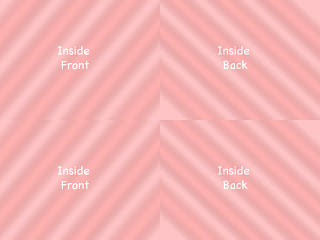
Generic Inside Layout

This is where the fun of assembling your card starts. Your card will be printed on two sides. The front picture will be print on one side, two to a sheet so you will end up with two cards per 8.5" x 11" sheet of ultra white card stock. Then you flip that printed side over and feed back through the printer to print the inside. When printed the cards, in this case two cards per sheet will be ready for cutting using a paper cutter and any extra textural embellishments.

I purposely made the inside layout pictured different from the card for illustration purposes.
  1. create a new image size 8.5" x 11"
  2. open your outside front
  3. click on the outside front image then with the move tool, drag onto the upper right of the new image
  4. repeat, dragging onto the lower left of the new image
You have now created the front of two cards. Save the image as a .jpg This will be the file you print first.

  1. create a new image size 8.5" x 11"
  2. open your inside front and back files
  3. click on the inside front .jpg then using the move tool drag a copy to the top left
  4. repeat dragging a copy to the bottom left
  5. click on the inside back .jpg and use the move tool to drag a copy to the top right then bottom right.
You have now created the inside of the two cards. It will be resemble the generic image above. Save the image as a .jpg You are now ready to print your card. Print the front on inexpensive paper with printer set to proof to conserve ink, then feed the paper back in to print the inside of the card on the reverse side. Make any adjustments necessary for printing. When you are satisfied with the way the cards print, change the print mode to quality print and proceed with printing on the final desired paper.
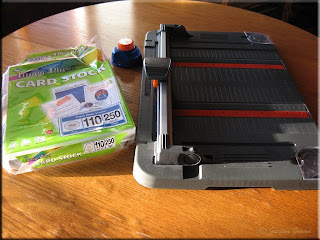
Tools Needed

The paper I recommend for printing cards is Image Plus+ Card Stock. This is 110 lb weight and a bright white that makes colours pop. It is also acid free so cards can be later put into scrapbooks. But don't limit yourself to just card stock. While card stock is the most economical there are so many great papers out there giving you endless possibilities for cardmaking.

A rotary cutting system is a must for scrapbooking and card making. I highly recommend Fiskars® 12" Home/Office Rotary Paper Trimmer. It comes with three cutting blades and a scoring blade. A scoring blade gives a nice, clean fold for making cards. The trimmer is designed to give clean, straight cuts. The grid markings help to ensure you cut the size you want.

Finally any scrapper will tell you punches are one of their most used tools. A punch can be used to create shaped cutouts. The cutouts can be used as punchies to decorate other layouts. A piece of scrap paper can be punched and used as a stencil as well so punches are quite handy. I used a 3 in 1 Corner Punch (Lace) for this project.

To score the card, lay the finished inside facing upwards, long side oriented with the long side of the trimmer. Score along the middle at 4.25 inches. This will allow the card to fold cleanly towards the inside. To cut the card, turn the inside facing upwards so the short side is facing the long side of the trimmer. Adjust to cut at the 5.5 inch mark. You now have two cards measuring 4.25" x 5.5" ready to fold and embellish with paper punching or any desired embellishment you want.
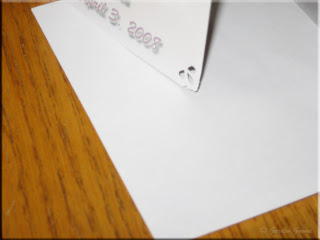
Corner Detail & Envelope

I used the punch on the two outer corners of the card. When closed the colour of the inside of the card peaks through. This is just a nice, subtle way of adding detail and making the card look expensive when in fact it wasn't.

Once the card is made you need an envelope. Here you have the choice of making your own or buying them. I used white invitation envelopes (45727) sized 4⅜" x 5¾" from Staples. There are coloured invitation envelopes in the same size available. The envelopes can be customized as well by adding a liner, using the printer for digital embellishments or using scrapbooking techniques. So have fun with the envelopes as well.

Garden Gnome
© 2007


Friday, April 13, 2007

I've had Adobe® Photoshop® on my computer for quite sometime but up until a few months ago had only used it for resizing images. Talk about not using a program to it's potential. It all started because I wanted to make a custom made blinkie. Then working with the program I quickly saw this had a lot more potential for scrapbooking than the two programs I had. I like that I can customize as I want through my eyes and how the image makes me feel, not to someone else's standard. Over the past few months I've learned a lot about Photoshop® especially through a lot of online tutorials. I would like to make a special mention for Obsidian Dawn. I'm enjoying her brushes and tutorials immensely.

Since our first grandbaby was born in late December, the pictures and video clips have been going back and forth. What I started was a digital scrapbook of her first year but I knew I wanted full control of how it came out. She along with each set of grandparents and her parents will have a printed and CD copy. I plan to make CD copies for anyone who asks. But I want the scrapbook to look like a traditional paper scrapbook when printed. This is where Photoshop
® really will be an asset. The main rule for printing these types of pages is to use a high quality, brilliant white photo paper. I find for scrapbooking that matt works nicely when printing a full layout. This will cost a bit more than regular paper but the detail and colours are crisper. The amount you will save in not having to buy embellishments like ribbon, vellum, brads, stickers and ect. will more than cover the cost for the paper.

I made the image for this post using
Photoshop®, layers and different brushes in about 10 minutes. I started with layers right off the bat while learning how to do simple animations. Then I started playing with layers using digital photographs I take. Once I got the hang of working with layers, I found there were so many things I could do. I use layers for most of the images on my blogs now. So if you have Photoshop® and haven't explored the possibilities, check out some of the online resources in the links section. You will be amazed at what this program is capable of doing!

Have a great day,

Garden Gnome
© 2007


Wednesday, April 11, 2007

Dishcloth Pajamas

Presenting ordinary, practical items in different ways can be a challenge for gift giving. Dishcloths are one thing that no new homemaker or even a long time homemaker would ever say no to. They fall under the category of there's no such thing as too many!

Dishcloth Pajamas

I discovered a novel way give dishcloths from a vendor at a farmer's market. It was immediately apparent that these would make a really cute housewarming present. So I bought a set simply to take them apart to see how they were made. Besides, I can always use more dishcloths!

Pictured here are dishcloth pajamas that are just perfect for a novel housewarming gift. They are quite inexpensive and easy to make using simple folds and tacking them together with thread.

Folded

Materials Needed:

  • 3 dish cloths
  • 2 buttons
  • thread
  • needle
  • glue (optional)
  • cutsey verse (see below)
Fold the wash cloths to form the pieces:

sleeves: Fold one wash cloth in half to form a rectangle. Fold in half again.
pants: Fold 1 inch of an edge on one wash cloth. Turn so the folded edge in down on the table. Fold one edge to the centre and repeat with the other edge. Tack the cuff edges together using needle and tread.
top: Fold one wash cloth in half to form a rectangle. Fold each short end in to the centre of the rectangle. Turn down the top corners to form the collar. Tack into place with needle and thread. The original pajamas I worked from had the buttons glued on but I prefer to sew them on. Punch a small hole in the printed verse and attach when adding one button. On top of the pants as pictured and tack into place.

To assemble:

Place the sleeves long end facing you. Place the pants on top in the centre of the sleeves, cuff end facing you. Tack these pieces together with needle and thread. Place the top
Verse:

We look like pajamas
but really we're not
We are three little dishcloths
You'll like us a lot

For washing the dishes or
chasing the dirt
Just take us apart
It really won't hurt


Enjoy!

Garden Gnome
© 2007