What does a Garden Gnome do when she is not gardening, in the kitchen or doing genealogy? Well the answer might just surprise you so read the entries to find out more. This blog focuses on everything we do to make our house a home. There will be a strong emphasis on home energy efficiency and do-it-yourself (DIY) projects. At the same time there will also be crafts, knitting and crocheting projects along with any other little tips we do to create that down to earth, I want to be here home. Please enjoy your visit :)
Our Honeywell UtilityPR)™ programmable thermostat installed in May of 2010 has a safety feature that will cut cause the display panel to turn off if air flow to the furnace is restricted in any manner. This serves as a warning that the furnace needs to be checked for anything that may be restricting the air flow. Ultimately by keeping the air flow at the proper level it saves money. The Friday before leaving for our vacation home the thermostat blacked out. I quickly realized that the burner wasn't being lit so called our repairman. The problem ended up being the drain was clogged and gunked up contacts so it was a relatively quick and inexpensive repair. A couple of days ago the thermostat cut out twice but we could find no immediate problem. When the thermostat cut out again the following day we did a bit more troubleshooting. The most obvious problem we could find was the furnace filter needed replacing.

Furnaces us filters to help keep the indoor air clean as well as prevent dust build-up in the furnace that would result in air restriction causing the furnace to run inefficiently. Furnace filters should be changed every 30 to 90 days. My husband bought a 2 pack of Dustsop air filters (made in Canada). These are premium MERV 8 furnace filters that help remove dust, pollen, mould spores, bacteria, pet dander and other household fibres from the air. MERV is the
Minimum Efficiency Reporting Value. This is an industry standard used to evaluate the filter's ability to capture various sized airborne particles. The MERV scale ranges from 1 to 16. Under test conditions it measures the ability of the filter to remove particles from .30 to 10 microns in size. A higher MERV rating means the filter will be more effective at capturing smaller particles from the indoor air.
Changing the air filter seems to have corrected the problem somewhat. It was apparent the filter needed replacing so changing it out was a wise decision. However, the thermostat cut out as I was writing this post so we still need to do a bit more troubleshooting. So that will be this afternoon's DIY project.
Garden Gnome
©2006-2011
When we moved here we discovered we had a Clare Megasave II furnace installed about 1983. We were told the furnace is a good one but if a part goes, many replacement parts are no longer available. We were advised to continue using the furnace rather than replace it as it is on the higher efficiency side and it is in very good condition. We had a problem back in 2009 with the fan belt that ended up being a fairly easy DIY repair. Other than that the furnace has been working quite nicely. This past Friday morning the furnace decided not to work.

Every furnace has its own set of sounds that as a homeowner you become aware of that helps you to determine the furnace is working properly without necessarily checking it. Our furnace has a pre-cycle with a low powered fan. If you are close to the furnace you can hear the electronic ignition then then burner fire up. Once the burner fires up the secondary but higher powered fan kicks on. Well Friday morning I noticed the low powered fan was running a lot longer than it should. Upon investigation I found the burner was on but watching it I heard the electronic ignition followed by the burner firing up then immediately going out.
I called my husband who called a heating and cooling firm to have them come out as this did not sound like a DIY repair. By 2 PM the firm had still not called back so he called them again only to be told it was too far to come out! Well that was nice as finding someone else on a Friday afternoon to fix the furnace that late in the day would be a challenge. Complicating the problem was we had dinner plans as well. He called another local firm that really is an owner operated business. The owner/repairman showed up about 4:30 PM. The problem ended up being a blocked drain and gunked up contacts for the secondary fan. He had the furnace up and running in no time! The bill came to $75 and we were on our way out the door to get to our dinner on time. You can bet he will be getting an excellent recommendation from us!
Garden Gnome
©2006-2010
It's always interesting moving to a new home then discovering all those little things you didn't notice when you viewed the house. In fairness we went through the house only once before signing the papers and a quick trip through for measuring just before moving. This is fairly typical of most home purchases I think. Unlike some we did not get a home inspection as this house was purchased based on location but I have to tell you this is our fifth purchased house and we have never had home inspections for any of them. As long as the buyer is well away of what they are getting into with the house I don't feel a home inspection is worth it.
During the heating season the indoor air can get quite dry. Most people are comfortable at humidity levels between 30% and 50%. Lower than 30% humidity will result in increased colds due to irritated and dry mucosal membranes, dry skin, dry hair, wood/furniture damage, drywall/plaster cracking and increased static electricity. Humidity levels higher that 50% can create mold issues, moisture problems, insect problems, wood/furniture damage and provide the ideal environment for dust mite population explosion. In our area a humidifier is commonly added to the furnace to improve dry winter air while in the summer a stand alone dehumidifier and/or air conditioning is used to reduce indoor humidity. Those using other heating systems than a furnace often use a stand alone humidifier.
 Old Humidifier
We knew the furnace here was old and that we cannot have it repaired as the manufacturer went out of business so parts are not longer available other than very generic parts. However, the previous owner had the maintenance record since the installation in 1983. The furnace was routinely checked and any necessary repairs done each fall. In addition to this the previous owner shut down the house for the winter months to vacation in Florida for 10 years prior to us buying the house so the furnace was used mainly in October. As a result the furnace is in excellent condition. We have been advised not to replace it until absolutely necessary. Just in case you are wondering about the energy efficiency of the furnace, our January gas bill (dryer, furnace, fireplace, outdoor grill) was $100.21 (31 days/406.674 total cubic meters gas used).
Pictured is the old furnace humidifier that was actually installed incorrectly. Sorry the humidifier went from that spot directly into the garbage so I didn't get the brand name in the blink of an eye. It was toast! It had actually been installed on the hot air return quite contrary to the new humidifier.
 Wait 6000 Humidifier
We have an uncanny knack of being able to get great deals on necessary home improvement items simply because we are willing to wait until we see a great deal. The list price for the Wait 6000 Humidifier was $179 but we got it for 50% off and we bought it back in the late summer when we were still dealing with plumbing issues. Certain items like this can easily be bought at greatly reduced or clearance prices then installed later as you have time. For example we have the Moen faucets and tub/shower assembly bought on clearance at the same time we bought the kitchen sink and faucet but we saved enough to warrant buying it then.
The AirKing® Wait 6000 Humidifier is a flow through model that uses up to 12 gallons per day. It can be heat activated unit can be set to the desired humidification that should be somewhere between 30% and 50%. This humidifier only comes on after the furnace cycles on then turns off immediately after the cooling cycle. A flow through humidifier does use water so an inline restrictor but there is no tumbler or moving parts. It may be necessary or the valve controling the water supplied to the unit can be turned to the amount of water being drained is acceptable.
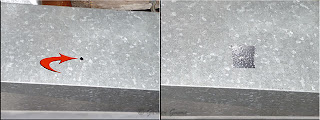 Duct Problem
One problem is older heating systems is the duct work. Contrary to many beliefs, actual duct tape is not good for sealing ducting seams, hole or other problems. Metal foil tape should be used instead and be careful when using this tape as it can give little cuts across your fingers. The metal foil tape gives a nice tight seal that won't lift over time as regular duct tape will.
Any home heat ducting system should be checked for air leakage. Any air leakage from the duct work via holes or seams ends up costing money because the heated or cooled air is not getting where it is supposed to go. Seal any holes (red arrow) with metal duct tape. This is a very simple, low cost yet effective way of making your furnace/air conditioning more efficient.
 Installed
Installation meant removing the old humidifier and patching that hole with sheet metal (red arrow) and cutting 2 new holes. It turned out to be a bit more complicated than planned so the project ended up taking about 4 hours. In the end after a few tests we assured ourselves the humidifier was working properly. According to the instructions we were supposed to set the humistat at 50% for the first 2 weeks of operation to allow the humidity level in the house to equalize. This also ensures the unit cycles on with every furnace cycle. After this initial run the humistat can then be adjusted to a comfortable humidity level. In our case we will aim for the 30% to 35% humidity level.
On a scale of 1 to 10 I would rate this project as a 7 in terms of ease of installation as a DIY project with 1 being easy and 10 being hard. Much will depend on whether there is a pre-existing humidifier and whether it is in the correct location. A water line will need to be tapped into if there is no pre-exisiting humidifier. A drain line will also need to be installed if one is not already there. So this is a project that can take a fair number of DIY skills.
Garden Gnome
©2006-2010






 Old Humidifier
 Wait 6000 Humidifier
 Duct Problem
 Installed