What does a Garden Gnome do when she is not gardening, in the kitchen or doing genealogy? Well the answer might just surprise you so read the entries to find out more. This blog focuses on everything we do to make our house a home. There will be a strong emphasis on home energy efficiency and do-it-yourself (DIY) projects. At the same time there will also be crafts, knitting and crocheting projects along with any other little tips we do to create that down to earth, I want to be here home. Please enjoy your visit :)


Friday, January 11, 2013

Purging and Decluttering

It's a brand new year, perfect timing for purging and decluttering.  I'm on day 2 of doing both and it will likely take me a couple more days which is surprising since we have only been here 16 months and I did massive decluttering before the move.  I have also been very careful to not increase the clutter.  Still, the decluttering continues.  Here is what I'm targeting:

  • receipts - Any receipts over 7 years old kept for tax purposes can safely be destroyed.  Any receipt over a year old for small appliances can be destroyed unless there is an extended warranty which in my case only applies to a very few items.  I am a huge pack rat with respect to grocery receipts, the reason being I author a food blog that discusses food prices so I need to be able to refer to them.  After a year, the prices have changed anyway so the receipts are no longer needed.
  • medicines - Both over the counter and prescription medications have expiry dates.  While they may continue working after that date, there may be a reduced efficacy and/or chemical changes that could cause harm.  This is the time of year I go through the medicine cabinet discarding everything out of date, including vitamins.  I take all medications to be discarded to the pharmacy for safe disposal.
  • sunblocks/sunscreens - Both sunblocks and sunscreens have expiry dates.  We have a boat, a pool and and vacation home (in Florida) plus we do a lot of entertaining.  I always have sunblock and sunscreen on hand for ourselves and for our guests.  Expired sunblock and sunscreen lose the protection factor so even if you apply it, you can end up with a nasty burn.  I emptied all that were over or close to the expiry date.  
  • make-up - I very seldom wear much in the way of make-up so don't have a lot to begin with.  I tossed anything over a year old and I have no plans of replacing it.  I like the natural look.  
  • hair care products - I am a hair care fanatic!  I have waist length virgin (not treated) hair that is greying but I refuse to colour it.  At one time I had just about every hair care product imaginable (eg. gels, anti-frizz, sprays, detanglers, conditioners, shampoos).  Back in May of 2011 I started experiment with all natural hair care then in September discovered the Organix line of keratin hair care products and everything else was history.  When the kids were home for the holidays, I gathered up all the unopened bottles and there were a lot since I stocked up when on sale and sent them home with them.  I went from about 30 bottles and tubes of hair care products down to 3 from the Organix line and 2 Pantenes for my husband who hasn't embraced the Organix line yet.  Once the Pantene products are gone it will be the Organix as they are healthier for your scalp and hair because they are sodium and sulfate free.  Everything else I use on my hair is all natural (eg. baking soda, apple cider vinegar, olive oil, coconut oil) health, beauty and culinary.  
  • food - Generally, my time to go through the pantry and freezers is mid-March before gearing up for our bulk meat purchases and the start of the busiest portion of home food preservation so there isn't a lot to declutter.  However, since I'm in the decluttering mood, I'm making a systematic check through the pantry, freezers and cupboards.  Still this is a good way to use up some of those stashed left-overs.
  • clothes - I'm being really brutal here this time.  If I haven't worn something in over a year, into the donation box.  That's the rule.  
  • nic nacs - I did a rather good clean-up before we moved here but the storage area under the stairs became the home to things that didn't have an immediate home.  After 16 months, we haven't missed these items and likely won't use them so I'm clearing it out!  I'm also clearing out those items I thought would work in our new home but really don't.


Wednesday, January 2, 2013

A Novel Way to Recycle a Plastic Clamshell Salad Container


During our December stay at our vacation home in sunny Florida, our resort held a couple of craft shows.  I seldom buy much at craft shows since I do a lot of crafts myself but I like going to them to discover new crafts.  I bought this Florida Favorites in a plastic clam shell because it was just a very unique presentation I had not seen before and immediately knew it could easily be adapted.

Our vacation home is in a 55+ gated retirement resort.  Aside of the multitude of amenities, it is important to know how the resort is used.  About 25% of the population live there year round.  The rest are snowbirds from the northern states and Canada, staying for part or all of the winter months ( late October through April).  Out of country owners such as ourselves, rent out our home during the peak season (January through April)  if we are not using it.  That means we can have upwards of 4 different renters, usually a couple during that time period.

Renters, much like us tend to use a few convenience products and the local grocery stores certainly cater to that.  Take-out salads are extremely popular because they are inexpensive, come with all the fixings including the dressing and large enough for four servings eliminating the waste of having to toss a bottle of salad dressing because you couldn't use it up before leaving.  The grocery store salads come in two piece clam shell plastic containers.  One of the ladies at our resort came up with a novel way to recycle them.

She made these really cute gift packs called Florida Favorites.  The cleaned clam shells were lined with tissue paper then three wooden seashell themed were placed on top.  She added a small tag printed from her computer and a bow to add a bit of pizazz.  The contents of the clam shell could not have cost her more that $2 at a dollar store and the container was recycled so she was making a profit of $2 for every container that she sold.  Oh, and she wasn't profiting personally as all profits went to the Make A Wish Foundation.  The neat thing is, these recycled clam shells could be filled with just about anything for gift giving!


Tuesday, January 1, 2013

Our Vacation Home Kitchen Range Repairs

Happy New Year!


We spent three weeks in May (one week in Aruba, 2 in Florida), three weeks in October and three weeks Nov 29 through December 20 at our vacation home in Florida.  It had been rented out January through April of 2012.  I was absolutely disgusted by how we found our vacation home when we arrived in May.  Despite the cleaners being in apparently three times, the floors were dirty, the bathrooms had not been touched especially the mirrors, the stove and backsplash had not been cleaned and the list goes on.  We arrived with friends of ours so I hit the floor running just so they could use the guest washroom.  The problem in May was we had guests and the side trip to Aruba so little time to go through the house properly looking for damage.  During the October trip, we had my husband's sister and son, took them to the airport and picked up the guys the same day.  They stayed for a week.  We dropped them off at the airport and the next day left at 7 AM in the morning to meet up with a couple of our kids at Disney World for a couple of days.

On the second day of our October trip, we found out from neighbours that the agent in charge of rentals had been in our house several times, once with a plumber ALL without our permission.  In this case, there is no need for a viewing other than pictures because the tenants are usually from the northern states or Canada so aren't there to do any viewing and at most they rent for one or two months, but usually only a month.  It isn't like it is a long term rental situation or they are looking to buy.  My husband replaced the dead bolts to prevent any unauthorized entry while we were there and because we were coming back in December, we could leave our personal belongings out including food in the fridge and cupboards.  The deadbolts the park has the key to will only be on our home when it is available for rent with the new deadbolts (agent doesn't have key) on the rest of the year.  Finally, during our December trip I had time to do a full inspection and believe me, I was not happy!

damaged drip bowls on our vacation home stove
Our vacation home is a 3 bedroom, 2 bathroom manufactured home, manufactured in November 2007 and assembled in it's current location in the spring of 2008.  The gentleman that owned it was hardly ever home and he lost it so the home sat empty for a year and a half when we bought it without seeing more than pictures, in March of 2010.  During our first visit in May of 2010, I took a lot of pictures.

The Whirlpool electric range was in perfect condition with the exception of one small chip that we repaired that trip.  Other than that there were no chips on any of the grey porcelain drip bowls.  Much to my dismay, I discovered all four of the drip pans were chipped during our May trip even though there had been no chips prior to the 2012 rental period!  An online search showed replacement cost of $13 for each of the 6 - inch drip bowls and $40 for each of the 8 - inch drip bowls.  In the big picture, $106 to repair the drip bowls wasn't too bad but they would likely get chipped again with the next renters.  The bottom line is, even when renting someones home and even at a premium price ($2,200 per month January through April), they really don't care if they cause any damages. [As a result of damages, we now have a neighbour that will go through our house and let us know of any damages so the renters' credit card (mandatory requirement if renting through the park) will be charged the day after they vacate if there are any damages.  Both of the 2012 renters will not be allowed to rent from us again.]

replacement drip bowls
We decided to replace the drip bowls with chrome drip bowls that we found at Lowes.  The first set didn't fit properly so my husband took them back and bought ones that actually said Whirlpool on the label.  They cost us $19.99 for the four of them which is considerably less expensive than the porcelain drip bowls.

I'm hoping that we get a couple of years out of them which isn't an unreasonable expectation providing they are cared for.  The nice thing is, the chrome drip bowls won't chip and they should clean up fairly easily.  Realistically, we have already put replacing the drip bowls on our annual repair list.

an overlooked area of the stove that should be cleaned
Electric stoves have an open space between the outside of the top of the oven and the stove top.  Unfortunately, many folks over look this area when cleaning electric ranges even though it can get a bit gunky from overflowing pots, spills, grease splatters and crumbs.  The reason this happens is regular drip bowls have a hole in the centre and another hole where the burner connects through into the socket.  That means foods and liquids can find their way onto this surface which can cause odours, attract pests (eg. ants, mice) and in severe build-up create a fire hazard.

Our vacation home stove is cleaned from top to bottom at the end of each stay.  It is also cleaned by the paid cleaners each time a renter leaves.  However, and this will be an issue to discuss with the agent, this problem area had not been cleaned.  I removed the burners and drip bowls then gave this space a good scrubbing.  It didn't take long to clean it up but this is one area that should be cleaned every other week.

new drip bowls in place
Once the stove was cleaned up, I put the new drip bowls in place and popped the burners in.  I personally would have liked to stay with the grey porcelain but quite frankly the chrome looks clean and fresh.  We won't have to worry about chipping either so it was a nice, inexpensive solution to a problem.  We are likely the only ones that will know the original drip bowls were grey porcelain anyway.  Renters want things clean, neat and tidy even though some renters don't leave our home in the same condition they found it.  At any rate, I think the solution looks nice while being practical.

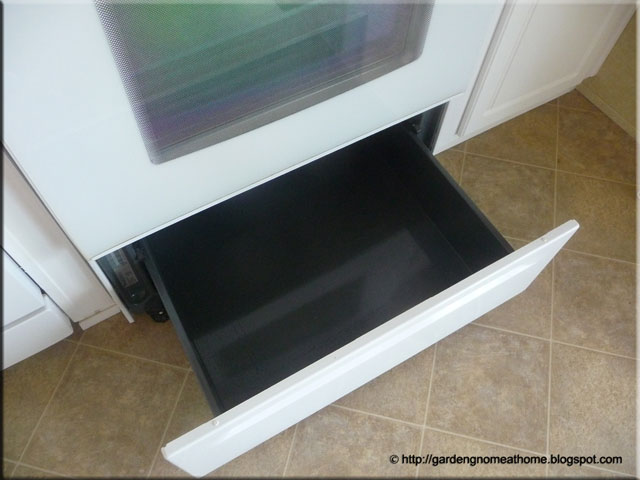
cleaning out the storage compartment
Many ranges have storage drawers underneath the over that are suitable for baking sheets and that type of thing.  I've only had one stove (JennAir down draft) that didn't have a storage drawer.  Storage drawers are another overlooked area for cleaning.  Yet they can get drips and crumbs in them from regular cooking. It is an area that should be regularly wiped down whenever cleaning the stove.

When we closed up our vacation home in December 2011, that storage drawer was squeaky clean along with anything that was in it.  I had to wash all the baking sheets and bakeware then vacuum out the storage drawer before washing it.  Once the storage drawer was dried, I gave it a good spray of rubbing alcohol to kill any remaining germs while seriously curing out the last renters.

a bit of rusting on the storage drawer
As I was cleaning I noticed a ridge of rusting on the inside of the storage drawer front.  Florida is moist and humid so that means potential moisture problems including rusting and mould that can happen very quickly.  Moisture problems can cause a significant amount of damage in a very short period of time.  That means you always have to be on the outlook for any signs of moisture damage.  We always leave the AC set to control any moisture when we aren't there.  The problem is we cannot force a renter to leave the AC on if they don't want to so we have to be extra careful when checking for moisture damage.

I honestly have only seen rust on a kitchen range twice.  The first was due to oven cleaner dripping into the storage drawer resulting in a couple of blisters that started to rust in our ancient Admiral (bought in late 1980's) and the area noted at our vacation home.  I know the rust was not there when we bought the house and I don't recall seeing it in December of 2011 even though I recall cleaning the storage drawer.  I cleaned off the rust with a wire brush, washed and let the area dry well including using a blow dryer to be sure it was dried.  Then I used a Rustoleum rust guard appliance paint to repaint the surface.  I used three coats so the area is well protected.  It's on my list of things to re-check during our next visit.


Monday, December 31, 2012

Check Those Expiry Dates

My husband is down with a cold graciously shared by our youngest grandchild.  Given the fact we just recently spent time in a busy airport filled with holiday travellers, spent time in a couple of malls infested with germs, and we are tired from our vacation, it is little wonder a few germs could get the best of him.  Neither of us are big into using any medications other that dietary supplements.  I am officially on two prescription drugs but even my doctor knows I only take them if I absolutely need to.  Neither of us get the flu shot even though I am considered high risk.  Instead, we believe in healthy eating with dietary supplementation if necessary, adequate sleep, a bit of exercise, well you get the picture.

When my husband gets a cold, he insists on using Nyquil.  I personally don't like this OTC product because it even knocks him out and he is a large man.  Aside of that,  it doesn't help the body naturally clear itself of the viral infection, which is what the common cold is.  Drying up muscus secretions can lead to chronic sinus infections and other complications.  So tonight, my husband pulled a bottle of Nyquil from the medicine cabinet but before he could take a dose, I told him to check the expiry date.

All medications including dietary supplements have expiry dates.  Unlike the expiry dates on food where the quality is diminished and yet the food may still be safe to consume, the expiry dates on many prescription and OTC drugs mean the drug should not be consumed after that date.  One of the reason is, all these products are synthetically made and synthetic chemicals breakdown over time.  In some cases, one or more chemicals in the drug start to breakdown and they can form toxic by-products that can be quite dangerous even toxic when consumed.  In other cases, especially with sunblocks, the active ingredients breakdown becoming ineffective meaning you can get a rather nasty sunburn even though you thought you were protecting yourself with sunblock.

I'm very, very careful to go through our medicine cabinet every month.  Living between two houses makes it a bit more difficult because items travel back and forth but still, it is even more reason for me to check to be sure something doesn't get pushed to the back.  His bottle of Nyquil was expired.  He had pulled the bottle from his overnight travel bag likely because that's where he remembered it was and I had never thought to check that bag.  I gave him a fresh bottle of Nyquil and he is sleeping like a baby but this serves as a reminder.  Teach everyone in your home to always check the expiry date before consuming any prescription or OTC drug including dietary supplements.  Never consume either if past the expiry date.


Sunday, December 30, 2012

'Tis the Season

'Tis the holiday season for spreading joy, kindness, cheer AND germs!  We were at our vacation home in Florida until December 20, then spent much of our arrival day home in mall and other seedy places where germs like to hide.  It didn't help that we had spent time in a germ laden airport or on a germ infested plane.  Still, by the 26th when we hosted our family Christmas, there was no signs of illness other than our little grandson who had a cold.  They left on the 28th and we hosted a larger gathering on the 29th.  My husband woke up with a cold and our daughter, parent of grandson with the cold called to say she had flu-like symptoms.  I have been in serious overdrive mode between cleaning up from the holidays and germ control.  I should have been on top of it earlier but with the holiday rush, I forgot.

I'm considered high risk with brittle asthma and I refuse to take the flu vaccination.  My husband also does not take the flu vaccination either and before you say we should there are adverse side effects to the flu vaccination that can be long lasting resulting in chronic symptoms neither of us wish to deal with.

My first line of defence is rubbing alcohol in a spray bottle.  Everything hands can touch gets sprayed a couple of times a day until there are no signs of sickness in the house.  I actually start this when I first start hearing of friends or family coming down with colds or flu-like symptoms.  I keep the spray bottle ready so every time I think about it things gets sprayed.  Rubbing alcohol (ethanol or isopropyl) is one of the best anti-biologicals there is because it kills 99% of virii and bacteria on contact.  It's what we used on our lab benches to effectively control biologicals.

And so it begins....'tis the season...


Monday, December 17, 2012

Turmeric Facial Mask

turmeric facial mask

I have been battling melasma for a number of years so have done a fair amount of research as to how to deal with the condition.  Successfully treating this hyper-pigmentation skin disorder involves both internal (eg. dietary, dietary supplementation) and external (eg. chemical, skin bleach, chemical peels, natural ingredient masks, natural skin bleaches, sunblocks).  And, they must go hand in hand because while the problem is internal it manifests itself externally.  During my research, I came across using turmeric as a facial mask.  Ideally, turmeric should also be taken as a dietary supplement to help clear the skin, but use caution as turmeric can cause gastointestinal problems, and too much can activate the gene p53 that deactivates damaged cells in the heart.

Turmeric has long been used by Indians (Asia) as part of lightening the skin for wedding ceremonies.  It is combined with one or more ingredients and applied as a mask to even out skin tone while reducing skin blemishes as it brightens and whitens the skin.  Turmeric is one of the best things you can use on your skin!

Turmeric Facial Mask

turmeric powder
fresh lemon juice
plain yogurt
local, unpasteurized honey
graham flour (optional)
aloe vera (optional)
olive oil (optional)

There are no measurements for this facial mask.  What you want is a thick paste that will cling to the face.  I started with about a half tsp of turmeric powder (strong antioxidant, nourishes the skin, neutralizer) then added a little fresh lemon juice (natural skin lightener), about a quarter of tsp of plain yogurt (exfoliate, skin brightener) and about a quarter tsp of honey (humicant, moisturizer, antibacterial agent) .  I simply use the back of the spoon to smooth the paste over my face.  I have had good results both adding aloe vera (moisturizer, antioxidant) to the mixture and alone as a pre-treatment.  Graham flour helps to whiten and exfoliate but I usually don't use it.  Olive oil will slow the drying of the mask while providing Vitamin E that aids in lightening as it moisturizes.  I allow the paste to dry thoroughly on my face for 30 minutes.  Add it to the mask or use it as a post treatment following the mask.  I remove the mask with warm water and wash lightly with goat's milk soap.  It does make a huge difference in evening out skin tone.

Turmeric is very effective as part of your skin management system.  The simple thing is, turmeric works.  The problem with turmeric is, it stains everything a bright orangy yellow.  When you are using a turmeric facial mask, wear old clothes you don't mind getting stained.  Use old face cloths as well as they too will become stained.  Your skin will be stained as well.  You have two choices after removing the mask.  If you rinse with warm water only, the stain will fade in about 3 hours.  If you rinse then wash with goat's milk soap, the stain is removed quickly.

I find that using aloe vera as a pre-treatment to the turmeric facial mask increases the effectiveness.  I also use aloe vera as a post treatment after removing the mask.  I've had good results using an all natural goat's milk soap to remove any skin staining from the mask.  Goat's milk soap provides lactic acid which acts as an exfoliant.  As soon as my skin is dry from washing the mask, I apply aloe vera then sunblock.  The number one rule when doing any kind of skin lightening (eg. melasma patches) is SUNBLOCK.  The area being treated should only be without sunblock during treatment.  It should always be protected with a high SPF sunblock with the exception of the treatment period.



Sunday, December 2, 2012

The Downside of Sunblock

We live in beautiful Ontario, Canada where we have a boat, a pool and we vacation close to 3 months of the year in Florida.  The problem is I have melasma, hyperpigmented patches on my face.  The recommended treatment for melasma is to use some type of lightening system (chemical, natural) then protect the face with the highest SPF broad spectrum sunblock you can find.  I have gone all natural as far as actually treating my melasma including using a custom made turmeric mask (more on that in the next post).  I am still using an SPF 110 sunblock and therein lies one problem.

Aside of the melasma, did you know that strong sun exposure can cause your hair to turn grey quicker?  'Tis true!  It works in reverse of tanning by bleaching out the melanin that gives hair it's colour.  Both my husband and I noticed more greying after being in Aruba

Chemical sunblocks contain a few chemicals that can actually cause more problems then they solve including making your skin more susceptible to skin cancer.  I've been paying premium prices for the ultra high SPF protection and while I heard of some of the chemical warnings, I did not know that the skin cannot absorb anything higher than SPF 50 protection.  Essentially, I have been wasting my money for extra protection my skin wasn't able to utilize.

The second problem with sunblocks is it reduces the production of Vitamin D.  In fact, many living in northern climates as we do have a Vitamin D deficiency.  The body makes Vitamin D via sun exposure so it stands to reason that in northern climates where your are covered from head to toe during the winter months and your face is protected with a high SPF sunblock, sun exposure is blocked so your body can't make Vitamin D.

The third problem is some of the chemicals in sunblocks can make you physically sick.  Not only can they cause allergic reactions, they can cause gastrointestinal problems because they are absorbed through the skin.  The worst part is, as I found out, you might not suspect your sunblock is the cause of your gastrointestinal problems.

Finally, sunblock can block your pores creating rashes and skin break-outs.  They can cause you to feel hot and sticky even if they say they are dry.  Beware of those who say they are dry with a lightweight feeling as those sunblocks can really end up drying your skin as well.

We are moving away from using chemical sunblocks wherever possible.  There are a multitude of ways to avoid strong UV exposure.  Be aware that UV exposure comes through windows including vehicle windows and from indoor lighting.  UV exposure can also be strong between 11:00 AM and 4:00 PM even with cloud cover.  We spent most of the month of October at our vacation home in Florida.  I was beyond pleased to be asked "Weren't you just in Florida?  Where's your tan?"  Now, those who live in Florida year round know how to avoid the sun.  I was also impressed during our Aruba vacation how folks avoid sun damage without resorting to using a lot of sunblock.  Here are a few things we are doing to avoid chemical sunblocks at both of our homes:

  • avoidance - We tend to avoid being outdoors when the UV rays are the strongest.  If we are in one of our vehicles we use the drop down shades on the side windows to block UV rays.  At home, we filter out direct sunlight so we still get the warmth during the winter months with greatly reduced UV exposure.
  • shade - I'm a shade seeker.  I don't like being in the direct sun.  If walking, I tend to walk on the shady side of the street.  If waiting, I stand under the shade of a tree and even at the pool both at home and at our vacation home, I'm the one sitting in the shade.  We have devised ways to create shade on the boat, at home on the decks and around the pool, as well as on the golf cart so we don't have to be in direct sun to enjoy the great outdoors.
  • clothing - Did you know there are actual SPF ratings for various fabrics?  What you wear especially during the strong UV exposure hours can make a huge difference.  Covering up is inexpensive and surprisingly can be cooling especially for women if you wear summer frocks that let the air in while blocking the UV rays.  During the heat of the day, put on a long sleeve, white cotton shirt to cover your arms.  Wear long but light weight pants or skirts as well.
  • hats - A broad brimmed hat is a must to keep the sun off your face.  I have several of them as does my husband who is an avid golfer meaning he gets a lot more sun exposure than I do.  I like the straw hats with wide brims because they tend to be a bit cooler on the head while shading the face and neck.  
  • parasols - Parasols are a fancy type of umbrella designed to keep the sun off your face.  They were very popular during Victorian times where milky white skin was seen as a beauty asset.  They remain popular in cultures cultivating the milky white skin (eg. Japan, Asian cultures) but can be seen world wide now as folks travel.  I was surprised to see several of them during our visit to Disney World this past October.  Now, parasols make perfect sense because they provide you with instant shade something that is difficult to find at theme parks.    They are available in ultra compact sizes and if you don't want to splurge on an actual parasol, an ultra compact umbrella will achieve the same thing. 
  • natural skin correctors - There are a number of natural skin correctors that reverse the damage from sun exposure.  They include: turmeric, honey, milk, lemon juice and aloe vera. Of those, aloe vera is very effective when used both before and after sun exposure.  Vitamin C, E and L-cysteing as well as pomegranate extract, ellagic acid and ferulic acid are natural ways to reduce melanin production as well.