What does a Garden Gnome do when she is not gardening, in the kitchen or doing genealogy? Well the answer might just surprise you so read the entries to find out more. This blog focuses on everything we do to make our house a home. There will be a strong emphasis on home energy efficiency and do-it-yourself (DIY) projects. At the same time there will also be crafts, knitting and crocheting projects along with any other little tips we do to create that down to earth, I want to be here home. Please enjoy your visit :)


Showing posts with label vacation homes. Show all posts

Wednesday, January 2, 2013

A Novel Way to Recycle a Plastic Clamshell Salad Container


During our December stay at our vacation home in sunny Florida, our resort held a couple of craft shows.  I seldom buy much at craft shows since I do a lot of crafts myself but I like going to them to discover new crafts.  I bought this Florida Favorites in a plastic clam shell because it was just a very unique presentation I had not seen before and immediately knew it could easily be adapted.

Our vacation home is in a 55+ gated retirement resort.  Aside of the multitude of amenities, it is important to know how the resort is used.  About 25% of the population live there year round.  The rest are snowbirds from the northern states and Canada, staying for part or all of the winter months ( late October through April).  Out of country owners such as ourselves, rent out our home during the peak season (January through April)  if we are not using it.  That means we can have upwards of 4 different renters, usually a couple during that time period.

Renters, much like us tend to use a few convenience products and the local grocery stores certainly cater to that.  Take-out salads are extremely popular because they are inexpensive, come with all the fixings including the dressing and large enough for four servings eliminating the waste of having to toss a bottle of salad dressing because you couldn't use it up before leaving.  The grocery store salads come in two piece clam shell plastic containers.  One of the ladies at our resort came up with a novel way to recycle them.

She made these really cute gift packs called Florida Favorites.  The cleaned clam shells were lined with tissue paper then three wooden seashell themed were placed on top.  She added a small tag printed from her computer and a bow to add a bit of pizazz.  The contents of the clam shell could not have cost her more that $2 at a dollar store and the container was recycled so she was making a profit of $2 for every container that she sold.  Oh, and she wasn't profiting personally as all profits went to the Make A Wish Foundation.  The neat thing is, these recycled clam shells could be filled with just about anything for gift giving!


Tuesday, January 1, 2013

Our Vacation Home Kitchen Range Repairs

Happy New Year!


We spent three weeks in May (one week in Aruba, 2 in Florida), three weeks in October and three weeks Nov 29 through December 20 at our vacation home in Florida.  It had been rented out January through April of 2012.  I was absolutely disgusted by how we found our vacation home when we arrived in May.  Despite the cleaners being in apparently three times, the floors were dirty, the bathrooms had not been touched especially the mirrors, the stove and backsplash had not been cleaned and the list goes on.  We arrived with friends of ours so I hit the floor running just so they could use the guest washroom.  The problem in May was we had guests and the side trip to Aruba so little time to go through the house properly looking for damage.  During the October trip, we had my husband's sister and son, took them to the airport and picked up the guys the same day.  They stayed for a week.  We dropped them off at the airport and the next day left at 7 AM in the morning to meet up with a couple of our kids at Disney World for a couple of days.

On the second day of our October trip, we found out from neighbours that the agent in charge of rentals had been in our house several times, once with a plumber ALL without our permission.  In this case, there is no need for a viewing other than pictures because the tenants are usually from the northern states or Canada so aren't there to do any viewing and at most they rent for one or two months, but usually only a month.  It isn't like it is a long term rental situation or they are looking to buy.  My husband replaced the dead bolts to prevent any unauthorized entry while we were there and because we were coming back in December, we could leave our personal belongings out including food in the fridge and cupboards.  The deadbolts the park has the key to will only be on our home when it is available for rent with the new deadbolts (agent doesn't have key) on the rest of the year.  Finally, during our December trip I had time to do a full inspection and believe me, I was not happy!

damaged drip bowls on our vacation home stove
Our vacation home is a 3 bedroom, 2 bathroom manufactured home, manufactured in November 2007 and assembled in it's current location in the spring of 2008.  The gentleman that owned it was hardly ever home and he lost it so the home sat empty for a year and a half when we bought it without seeing more than pictures, in March of 2010.  During our first visit in May of 2010, I took a lot of pictures.

The Whirlpool electric range was in perfect condition with the exception of one small chip that we repaired that trip.  Other than that there were no chips on any of the grey porcelain drip bowls.  Much to my dismay, I discovered all four of the drip pans were chipped during our May trip even though there had been no chips prior to the 2012 rental period!  An online search showed replacement cost of $13 for each of the 6 - inch drip bowls and $40 for each of the 8 - inch drip bowls.  In the big picture, $106 to repair the drip bowls wasn't too bad but they would likely get chipped again with the next renters.  The bottom line is, even when renting someones home and even at a premium price ($2,200 per month January through April), they really don't care if they cause any damages. [As a result of damages, we now have a neighbour that will go through our house and let us know of any damages so the renters' credit card (mandatory requirement if renting through the park) will be charged the day after they vacate if there are any damages.  Both of the 2012 renters will not be allowed to rent from us again.]

replacement drip bowls
We decided to replace the drip bowls with chrome drip bowls that we found at Lowes.  The first set didn't fit properly so my husband took them back and bought ones that actually said Whirlpool on the label.  They cost us $19.99 for the four of them which is considerably less expensive than the porcelain drip bowls.

I'm hoping that we get a couple of years out of them which isn't an unreasonable expectation providing they are cared for.  The nice thing is, the chrome drip bowls won't chip and they should clean up fairly easily.  Realistically, we have already put replacing the drip bowls on our annual repair list.

an overlooked area of the stove that should be cleaned
Electric stoves have an open space between the outside of the top of the oven and the stove top.  Unfortunately, many folks over look this area when cleaning electric ranges even though it can get a bit gunky from overflowing pots, spills, grease splatters and crumbs.  The reason this happens is regular drip bowls have a hole in the centre and another hole where the burner connects through into the socket.  That means foods and liquids can find their way onto this surface which can cause odours, attract pests (eg. ants, mice) and in severe build-up create a fire hazard.

Our vacation home stove is cleaned from top to bottom at the end of each stay.  It is also cleaned by the paid cleaners each time a renter leaves.  However, and this will be an issue to discuss with the agent, this problem area had not been cleaned.  I removed the burners and drip bowls then gave this space a good scrubbing.  It didn't take long to clean it up but this is one area that should be cleaned every other week.

new drip bowls in place
Once the stove was cleaned up, I put the new drip bowls in place and popped the burners in.  I personally would have liked to stay with the grey porcelain but quite frankly the chrome looks clean and fresh.  We won't have to worry about chipping either so it was a nice, inexpensive solution to a problem.  We are likely the only ones that will know the original drip bowls were grey porcelain anyway.  Renters want things clean, neat and tidy even though some renters don't leave our home in the same condition they found it.  At any rate, I think the solution looks nice while being practical.

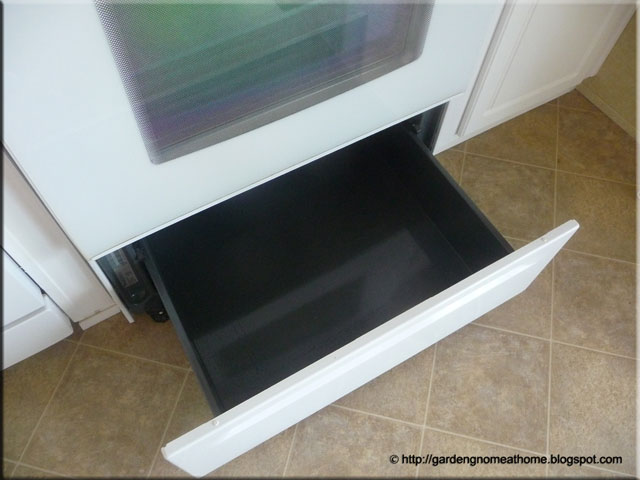
cleaning out the storage compartment
Many ranges have storage drawers underneath the over that are suitable for baking sheets and that type of thing.  I've only had one stove (JennAir down draft) that didn't have a storage drawer.  Storage drawers are another overlooked area for cleaning.  Yet they can get drips and crumbs in them from regular cooking. It is an area that should be regularly wiped down whenever cleaning the stove.

When we closed up our vacation home in December 2011, that storage drawer was squeaky clean along with anything that was in it.  I had to wash all the baking sheets and bakeware then vacuum out the storage drawer before washing it.  Once the storage drawer was dried, I gave it a good spray of rubbing alcohol to kill any remaining germs while seriously curing out the last renters.

a bit of rusting on the storage drawer
As I was cleaning I noticed a ridge of rusting on the inside of the storage drawer front.  Florida is moist and humid so that means potential moisture problems including rusting and mould that can happen very quickly.  Moisture problems can cause a significant amount of damage in a very short period of time.  That means you always have to be on the outlook for any signs of moisture damage.  We always leave the AC set to control any moisture when we aren't there.  The problem is we cannot force a renter to leave the AC on if they don't want to so we have to be extra careful when checking for moisture damage.

I honestly have only seen rust on a kitchen range twice.  The first was due to oven cleaner dripping into the storage drawer resulting in a couple of blisters that started to rust in our ancient Admiral (bought in late 1980's) and the area noted at our vacation home.  I know the rust was not there when we bought the house and I don't recall seeing it in December of 2011 even though I recall cleaning the storage drawer.  I cleaned off the rust with a wire brush, washed and let the area dry well including using a blow dryer to be sure it was dried.  Then I used a Rustoleum rust guard appliance paint to repaint the surface.  I used three coats so the area is well protected.  It's on my list of things to re-check during our next visit.


Wednesday, June 13, 2012

Oh the Joys of Renting Out Our Vacation Home

We along with another couple arrived at our vacation home in Florida on May 8.  I seriously was embarrassed!  The resort takes care of any rental arrangements for us but believe me that is going to change.  It has been nothing but problems this year what with late rent payments and bogus repair charges.  Then we arrive to find a house that was dirty even though the cleaners had been in three times.  Apparently the cleaners don't do sinks, toilets, the wall behind the stove, or floors.  I was beyond ticked!  I should have called them right then but it was well after 10 PM so the next day I got busy cleaning then we flew out to Aruba.  When we returned from Aruba and our friends left, I had a good chance to assess our home.

Two bath towels had somehow become violet, not white, violet.  Two hand towels looked like they had been used to clean up axial grease.  Every cabinet had been rearranged and someone had plastered stickers all over our patio doors.  The microwave oven was beyond being disgusted, it was down right filthy.  The drip pans on the stove were equally dirty.  The hard flooring was quite dirty and clearly the mirrors had not been cleaned at all.  I actually had to clean toothpaste splatters off one of the mirrors.

I spoke with the resort.  They were very apologetic and reassured me it will not happen again.  They are replacing our towels.  Clearly, we cannot leave out good towels or anything else we don't want ruined.  That includes some small kitchen appliances.  We have a locked storage closet but need to add personal storage in the shed.  The thing is we have rented plenty of condos, time shares, and cottages where there is a fully equipped kitchen.  I wouldn't dream of rearranging the kitchen or leaving the place dirty or destroying what was left there to make life easier during the rental period.  Apparently others do not feel the same way!


Garden Gnome
©2006-2012


Saturday, June 11, 2011

Back From Vacation

We recently spent a week in Las Vegas, a brief 18 hour stop at home then ten days at our vacation home in Florida.  We rent the house out when we are there if possible.  It was rented out for the months of February and March.  I was on pins and needles but I think once I get used to the idea of rent out our vacation home it will be fine.  The first tenants came across as those we don't want back.  They were not friendly with our neighbours at all.  Being in Canada and the vacation home in Florida it is very important that we have good neighbour relations in Florida.  We are depending on them to keep an eye on our investment when we aren't there.  They were a bit on the nit picky side as well.  The second couple got along good with our neighbours.  They were friendly and from what we saw treated the house as they would have treated their own even using the bug spray we left in the garage to treat the outside of the house.  They left us a thank-you card for letting them rent our home.  I thought that was quite nice.

Tenants pay a cleaning fee.  The house was left in good condition but one of the beds was not made.  It wasn't a major problem but it should have been made.  There was a chip out of one of the stove drip pans so I wasn't impressed with that but it was likely an accident.  Other than that the rental experience of our rental home is going rather well. 

Garden Gnome
©2006-2011


Wednesday, January 12, 2011

Vacation Home Food Issues

Yesterday I eluded to a few issues with the food at our vacation home.  This year we are planning on using our vacation home for a total of 3 months with the rest of the time spent at our primary residence.  Food immediately became an issue because I am limited as to what I can bring to the vacation home due to space, distance and crossing the border.  I'm limited as to what I can bring back from the vacation home for the same reasons.  Furthermore I am restricted when it comes to refrigerated/frozen foods during those periods where our vacation home will be rented out.  This means that thing like condiments end up being tossed if we are flying so I really must come up with a better solution.  I can however store a limited amount of home canned and dried foods in our locked closet so that helps.

This past trip because we were driving and heading to our kids house before going home, I packaged up all the refrigerator contents and left them at their house.  I also left them any of the dried foods that had been opened.  That worked well for this particular trip.  However, it will not work for the majority of the trips and until we get to know our neighbours there a bit better I feel uncomfortable offering opened containers of food to them. 

Time to rethink how we are doing food at the vacation home...

Garden Gnome
©2006-2011


Tuesday, January 11, 2011

Living Between Two Homes

Living between two homes is not a new idea by any stretch of the imagination.  Many North American native tribes had a summer and winter homeland.  During the Victorian Era those living in urban settings would head to their summer homes.  Summer cottages have long been a tradition along with camping and RVing.  I can recall my best friend in elementary school always leaving the day after school got out not to return until the day before school started.

Last March we purchased our vacation home which effectively meant we would be spending time between the two homes.  We are not new to having a vacation home but we are new to having a stationary one.  Our RV sat in the driveway when not in use which meant I could equip, load and unload it quite conveniently.  Our vacation home on the other hand involves either a long commute by car or air and an International border.  This by default creates a logistical problem for equipping, loading and unloading the vacation home.  We ended up stocking the vacation home from empty to livable with mostly new and some used items.  We were very limited as to what we could bring from our primary residence.

Food becomes a huge issue because I am used to a well stocked pantry and taking food from home.  I am limited in what I can bring from our primary home to our vacation home not only in space and customs restrictions but when traveling through the colder weather the threat of food freezing.  At the same time I am restricted as to what can be kept in the vacation home when we aren't there.  If we are planning on returning within a month or so without renting it out then the food can stay in the refrigerator and pantry but if we are gone for a longer period of time with renting it out we have to remove everything.  Some pantry items can stay in our special locked closet but all refrigerator items have to be removed.  This actually presents quite the challenge.  More on that tomorrow...


Garden Gnome
©2006-2011


Saturday, January 8, 2011

Vacation Home Toilets

Our vacation home has two toilets.  Unlike RV toilets that can be cleaned then a chemical holding tank fluid poured into the tank to prevent odours, vacation home toilets must be shut down during extended periods of absence.  Once the toilet has been cleaned we turn the water off to prevent any problems that could occur in the event of a burst pipe or water leak.  Normal toilets have a P-trap to prevent sewer gases and odours from entering the house.  The P-trap is designed to hold a certain amount of water.  During extended periods of the house being shut down there is the possibility that the P-trap can dry out through evapouration.  This would allow odours to get into the house along with any critters like Palmetto bugs that can come up through sewer pipes.  We learned this tip from our neighbours in our vacation home community.  Covering the top of the toilet bowl with plastic wrap is a way to prevent water in the P-trap from evapourating.  In the event a critter gets in the sewer pipe it will be confined to the toilet bowl instead of getting out into the house.

Garden Gnome
©2006-2011


Friday, December 31, 2010

2010 Winds Down

This has been a frustrating but exciting year for us on the homemaking front.  With our primary residence up for sale and house hunting for most of the year a lot of things have been put on hold.  On the other hand with the purchase of our vacation home we have had a good deal of fun getting it equipped for renting out when we aren't there.

What was rather fun about getting the vacation home equipped was being able to buy pretty much everything new, something when first setting up a home usually isn't possible.  We even discovered 'beds in a bag'!  Oh sure I had bought these as gifts for others but had never bought one for ourselves.  Within minutes the vacation home beds were gorgeously co-ordinated looking very much motelish.  All my bath and kitchen towels match perfectly at the vacation home.  We bought cutesy bedroom lamps, whimsical and definitely not our regular at home look.  We bought 2 throws for the livingroom and while they are nice they are the handmade crocheted or knitted throws we are used to.

There's a down side to that aside of the cost though as there's no history or emotion attached to the 'stuff' used to fill the home.  There is none of that 'have to have spoon' because that is special or the 'remember when stains'.  We ended up bringing down several things from our primary home just to make our vacation home feel more like ours.  I'm sure as we visit more it will become our home away from home as well but for now it is new.  It even smells new!

Overall, we are excited and looking forward to changes in 2011!

Garden Gnome
©2006-2010


Monday, December 20, 2010

Core Charge on Batteries

Batteries have rechargeable life span so any rechargeable battery from AAA to 12 V will at some point need to be replaced.  All batteries whether rechargeable or not should be disposed of in a manner that they do not contaminate land fills.  In most cases batteries are disposed as a hazardous waste via special hazardous waste disposal sites or through the repair shop or store where you bought the batteries.  To ensure you dispose of the old batteries properly there is a provincial  (Canada) or state (United States) fee charged on the purchase of the new 6 V, 8 V or 12 V batteries that is refunded when the old battery is brought back.  There may or may not be an additional battery disposal fee.   If the battery is replaced at an auto repair shop or similar type repair shop for other battery powered equipment (eg. golf carts) the fee is waived although any battery disposal fee is still charged if applicable. 

It was rather nice that we were able to return the old golf cart batteries to get our $9 back per battery.  That ended up being a refund of $45 and we did not have the hassle of finding another eco-friendly way of disposing them.  We didn't get the $9 refund for the battery that blew as it was too damaged to transport safely.  It ended up going into the hazardous waste collection in our vacation home community.

Garden Gnome
©2006-2010


Sunday, December 19, 2010

Golf Cart Battery Problem

We certainly are not strangers to large battery operated power having had an RV for a number of years that used a deep cycle 12 V battery and now a boat using two 12V deep cycle marine batteries.   Large batteries meant for marine, RV, golf cart and solar use range from 6V to 12V depending on the usage.  If the power is meant to be depleted before a full charge then a deep cycle battery is needed and usually the batteries are in pairs so you are using one while the other is being recharged.  These batteries differ from vehicle batteries that receive a constant charge from the alternator each time the vehicle is operated.

exploded battery
Solar power requires deep cycle batteries and one of the problems stressed is batteries can and do blow-up.  If they blow sulphuric acid is released in larger amounts but small amounts can be released under normal use.  This is why batteries of this size should not be stored in living spaces but rather in a separate battery shed if used for solar.  Special battery boxes are recommended for RV and marine use.

A battery bank of 6 - 8 V batteries sits below the seat on our golf cart.  This is the power that allows the golf cart to operate.  They are charged via an electrical battery charger.  Well, one of our batteries blew.  It likely was going from the time we bought the cart but chose this particular time to go.  If you heard the noise you would certainly know why and oh my gosh it was loud!  Thank goodness it was outdoors as there was a bit of battery acid spillage.  We neutralized the spillage with a baking soda solution.  We also washed the tools used to remove the battery with the same solution to neutralize any battery acid that may have got on them.

These larger batteries aren't cheap but if looked after properly will give dependable service for several years.  However, like a car battery at some point they will need to be replaced.  Given the condition of the batteries in the golf cart rather than replace just the blown battery we replaced all 6.  The batteries cost $79.82 each plus a state fee of $1.50 and a core charge fee of $9 for a total cost of $541.92.  Under normal usage these batteries should last about 4 years.

Garden Gnome
©2006-2010


Wednesday, October 6, 2010

We Signed the Contract for Our Vacation Home to Rent Out

We finally have our vacation home equipped to the point we were able to sign the agreement to rent our home out when we aren't there.  It is a big step but one that we are confident will work out to our advantage.  It's amazing how much can be done through fax and internet these days.  At any rate we are ready to go with two and a half months rented already so that's a good sign!

Garden Gnome
©2006-2010


Tuesday, October 5, 2010

Vacation Home Locked Closet Hinge Solution

Like many in our vacation home community we decided even before purchasing the vacation home that we would be renting it out when we weren't there.  We figured it would be better than leaving the house empty and this way we end up with the vacation home paying for itself as well as generating a little income.  Based on the figures renting the house on a short term basis for a total of 5 months all expenses are paid for the year and everything else is extra money.  So this will end up being a nice bit of rental income as well as giving us a free place to stay on vacation.

door hing
Most home owners in our vacation home community do the same thing.  Since we have no desire to cart some of our personal effects back and forth we are doing like many by setting up a locking closet.  This really is not a difficult undertaking.  Essentially all that is required is to remove the existing handset and replace it with a locking handset.  This part went smoothly but then I noticed a potential problem.

The closet we are using is in the second bedroom.  The doors are set so they swing into the room rather than into the closet.  As a result the hinge pins are on the room side of the door which means even if the door is locked someone could pop the hinge pins out to get into the closet.  While this is highly unlikely it made me a bit uncomfortable since we will be storing computer equipment, home canned foods, tools and other items not intended for use by the tenants.  I did a Google search to come up with an easy, low cost, DIY solution to this minor problem.

door hinge security solution
The solution I found was drilling a hole through the hinge then screwing in a screw through into the pin.  This would prevent removing the pin entirely unless the screw is removed but this can only be achieved on the closet side of the door.  If we securing a hinge pin at home this would be a great solution as we already have a drill to make the pilot screw hole.  However, at the vacation home that would mean buying a drill.  So we asked the helpful folks at Home Depot.

They came up with an even easier solution.  Pictured is the solution and it is a bit difficult to tell what we did from the photo.  The two centre screws of the hinge were removed.  Since the screw holes did not line up we improvised.  We put a nail adjacent to the screw hole that would line up with the empty screw hole leaving the nail out by about ¼ - inch.  What happens is when the door is closed the nail head goes into the empty screw hole so even if the pin is pulled out the door cannot be removed.  I thought this was a great solution!  We used two nails on each hinge but that is because of the design of the hinge.  One nail would be sufficient on a normal straight design hinge.

Garden Gnome
©2006-2010


Monday, October 4, 2010

Renting Out Our Vacation Home

Renting out our vacation home is considerably different than simply renting a house out as a rental property.  We hope to rent our vacation home during the periods of time we are not using it.  That means it may be rented for a week or two at a time to as long as three months.  We have to options available to us.  We can rent the property out ourselves or we can use the rental agent.  There are pros and cons to both options but using the rental agent is the lower risk option even though we pay them a monthly fee.  In return they do the credit and security checks, security deposit, collect the rent, ensure the tenant is following the rules we set out (eg. no smoking, no pets), arrange for cleaning when the tenant leaves and in short do all the things we would be doing if we were renting it ourselves.  The real plus is they are on site within the community to take care of any problems as they arise.


We have rented vacation homes on several occasions so already had a fairly good idea of what tenants need in a rental vacation home.  In order for our vacation home to go into the rental program the home must look like a home which means it has both function and decor but it doesn't need to be extravagant or fancy.  The furniture must be good working condition and there is a minimum amount of furniture required in each room.  There is also a listing as the minimum specific extras (eg. towels, bakeware, cookware, small kitchen appliances, etc.) that must be provided.  A vacuum cleaner, washer, dryer, iron, ironing board and telephone must be provided.  The telephone is in our name but we have to put a #2 block on it restricting use to local calls only.  Long distance calls can be made by the tenant only through their own calling card or major credit card.  A golf cart must be provided and if one is not available the rental agency arranges for one with the cost coming out of the rent paid to us.  We can provide extras if desired but it isn't mandatory.  For example a popcorn maker is not on the list of required small appliances but I added one because it is a nice option to have.

Common to all the vacation homes in our community that are rented out when the owners are not using them is one or more locked closets.  Personal effects that we don't want tenants to use can be stored in the locked closet.  We can put things like non-perishable foods, clothing, toiletries and any other extras as we need which eliminates us having to bring them with us each time.  Ideally we would like our personal storage to be stocked to the point when flying all we have to bring is a carryon.  The closet we are using for this is 29" deep, 44" wide and 8' high at it's highest point.  The is one open wire shelf for hanging clothes and shelf storage but with good organization it will provide ample storage for our needs.

Garden Gnome
©2006-2010


Sunday, October 3, 2010

The Vacation Home Office Futon

futon
Vacation Home Office Futon
September 17, 2010

When we bought our vacation home it was pretty much empty.  The previous owner left a kitchen table set, patio set, couch, chair, tv stand with tv, a double sized mattress with boxpring, low boy dresser and 2 night stands.  We were very fortunate that furniture was left as it saved us a bit of money in having to completely furnish the house.  Since our intentions were to rent the house out when we weren't using it, we had no choice but to buy furnishings and all the extras required to put the house into the rental program.

We are rather savy shoppers certainly not above buying good quality used furniture or knock down furniture.  I posted earlier about the knock down furniture we bought for the vacation home office.  This is really a cute little room with double French doors set on an angle to cut one corner from the room creating a rather appealing shape.  We immediately saw the potential to use this room for extra sleeping quarters if necessary.  The problem was we didn't want it to look like an extra bedroom.  As luck would have it we found a used futon in excellent condition that is a very close match to the livingroom couch and chair.  It is the same material, same colour and only differs a bit in design.  This is nice because the office opens to the livingroom so matching colours is a nice bonus.  The futon came with two matching pillows and has extra storage underneath for bedding.  The futon cost $125.  We also bought a floor lamp for $17.99.  The total cost to furnish the den was $271.21 coming in well under our $500 budget.

A couple of decorative elements will finish off the room.  I'm thinking a couple of artificial plants (practical as they won't need care when the house is empty) and a mirror or framed print will finish off the room nicely.  These won't be expensive items either.  It is just a matter of finding something that works well with the room.

Garden Gnome
©2006-2010


Wednesday, September 22, 2010

Our Vacation Home Transportation

Years ago when we did a lot of camping our favourite way to economically get around the various National and Provincial parks was by bicycle.  Many a weekend we were able to camp quite comfortable without ever moving the vehicle.  When we lived in an small urban setting our bicycles were still our preferred mode of transportation for making a quick trip to the grocery store.  Unfortunately we are restricted to vehicle transportation for getting any necessities where our permanent home is due to its rural location.  We have considered buying a scooter for quick trips into the nearest village but put that on hold when the house was listed so that may still be a possibility.  However finding alternative, low cost and economical transportation while on vacation is always a priority.  One one trip we rented scooters to get around the area we were staying.  We rented a canoe at one campground and the guys travel into two via small fishing boat when at hunt camp.


golf cart as purchased
The preferred mode of transportation where our vacation home is by golf cart.  In fact if we go through the park to rent our home out when we aren't here we must provide a golf cart for the tenants.  If we don't the park will rent a golf cart to the tenants and deduct $100 per month off of the rent collected.  The golf cart is such an important mode of transportation within the community that many households here have two.  So we were in the market for a golf cart.

My husband put the word out that we were looking for a golf cart.  Now the one he really would like to have costs about $3,000 new so he decided to look for one that tenants could use first.  The major requirements were good condition, reasonably priced, good batteries and within the community so we did not have to worry about transporting.

He found just what we needed!  The asking price was $1.000 OBO with batteries only 2 years old.  He offered the gentleman $850 who said sold.  Pictured is our new to us golf cart.  It is not the fastest golf cart around but it is torqued to climb inclines nicely.  The only thing my husband wasn't happy with was the seat coverings but that proved to be an extremely easy DIY fix.

golf cart with seats reupholstered
My husband bought an outdoor fabric meant for things like hammocks or outdoor cushions.  It cost $18.50 at Wal-Mart.  Then we set about recovering the seats and back rests.  We have done this type of thing before learning on our RV that we completely redid from cushions and curtains to valances and wallpaper.  Doesn't the fabric change make the golf cart look entirely different?

Materials needed for this DIY project:

  • 2 yards outdoor fabric
  • staple gun with staples
  • star screwdriver
  • scissors
  • utility knife


There are a few tricks to doing this type of spruce up yourself but again it isn't difficult at all:

  • remove the part to be recovered if at all possible - In this case the seat and back rests were unscrewed from the golf cart.  Then the hand rail was unscrewed from the seat and metal portion unscrewed from the back rests.
  • use the existing cover as your pattern - Carefully remove any existing cover to use as a pattern to cut material for the new cover.
  • corners - If you are covering something like the seat and back rests shown corners can easily be formed by tacking sides and end in a couple of spots so they don't move.  Then bring one long end piece and one short end piece tightly together for form a flag.  Tack the fabric on each side mitre of the flag piece.  Pull the flag up and over forming a man's tie shape.  Secure into place and trim the pointed portion from the tie shape.  This sounds complicated but it isn't.  The end result is a nice corner.
  • take your time -  While this type of DIY project is not difficult, taking your time and paying attention to detail will give a much nicer result. 


Garden Gnome
©2006-2010


Thursday, August 19, 2010

The Leak

Well, it was bound to happen and for some reason lately all of our housing problems have involved water leaks!  We got the dreaded call from one of our vacation home neighbours that there was a water leak at our vacation house.  My husband immediately called the resort manager to have the leak taken care.  Apparently it is a rather common problem in the resort and we were told to call the utility company to remind them we had had a leak if there were any charges.  We got the bill today and was sickened to see 1.200 gallons of water had been used!  In terms of cost is was only $10.48 but heavens that amount of fresh water going to waste is just horrible in my eyes.  So I called the utility company and they said the leak must have been on the house side otherwise it would not have registered on the meter.  Anything on the house side of the meter is the customer's responsibility.  That's fair enough as it is the same thing here in Canada so no big surprise.  At any rate the problem has been repaired by the park so we will likely have a small repair bill when we get down there the next visit although we have had no notification of any type of bill. 

We now find ourselves in the same position many Canadian snowbirds who own property outside of Canada face year round.   We have to rely on good neighbours and the resort itself for these types of problems given the distance the vacation home (US) is from our permanent home in Canada.  It isn't like we can just drop, run and be there within a few minutes or even an hour or so.  We are very lucky we bought in this community where not only the resort itself looks out for residents the neighbours do too!

Garden Gnome
©2006-2010


Monday, June 21, 2010

Vacation Home Office

vacation home office desk and chair
Desk & Chair
May 22, 2010

Most people don't think of setting up a small office in their vacation homes but in our case it is a necessity.  We will be using the laptop and iPod Touch for communicating while away and while a week of having computer equipment set up in a kitchen or bedroom may be fine while on vacation, longer term vacations require a bit more suitable arrangements.  In addition to our needs we are trying to consider the needs of our guests (family, friends) and tenants.  Our vacation home will likely be rented out for the months of January through March so a lot of tenants would appreciate having a separate office space available for that 3 month period. 

The room being used as the office is about 9' x 9' with double French doors cutting off the front corner making the room square footage smaller than it would be if square.  It is intended as a den or office but can easily be used as a third bedroom.  We bought knockdown furniture for the office.  Knockdown furniture is furniture you assemble yourself.  It is available from stores like Big Lots and Wal-mart as well as the more famous IKEA.  The brand to look for in the box stores is Saunder (I'm not affiliated with Saunder just a happy customer.)  This company offers a wide range of knockdown furniture from desks to shelf units, dressers, tv stands and more.  As far as quality goes in knockdown furniture, IKEA (no affiliation just a happy customer) is the best as many of their pieces are solid wood.  We honestly have a coffee table and end table bought in 1980 from IKEA that still look great even after having been refinished a few times as they took up temporary residence at the kids apartments during their university years.  What is really nice is we were still able to buy a table that matched these two pieces as they still carry the line in the stores.  Next in quality is Saunder followed by most of the other brands of knockdown furniture.  We have a Saunder 6' wide tv unit stand bought in 1994 that still looks good after a couple of moves.  So knockdown furniture can be just as durable as as good looking as furniture bought elsewhere.

We chose a Saunder knockdown computer desk ($69.84) for the office along with a knockdown computer chair.  The desk presented a bit of assembly problems but that is to be expected with all knockdown furniture especially if you don't interpret the instructions clearly.  Once assembled the desk was quite sturdy.  The instructions called for gluing as well as using joiners.  The back of the short end is not finished but the long end is giving a couple of possible orientations in the room.  The chair ($49.99) assembly including attaching the arms and the swivel base.  The total cost for both pieces came in at $128.22 including taxes.  It was a low cost way to start furnishing the vacation house home office.  We hauled out an exercise glider that had been left behind in the garage so the office looks somewhat like an office.  We intend to buy a day bed for extra sleeping capacity for that room as well.

Garden Gnome
©2006-2010


Thursday, June 10, 2010

Palmetto Bug (Waterbug)

palmetto bug
Palmetto Bug
May 25, 2010


On the last day of our vacation I spotted what I thought was a Palmetto bug on the outside of the lanai so snapped a picture to find out what we were dealing with.  Despite the house being empty for a year and a half it was surprisingly free of any signs of insect infestation.  There were a few tiny flies that were dead on some of the windowsills which would be quite normal even if the house had been open.  Other than that the only other bug in the house was again what I thought was a live Palmetto bug in the toilet but I was half awake so didn't think much more about it other than flushing.  When we arrived home I decided to do a bit of research.

The bug in the toilet and outside the lanai were Palmetto bugs.  The Palmetto bug aka Waterbug is also called the American cockroach.  They are frequent house pests in the southern United States.  Palmetto bugs reach a length of about 2 inches.  They can walk across ceilings and fly.  Palmetto bugs will not hurt you unless trapped in something like a shoe then they will bite.  They may fly at your face mistaken you for a tree if trying to get to safety.  Great just what I need!  The solution to Palmetto bugs is much the same as any other insect that invades the house.
  • remove all sources of food and water
  • block and seal all entry points
  • manual removal
  • in the case of large infestations do a complete knockdown with a residual pesticide
  • clear any encouraging vegetation (habitat) from around the perimeter of the house
  • hang damp clothing and towels rather than leave them on the floor
In the case of Palmetto bugs it is advised to keep all drains plugged when not in use.   Since the vacation home will be closed up when we are not there or when rented out keeping the food area meticulously clean won't be a problem.  There won't be any food in the cabinets the bugs could get into either.  I will take the precaution of sealing the toaster in a large sealable bag as well, a trick I learned when dealing with the large black ants here.  We don't have any potted houseplants so that removes that source of water.  On our next trip I will put out a few of the sticky mouse traps.  I don't think it is really necessary but it won't hurt when the house is closed up just in case.  I will also be going around the house to caulk any cracks or openings these bugs could get in. 

Again this is a fairly new house (2007) so this is not going to be a big task and I certainly don't think there is any real infestation but the time to deal with this is the first time the pest is spotted.  I think the area to focus on is the lanai as we know the small gecko can get in.  Geckos will catch and eat Palmetto bugs so the lanai to some degree is protected with out little guy.  From experience if the patio door between the lanai and kitchen is not closed then anything that gets into the lanai can get into the house.  So I will focus on sealing the lanai then check for any other areas that need sealing.


Garden Gnome
©2006-2010


Wednesday, June 2, 2010

Vacation Home Lanai (Sunporch)

lanai (sunporch)
Lanai
May 24, 2010

There is a lanai (sunporch) on the front of our vacation home.  I'm not sure why it is called a lanai but lanai is the Hawaiian term for sunporch or verranda so likely lanai sounds a bit more tropical.  We are not new to sunporches as the turn of the century home we renovated had a small all season sunporch on the main level and this house has a 3 season sunporch spanning the width of the house on the upper level.  The house we are planning on moving to if we sell this house also has a large 3 season sunporch. 

Sunporches are usually designed as all season or 3 season with most 3 season being convertable to all season by installing windows in front of the screens and providing some type of heat.  They are light, bright and airy shielding from the heat of the sun but with lots of light for growing a multitude of plants.  Screening keeps them for the most part pest free but insects can and do get inside unless they are well sealed.  In northern regions such as our permanent home in Ontario, Canada a sunporch can double as a heat sink in the wintertime.  As the sunporch warms on sunny days it can heat up enough to provide passive solar heating for your home.

The vacation home lanai is off of the kitchen with the only entrance being through the kitchen.  This is the one room where we will be doing the most work.  The previous owner left an artificial fig tree, a small plant stand and a patio set.  The chairs were in such rough shape we discarded them.  The new chairs are black while the table is a faded olive green that I will likely paint black during our next trip.  There was indoor/outdoor carpeting on the cement pad.  We pulled it up simply because we thought it looked awful and since we only have screens both rain and dust can get it making the carpet a horrid dirt trap.  We had the inside of the lanai power washed when the outside of the house was done.  Since we are not there all the time I will keep the plants to artificial ones that can be brought in while we are gone.  Any decorations will also be brought in as we already had a taste of how violent some storms can be there.  Here's what we have planned for the lanai so watch for all these projects as we get to them:
  • install ceiling fan
  • paint floor
  • install windows to make it all season
  • install window treatment to shade afternoon sun
  • basic, low maintenance decorating
Garden Gnome
©2006-2010


Monday, May 31, 2010

Closing Up a Vacation Home

Vacation homes are generally used on a temporary basis regardless whether they are mobile (eg. RV, trailer) or permanent (eg. cottage).  At some point closing up a vacation home for periods of non-use becomes important.  In both cases the care and attention to detail that you take when closing up your vacation home will lessen the chance of problems while the home is closed up and lessen the work involved in opening it up for the next use.  There is some overlap as to chores so I will start of with those chores that are needed for both mobile and permanent followed by those specific to each.

Mobile and Permanent Vacation Homes

  • do a good general cleaning
  • check for and seal any possible entry spots for rodents and insects
  • remove any food that will spoil or expire before your next use
  • clean out the refrigerator, turn it off and prop the door(s) open to prevent mould and mildew
  • do any necessary laundry making sure there is no damp laundry that could mould or attract moisture loving insects
  • secure all windows
  • close all blinds and window coverings to prevent sun damage 
  • secure all doors

Mobile Vacation Homes
  • empty and flush grey and black water tanks then add RV anti-freeze
  • leave faucets open
  • pour holding tank deodorizer into the tank
  • if storing for winter remove any batteries and store where they won't freeze
  • turn off propane tanks and bleed the lines then turn off any controls
  • seal any outside ports (eg. electrical, water) and vents with heavy plastic secured with tape
  • place a couple of rodent baits and ant traps in the unit as a bit of insurance
Permanent Vacation Homes
  • discontinue any unnecessary services (eg. newspaper) depending on length of time the house will be empty; internet and cable can be left on if the house will be empty for under a month otherwise turn them off
  • forward any mail to your permanent address
  • close up any chimneys or fireplaces
  • turn off the water
  • turn off the AC unless in a location where it is necessary to leave it on, if so turn it up to 85ºF where it will serve to keep moisture out of the home
  • take in any outdoor ornaments
  • bring in patio chairs and secure the table or bring it in
  • notify at least one of your neighbours leaving contact information and a key in case of emergency
Garden Gnome
©2006-2010